Long ago, when the green hills of Cornwall rolled wild and misty, giants roamed the land. They were monstrous beings, tall as church towers and fierce as thunder. They plundered villages, devoured cattle, and struck fear into every farmer and shepherd from Devon to Yorkshire. But in the midst of this dread, a young man named Jack rose to defend his people.
Jack was no knight, nor the son of a lord. He was a farmer’s boy, clever, quick of thought, and fearless of heart. His father had taught him that a sharp mind could fell a foe stronger than any sword. And so, when news came that the cruel giant Cormoran had taken to stealing sheep and men alike from the nearby fields, Jack vowed to end his reign of terror.
He set out at dawn with only a horn, a pickaxe, and his courage. Reaching St. Michael’s Mount where the giant slept, Jack dug a deep pit at the base of the hill and covered it with brushwood and loose soil. When the morning sun rose, he blew his horn so loudly that the sound echoed off the cliffs.
“Who dares wake Cormoran?” the giant bellowed, storming down the hillside in fury. But the earth gave way beneath him, and with a mighty roar he tumbled into Jack’s trap. Without hesitation, Jack struck the giant down with his pickaxe, ending his terror once and for all.
From that day forward, he was known across Cornwall as Jack the Giant-Killer.
Not long after, word spread of another monstrous being, Blunderbore, who vowed to avenge Cormoran’s death. Jack, hearing this, armed himself with only a sword and set out to face him. But on the road, he was captured by Blunderbore and locked in a stone castle with another prisoner, a fair maiden doomed to be eaten by dawn.
Jack, though bound in chains, did not despair. As Blunderbore and his brother slept, Jack slipped free, seized a rope, and tied the two giants by their long beards. With a quick pull, they awoke in fury, only to strangle one another in their confusion. The maiden wept with joy, blessing Jack as her deliverer. He freed all the captives in the castle and shared the giants’ stolen gold among the poor.
Jack’s fame grew far and wide. Kings heard his name, and nobles offered him reward. But Jack cared little for gold or titles; he journeyed on, seeking to rid England of every last giant. Along his travels, he met strange foes, giants who guarded enchanted castles, others who carried iron clubs or wore armor made from stone. Yet always, Jack used wit over weapon. When one giant boasted of his invincibility, Jack invited him to breakfast and fed him a belly full of rocks disguised as bread. The fool later shattered himself leaping off a cliff in a test of strength.
At last, Jack reached the court of King Arthur himself. The king welcomed him warmly, for his name had become legend. While at court, Jack heard of yet another cruel giant, Galligantus, who kidnapped noble children for his dark magic. Jack took up his journey again, this time with a cloak of invisibility gifted by a grateful wizard he had once saved.
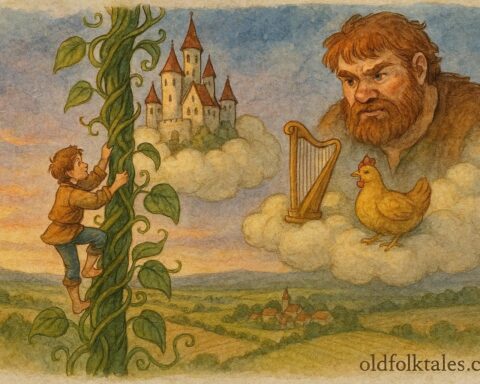
Through cunning and courage, Jack entered Galligantus’s castle unseen. He freed the children, cut down the giant’s magic harp, and faced the monster in his own hall. Galligantus swung his club, roaring like thunder, but Jack darted beneath the blow and struck true with his sword. When the giant fell, the castle’s dark enchantments broke apart like mist before the morning sun.
The people hailed Jack as England’s protector, the boy who used his mind and bravery to defeat terror and tyranny. As a reward, King Arthur knighted him and granted him the hand of a noble princess. But even in honor, Jack remained humble, saying only, “Wit and courage are the arms of a true man.”
And so the name of Jack the Giant-Killer became a legend told beside hearths across England, a story not of might, but of cleverness, courage, and heart.
Moral Lesson
This story teaches lessons on courage, intelligence, and humility. True strength lies not in size or power, but in wisdom, courage, and a kind heart. Those who use their gifts to protect others earn a legacy that outlives them.
Knowledge Check
1. Who is the first giant Jack defeats, and how?
Cormoran, Jack tricks him into falling into a pit he dug at St. Michael’s Mount.
2. What key trait helps Jack succeed against the giants?
His cleverness and quick thinking rather than brute strength.
3. How does Jack defeat Blunderbore and his brother?
He ties their beards together while they sleep, causing them to strangle each other.
4. What magical gift does Jack later receive, and how does he use it?
A cloak of invisibility, he uses it to rescue children from the giant Galligantus.
5. What moral does “Jack the Giant-Killer” teach?
That courage and intelligence triumph over greed and strength.
6. What is the cultural origin of this tale?
It is an English folktale rooted in Cornish and Arthurian traditions.
Source: Adapted from “Jack the Giant-Killer” in English Fairy Tales by Joseph Jacobs (1890).
Cultural Origin: England (Cornish and Arthurian folk tradition).