In the heart of Romania, where rolling hills cradle small villages and the scent of wildflowers mingles with smoke from humble hearths, there once lived a man named Stan Bolovan. Though poor, Stan was honest, hardworking, and deeply devoted to his wife. Yet sorrow shadowed their lives, for despite all their prayers and offerings, they had no children.
This longing weighed heavily on them both. The wife, pale and tearful, sat by the hearth each day like a frost-touched flower. “Why do you grieve so, my dear?” Stan would ask. “We have food, a roof, and peace. Why not be content like others?”
But his wife only sighed. “Husband,” she said at last, “we have no children. There is no laughter in this house.”
From that day, Stan’s heart grew heavy too. They sought blessings in churches, prayed to saints, and even questioned witches, but still, the Lord sent them no child.
Then one day, two weary travellers came to their door. Stan and his wife, as kind folk do, offered them food and shelter. Before leaving, one of the travellers revealed himself as an angel, saying, “You have shown kindness to strangers. Ask what you wish, and it shall be granted.”
Stan bowed deeply. “Grant us children, good sir. That is all we desire.”
“Take care what you ask,” warned the angel. “Would you bear the burden of many mouths to feed?”
“Give us as many as Heaven pleases,” Stan replied eagerly.
And so it was. When Stan returned from walking the travellers to the road, he found his home overflowing with children, a hundred lively sons and daughters, all shouting, laughing, and tugging at his clothes. His wife smiled, radiant with joy.
But soon joy turned to worry. The children grew hungry, and the small barn and cow could no longer sustain them. “Wife,” said Stan, scratching his head, “perhaps the Lord gave us the children, but forgot their bread.”
“Go find it then,” she replied gently. “The Lord never does things halfway.”
So Stan Bolovan set off into the world to seek food for his hundred children.
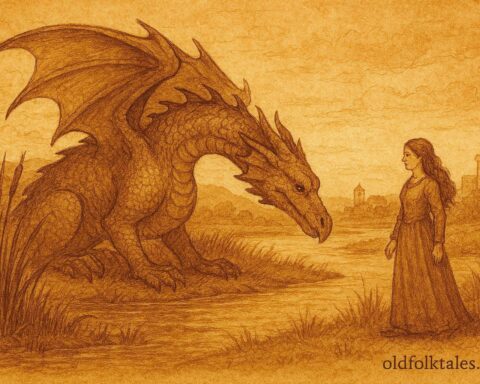
After many days’ travel, he reached a wide plain where seven shepherds watched over a flock. Stan asked for work, but the shepherds lamented, “Every night, a dragon comes and steals a ram, a sheep, and a lamb. None of us can stop him.”
Stan thought of his starving children and said, “If I rid you of this dragon, will you pay me fairly?”
They agreed to give him one-third of their flock. That night, as the moon climbed high, the ground shook. A monstrous dragon came thundering through the forest.
Stan stood firm. “Stop, beast!” he cried. “I am Stan Bolovan, who eats rocks by night and chews trees by day. Touch the flock, and I’ll carve a cross on your back!”
The dragon hesitated, startled by such boldness. “You boast much,” he growled.
Stan pulled a lump of cheese from his bag. “See this stone? I can squeeze milk from it.” He pressed the cheese, and buttermilk ran between his fingers. The dragon, believing it truly a stone, turned pale.
“Mercy!” said the creature. “You are a mighty man. My mother needs a servant, come with me, and she’ll pay you seven sacks of gold a day!”
Stan, ever cunning, agreed.
The she-dragon, old and fearsome, received them with fiery eyes and breath that reeked of smoke. She set Stan three impossible tasks to test him.
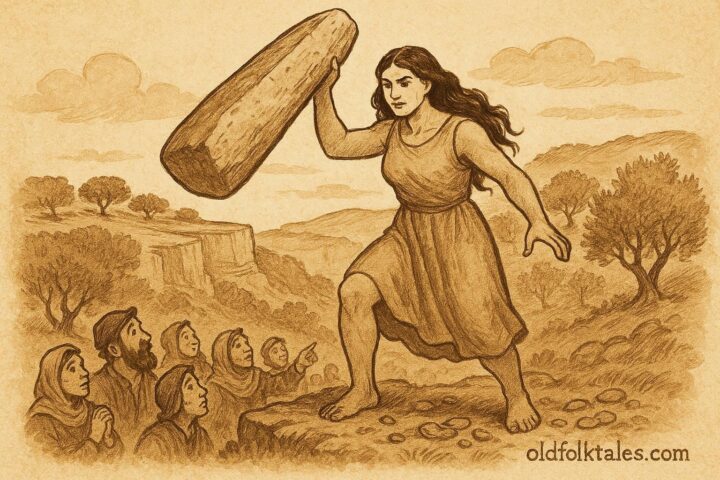
First, he must hurl a massive iron club as far as her son had thrown it. When Stan saw the club’s weight, he pretended to lift it easily but paused. “If I throw this, it will land in the moon,” he said solemnly.
Fearing he might truly do so, the dragon begged him to stop and gave him seven sacks of gold instead.
Next, the she-dragon ordered them to fetch water in twelve buffalo skins. Stan began scratching the ground with a knife. “I’ll take the whole well instead,” he said, “to save time.”
Horrified, the dragon pleaded with him not to uproot the ancestral well and carried both sets of water skins himself, adding another seven sacks of gold to Stan’s wages.
Finally, they were told to fetch wood from the forest. The dragon tore up trees by the roots, while Stan calmly tied the largest trunks together. “I’ll carry the whole forest at once,” he explained.
The dragon, terrified now, gave him seven times seven sacks of gold, desperate to be rid of him.
That night, the dragons plotted to kill Stan in his sleep. But clever as ever, he placed a wooden trough in his bed, covered it with his coat, and hid beneath the floor. When the dragon struck with his club, the trough echoed hollowly. In the morning, Stan appeared unharmed and complained only of a “mosquito bite.”
The dragons, trembling, hurried to fill his sacks and send him away. Yet Stan, too weak to lift them, pretended pride. “I cannot leave with so little,” he sighed. “If people saw me carrying only this, they’d laugh at Stan Bolovan the weakling.”
Fearing his strength, the dragons carried the gold for him all the way home. But when they neared his house, Stan warned, “Enter carefully, my hundred hungry children love dragon meat.”
As the children ran out shouting and waving knives, the dragon dropped the sacks and fled in terror. From that day on, no dragon dared return to the land of men.
And so, Stan Bolovan lived happily with his wife, his hundred children, and his treasure, proof that wit often conquers brute strength.
Moral Lesson
True strength lies not in muscle but in cleverness and courage. Stan Bolovan’s wit reminds us that those who think wisely can overcome even the fiercest of challenges.
Knowledge Check
1. Who is Stan Bolovan in Romanian folklore?
Stan Bolovan is a clever peasant hero known for using wit and courage to outsmart a dragon and his mother.
2. What is the main theme of the Stan Bolovan folktale?
The folktale celebrates intelligence and faith as the true weapons against hardship and evil.
3. What challenge does Stan Bolovan face with his children?
He is blessed with one hundred children but must find food to sustain them, leading to his encounter with the dragons.
4. How does Stan defeat the dragon?
Through cunning tricks—pretending to be immensely strong and using cheese, wit, and bluff to frighten the dragon.
5. What cultural values does this Romanian folktale reflect?
It reflects rural Romanian virtues of faith, hard work, cleverness, and divine justice.
6. What lesson does the dragon’s defeat symbolize?
It shows that wisdom and faith can overcome even the greatest physical or supernatural power.
Source: Adapted from the Romanian folktale “Stan Bolovan” in Roumanian Fairy Tales, collected by M. Gaster (1886), London: Elliot Stock.
Cultural Origin: Romania (Romanian folklore)