In the heart of ancient Romania, where forests whispered secrets and mountains glowed under the sun’s golden veil, lived an emperor who ruled over vast lands. Not far from his palace dwelt a humble shepherd and his wife, blessed with three beautiful daughters, Anna, Stana, and the youngest, Laptitza. The people of the land spoke of their beauty often, but none could match Laptitza, whose skin gleamed like fresh milk and whose hair was soft as lamb’s wool.
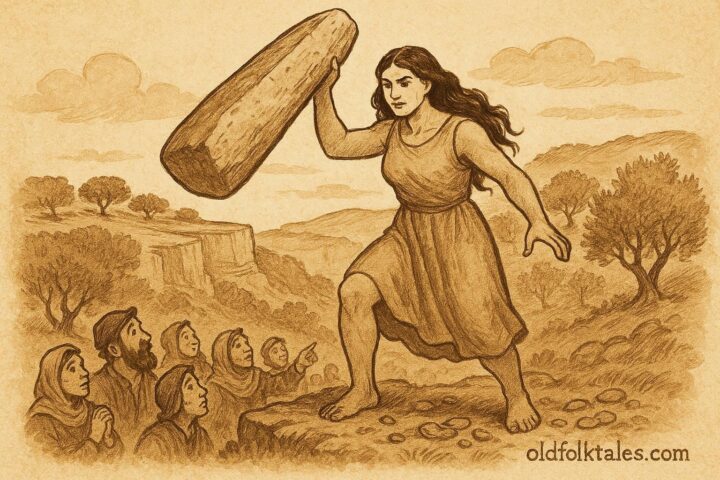
One summer’s afternoon, as the sisters picked strawberries by the forest edge, they heard the thunder of horses. It was the emperor’s son hunting with his noblemen. The sisters, half shy and half curious, paused their work.
Anna, gazing at the handsome riders, whispered, “If one of those young men would wed me, I’d bake him a loaf of bread that would keep him ever young and brave.”
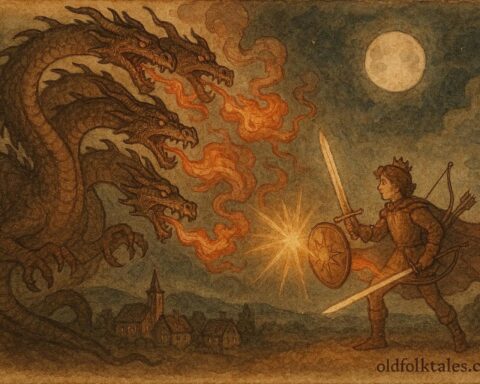
Stana smiled and said, “If one should take me for his wife, I’d weave a shirt that would protect him from water and flame, even from the fiercest dragon.”
But Laptitza, with a quiet grace, said, “If I were to marry, I would give my husband two sons, twin boys with golden hair and a shining star upon each forehead.”
The emperor’s son, who had overheard them, was struck by her words. He leapt from his horse and cried, “Sacred be your promise, fair one! You shall be my empress!” His companions, equally smitten, chose the other two sisters, and all three maidens were carried away to the imperial court.
Grand festivities filled the land for three days and nights as the three couples wed. Soon, Anna fulfilled her promise, baking her husband the miraculous bread. Stana too kept her word, weaving the magic shirt. Only Laptitza’s vow had yet to come true, for great blessings take time.
The emperor loved his gentle bride deeply. But envy lurked in the palace, for his stepmother had long wished her own daughter to be empress. Seeing that her schemes had failed, she resolved to destroy Laptitza and her unborn children.
When the emperor was called to war by deceit, for his stepmother had conspired with her brother to provoke battle, he departed, though his heart ached to leave his beloved. In his absence, Laptitza gave birth to two radiant boys, each with golden hair and a star on his brow, just as she had foretold.
But the wicked empress stole the infants and replaced them with two puppies. The true twins were buried under the emperor’s window. When he returned and saw the pups, fury and heartbreak filled him. Believing his wife faithless, he ordered that she be buried up to her breast in the earth, to serve as a warning to all.
The false empress rejoiced, but heaven did not. From the ground where the twins were buried, two slender aspens grew overnight, swaying before the emperor’s window. Their whispering leaves sang softly in the wind, so sweetly that the emperor would linger just to listen. The jealous stepmother, sensing their secret, begged to have them cut down. The emperor agreed, on the condition that the wood be made into two beds, one for him, and one for her.
That night, the beds creaked softly, and faint voices spoke:
“Brother, how is it with you?” asked one.
“Well,” came the reply, “for my dear father rests upon me.”
“And I,” said the other sadly, “bear the weight of a wicked soul.”
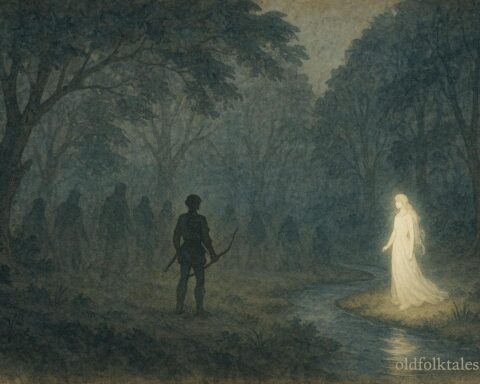
Terrified, the empress destroyed the beds and burned them to ash. But two golden sparks rose from the fire and fell into the nearby river, where they became two tiny fishes, glimmering like sunlit coins.
One morning, a fisherman caught the golden fishes in his net. As he lifted them, they spoke, pleading softly, “Do not take us to the palace, for we have come from there.” Astonished, the fisherman obeyed their instructions, to place them in dew and sunlight until the dew had dried. When he returned, he found instead two radiant boys with golden hair and stars upon their foreheads.
The boys grew with unnatural speed, their strength and wisdom far beyond their years. After three days, they appeared as young men. “Now let us go to our father,” said one. The fisherman, fearful yet proud, dressed them in fine clothes and sent them to the imperial palace.
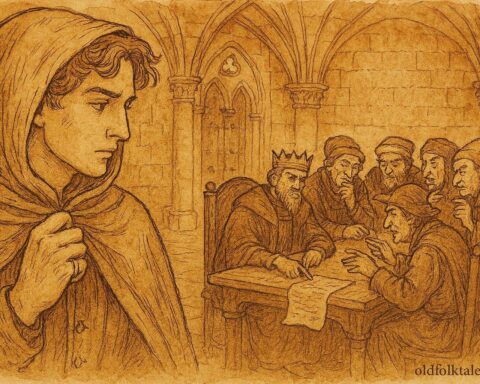
At the gates, the guards tried to stop them, but the princes’ noble bearing and courage made them unstoppable. They entered the great hall, where the emperor and the false empress dined among courtiers.
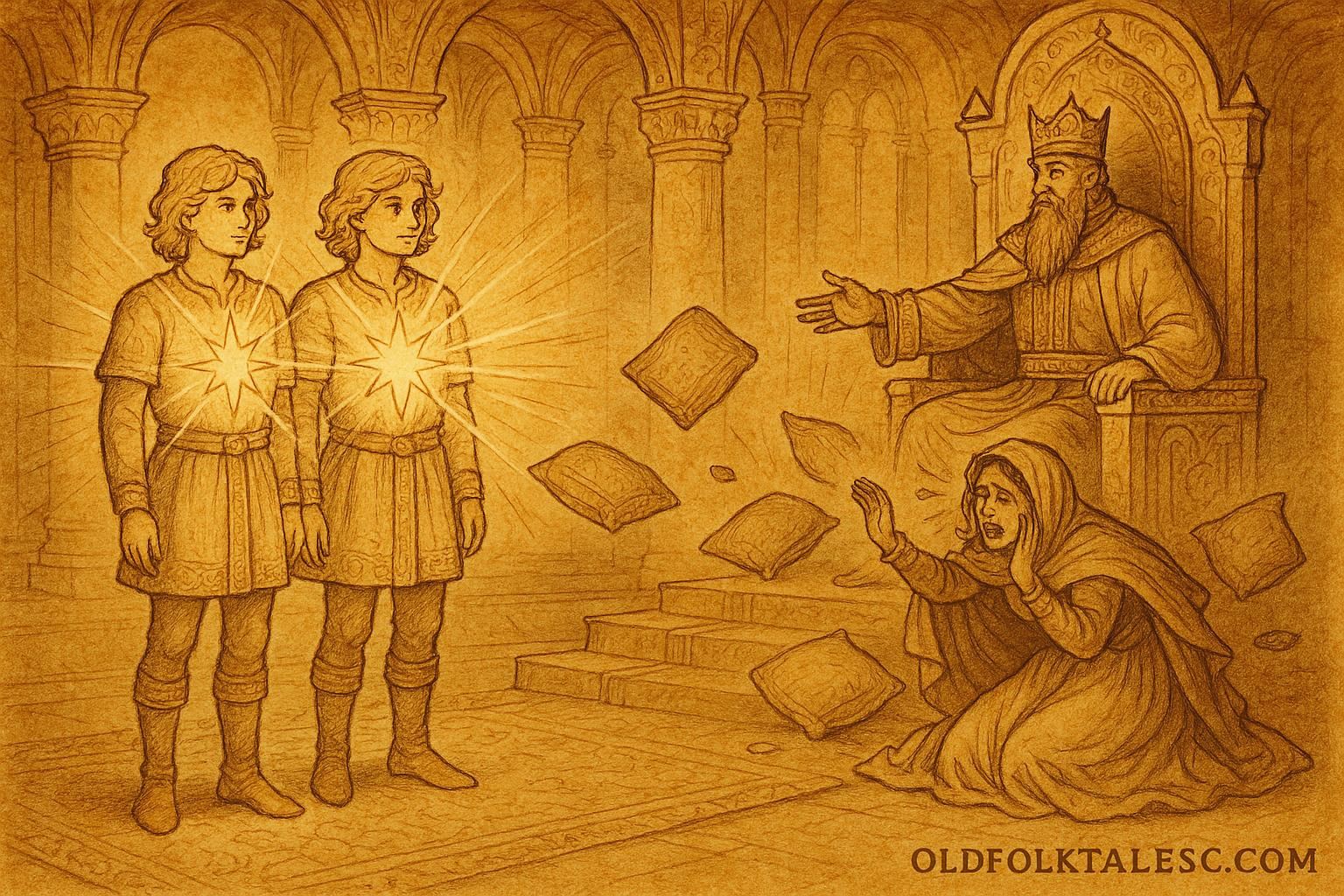
At their entrance, one of the empress’s twelve cushions fell to the floor.
“Remove your caps!” shouted a courtier.
“To cover one’s head,” said the elder twin calmly, “is the custom of free men.”
The emperor, moved by their confidence, asked, “Who are you, brave youths?”
“We are twins, born of one promise and one sorrow. Half our family is buried in the earth; half sits at this table,” they answered. “We come to sing a story you know, but do not remember.”
As they sang of the shepherd’s daughters, the emperor’s war, and the birth of the golden-haired twins, the empress’s cushions kept falling, until none remained beneath her. Finally, the princes removed their caps, and the light of their golden stars filled the hall. The emperor, trembling, recognized his sons. He rushed from his throne, lifting them in his arms, tears of joy flowing down his face.
Laptitza was freed and restored as empress. The wicked stepmother and her daughter met the fate they deserved, the former dragged by wild horses, the latter condemned to servitude. Peace returned to the realm, and justice, long delayed, reigned again.
Moral Lesson
Truth and innocence may be buried by envy, but like light through darkness, they will always rise and shine again.
Knowledge Check
-
Who were the three sisters, and what were their promises?
Anna promised eternal youth, Stana protection, and Laptitza golden-haired twins. -
What was the emperor’s stepmother’s motive?
She wanted her own daughter to marry the emperor and become empress. -
What happened to the twins after birth?
They were replaced with puppies and buried under the emperor’s window. -
How were the twins reborn?
They transformed into aspens, then into golden fishes, and finally into boys again. -
What did the talking beds symbolize?
The innocence of the twins and the guilt of the wicked empress. -
What is the main moral of this Romanian folktale?
Goodness and truth always prevail over deceit and jealousy.
Source: Adapted from The Twins with the Golden Star in Romanian Fairy Tales by Petre Ispirescu, translated by Julia Collier Harris and Rea Ipcar (1917), Project Gutenberg.
Cultural Origin: Romania (Romanian folklore)