In the rolling green hills of Ireland, where the wind hummed through the heather and cattle grazed along stony paths, there lived a poor young man named Gilla Na Chreck an Gour, known to all as the lad with the goat-skin. His name came from the ragged goat-skin he wore as clothing, for it was all he had to shield himself from the biting Irish winds. Though poor and mocked by others for his rough appearance, Gilla carried within him a spirit brave and unyielding.
The Mocked Boy of the Village
In his small village, laughter followed Gilla wherever he went. The other lads would point at his goat-skin and jeer, “Look at Gilla the goat-boy!” Yet Gilla never answered in anger. He kept his head high, helping his mother on their humble plot of land and dreaming of adventures beyond the hills. Unknown to others, he possessed a heart braver than many a knight.
One evening, as twilight crept over the boglands, a messenger from the king arrived at the village square. He announced that the king’s daughter was bewitched by a monstrous giant who held her captive in a dark glen. Many heroes had tried to rescue her but none returned. The king promised his daughter’s hand and half his kingdom to anyone bold enough to succeed.
The villagers laughed again. “Maybe Gilla in his goat-skin will try his luck!” one said. But Gilla only smiled. That night, he packed a loaf of bread, tightened his worn belt, and set off under the pale moon.
The Journey Begins
Through the forests and across the moors he traveled, guided only by starlight. On the second day, weary and hungry, he met an old woman spinning flax beside the road. Seeing his goat-skin cloak, she smiled kindly and asked where he was going.
“I’m seeking the giant who holds the princess,” he replied.
“Few return from that path,” she said, “but your heart is good. Take this.” From her apron she drew a small silver ring. “It will grant you strength when your courage fails. But remember, true power lies not in magic, but in the purity of your heart.”
Gilla thanked her and continued his journey. Before long, he reached a valley shrouded in mist. At its center rose a dark stone castle surrounded by thorns. The giant within roared so loudly that the ground trembled.
The Battle with the Giant
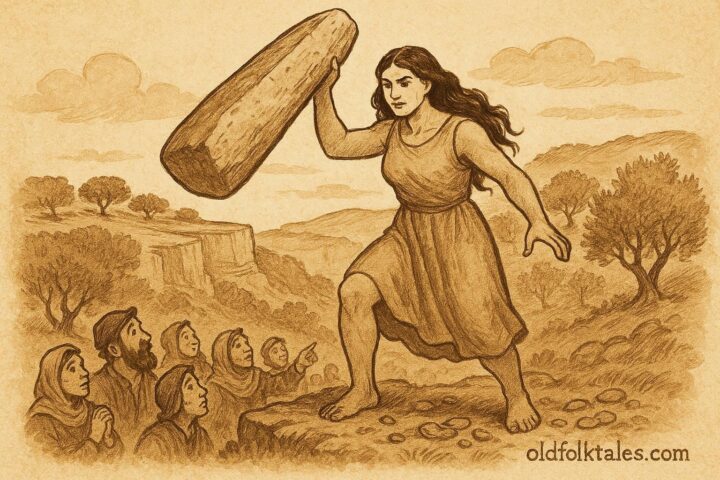
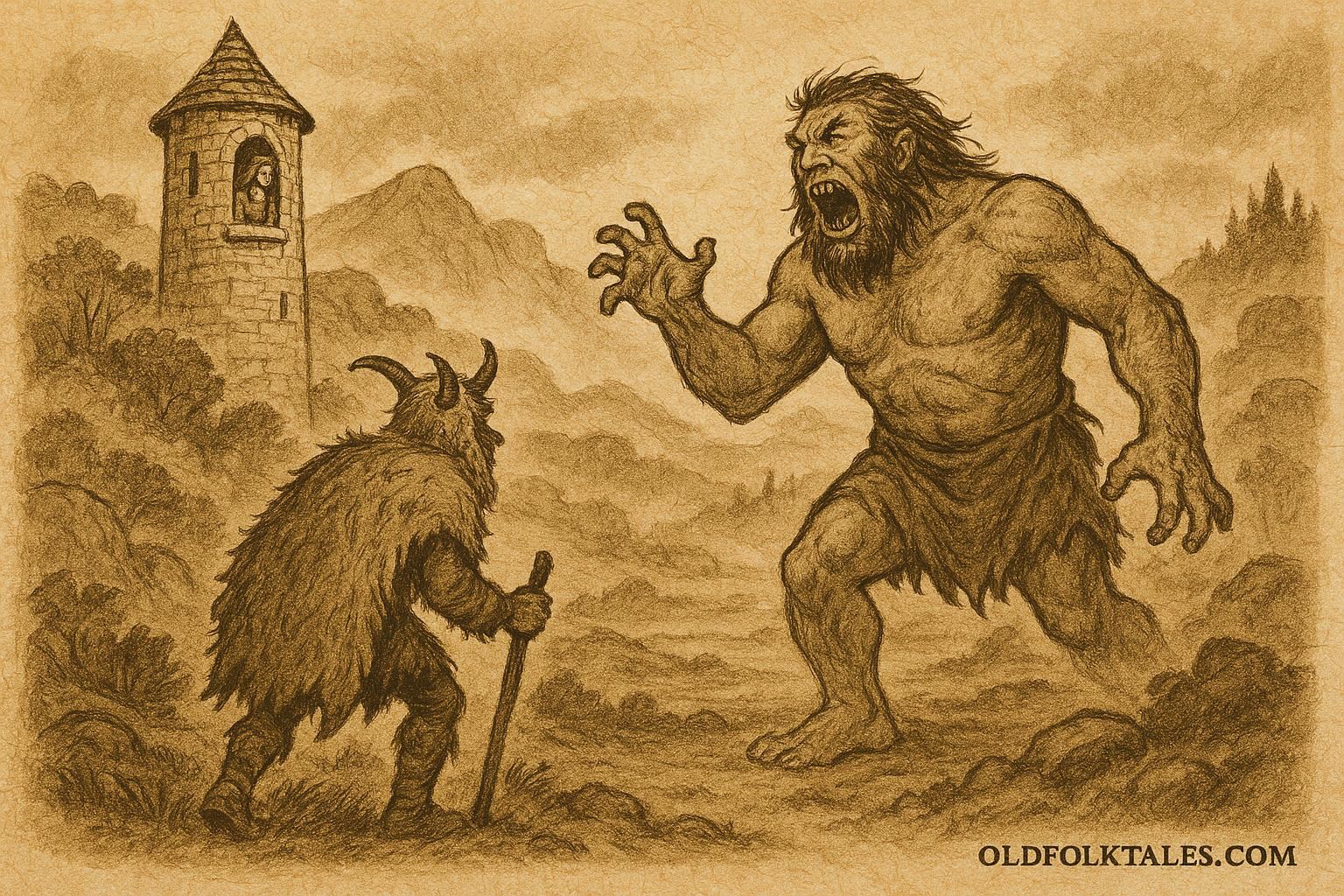
The moment Gilla entered the gate, the giant thundered forth, his club as thick as a tree trunk. “Who dares enter my domain?” he boomed.
“I am Gilla Na Chreck an Gour!” cried the lad, standing firm in his goat-skin coat.
The giant laughed so hard the hills echoed. “A goat-boy to fight me? You’ll be crushed like a beetle!” He swung his club with a roar, but Gilla was quick. He darted aside, the club striking the earth and splitting it like lightning. The fight raged on until Gilla, remembering the ring, whispered a word of courage. His strength grew tenfold. He struck the giant’s knee with a rock, and the beast fell with a crash that shook the glen.
Gilla climbed upon the giant’s chest and shouted, “The princess shall be free!” With a final blow, he ended the monster’s reign. From the tower above came a cry of joy, the princess was saved.
The Hidden Hero
But Gilla, modest as ever, did not reveal his name to her. Instead, he said, “Tell your father that a stranger freed you.” Then he vanished into the woods before dawn.
When the king heard of the hero, he declared a feast and promised a reward to the mysterious rescuer. Days passed, but no one came forward. Meanwhile, Gilla returned quietly to the village, still dressed in his goat-skin. The people mocked him again, never knowing he was the hero of the realm.
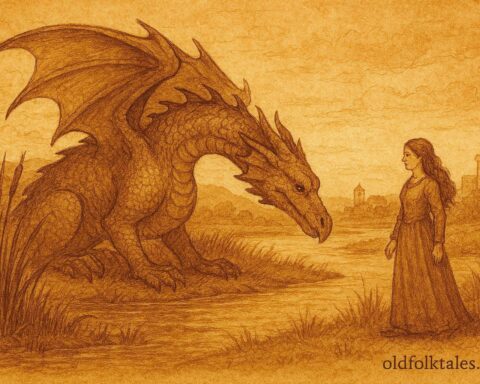
A week later, another challenge arose—a dragon had come to the coast, burning crops and villages. Again, Gilla went forth alone, fought bravely, and slew the beast. This time, however, he left behind the silver ring as a token. When the princess found it, she realized the humble lad in the goat-skin was her savior.
Recognition and Reward
The king summoned all men to the palace. “Who among you owns this ring?” he asked. Gilla stepped forward, quiet and unassuming. Laughter rippled through the court, until the princess herself rose and said, “This is the man who saved me.”
Silence fell. The king looked upon the lad, seeing not the goat-skin but the light of courage in his eyes. He took Gilla by the hand and said, “You are no peasant. You are a hero worthy of my daughter.” And so, Gilla married the princess, his humility and bravery celebrated across the land.
Though he lived in a palace thereafter, Gilla never forgot his roots. He kept the goat-skin in his chamber as a reminder that greatness is not measured by wealth or appearance, but by the heart.
Moral Lesson
This Irish folktale teaches that true worth lies not in one’s appearance or birth, but in courage, humility, and kindness. The goat-skin, once a mark of shame, becomes a symbol of strength and integrity.
Knowledge Check
- Who is Gilla Na Chreck an Gour?
A humble Irish youth known for wearing a goat-skin coat. - What does Gilla’s goat-skin symbolize?
Humility, endurance, and the strength found in simplicity. - How does Gilla defeat the giant?
By using courage, quick thinking, and a magical ring given by an old woman. - Why does Gilla hide his identity after saving the princess?
Because he values humility over fame and recognition. - What lesson does the folktale teach?
That bravery and virtue matter more than wealth or appearance. - Where does this folktale originate?
From Ireland, part of its rich oral storytelling tradition.
Source: Adapted from Legendary Fictions of the Irish Celts by Patrick Kennedy (1866).
Cultural Origin: Ireland (Irish folklore).