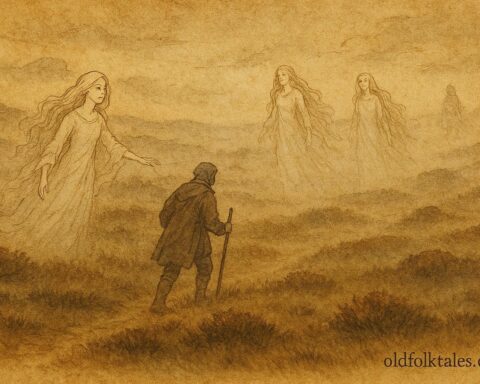
Long before men walked the earth and before the Finnish forests of pine and birch took root, there was only water, vast, endless, and silent. Across this boundless sea drifted Ilmatar, the Maiden of the Air. She was a spirit of heaven, graceful and alone, moving through the mists and winds. For ages, she floated, untouched and untethered, until a deep longing stirred within her heart. She yearned to touch something solid, to rest upon land that did not yet exist.
Discover the timeless charm of French, Dutch, and Belgian stories filled with cleverness and heart
Ilmatar and the Waters
Ilmatar descended from the heavens and drifted upon the waves. The sea winds caressed her hair, and the currents cradled her like a child. Yet loneliness filled her spirit, for she was alone in the endless expanse. She wandered upon the waters for centuries, listening to the song of waves and wind, waiting for creation to begin.
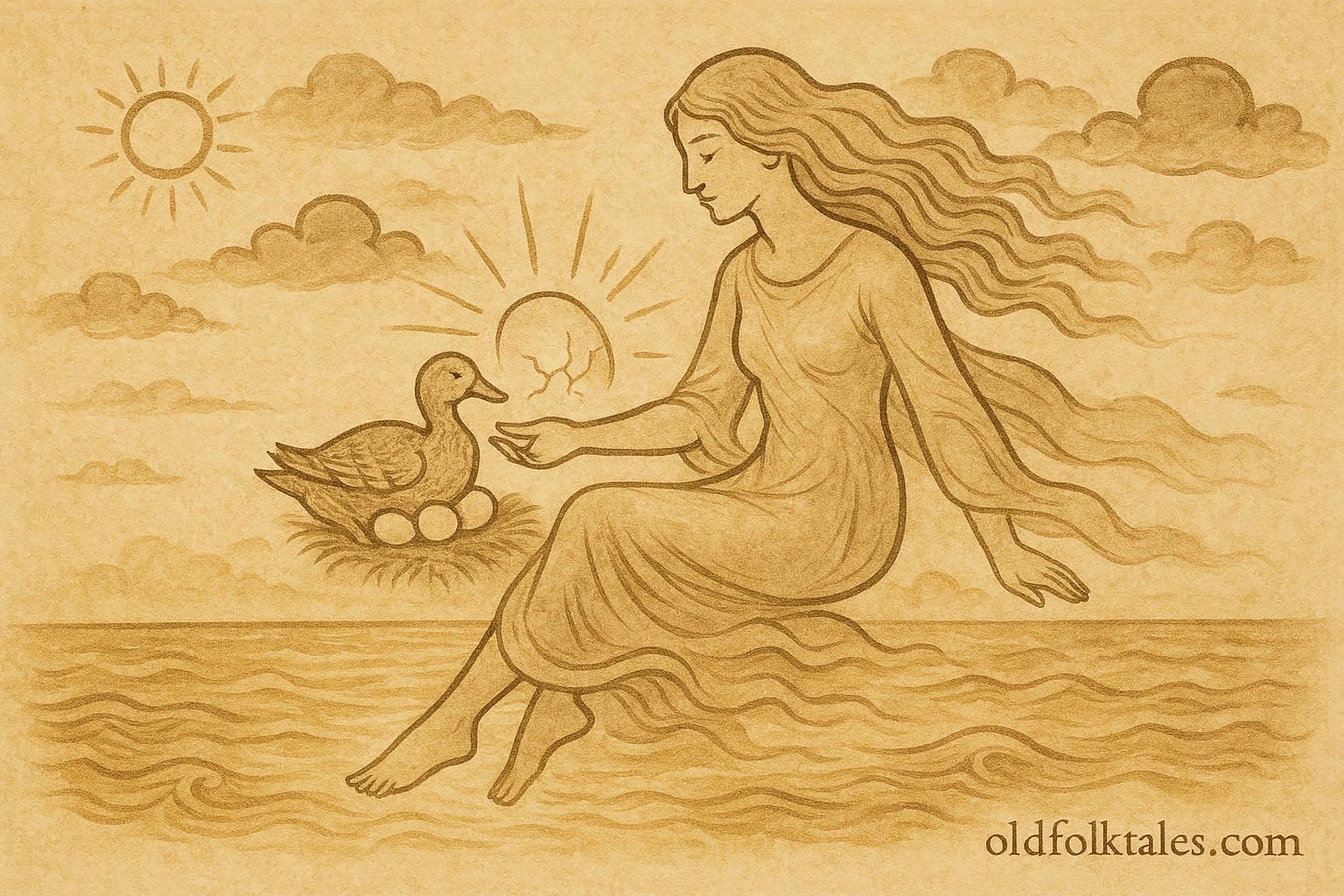
One day, as she floated in sorrow, a gentle duck came searching for a place to lay her eggs. The bird circled endlessly above the waves, unable to find a resting spot. Seeing the creature’s distress, Ilmatar lifted her knee above the water, forming a small island upon which the bird could rest. The duck, grateful and unsuspecting, built her nest upon Ilmatar’s knee and laid six golden eggs and one of iron.
The Breaking of the Egg
The warmth of the duck’s body spread across Ilmatar’s skin, but soon the heat grew unbearable. The goddess shifted in pain, and the nest toppled. The eggs rolled into the water and shattered. Yet from that shattering came creation itself.
The fragments of the eggshells drifted apart and took new form. The lower half of the shells became the earth, the upper half became the sky. From the yolk formed the sun, from the white the moon. The dappled fragments became stars that sparkled in the heavens, and the dark specks turned into clouds that drifted across the firmament.
The waters shimmered with light for the first time, and Ilmatar beheld the beauty of the new world. Mountains rose, rivers wound through valleys, and the sea found its rhythm. She moved through this forming creation, shaping its shores, smoothing its rocks, and tracing the courses of rivers with her hands. Her fingers carved out lakes, her footsteps deepened the sea, and her breath brought forth the wind.
The Coming of Väinämöinen
As Ilmatar wandered the living world, she felt a stirring within her, life itself was taking root inside her womb. After long ages of carrying the spirit of creation, she gave birth to Väinämöinen, the first of all men and the greatest of all singers.
When Väinämöinen was born, the earth was still raw and unshaped. He was cast into the sea, where he drifted for years upon years, nurtured by the waters his mother had once ruled. Finally, the waves carried him to the shore of the newborn land.
He rose from the sea, aged yet timeless, wise and solemn. His hair was grey like silver reeds, and his voice held the music of the world’s beginning. Väinämöinen looked upon the new earth and began to shape it with his songs. Wherever he sang, forests sprouted, rivers deepened, and flowers unfolded.
The Singing of the World
The songs of Väinämöinen carried the power of creation itself. He sang of the sun and it shone brighter. He sang of the moon and it took its place among the stars. His melodies tamed the restless seas and gave harmony to the earth.
Thus the world became filled with rhythm and life, the echo of Väinämöinen’s singing and Ilmatar’s ancient touch. In every gust of wind and in every flowing river, their spirit endured.
The Legacy of Creation
The tale of Ilmatar and Väinämöinen, sung by generations of rune-singers, tells not merely of how the world began but also of how song, spirit, and nature are bound together. The Kalevala’s vision of creation is not one of war or command, but of music, patience, and harmony.
From the broken egg came beauty; from loneliness came life. And from the endless song of Väinämöinen came wisdom the power to shape the world not through strength, but through understanding.
Moral Lesson
This ancient Finnish creation tale reminds us that life often emerges from patience, sacrifice, and transformation. The shattering of the egg symbolizes how even in loss or pain, creation finds a way to bloom. The story also celebrates the power of song and the deep connection between nature and spirit, a timeless message that harmony, not domination, sustains the world.
Discover the timeless charm of French, Dutch, and Belgian stories filled with cleverness and heart
Knowledge Check
- Who is Ilmatar in the Finnish creation myth?
Ilmatar is the Maiden of the Air, a celestial spirit who descends to the sea and becomes the mother of Väinämöinen, helping to shape the world’s creation. - What role does the duck play in the creation story?
The duck lays the cosmic eggs on Ilmatar’s knee, which, when broken, give birth to the earth, sky, sun, moon, and stars. - What does the breaking of the egg symbolize?
It represents transformation and creation, how life and beauty can arise from destruction or change. - Who is Väinämöinen, and why is he important?
Väinämöinen is Ilmatar’s son and the first human, a wise singer whose songs shape the landscape and bring balance to the world. - What is the key theme of this Finnish folktale?
The unity of nature, spirit, and song, creation through harmony rather than conflict. - What cultural source preserves this story?
The tale is found in the Kalevala, Finland’s national epic, compiled by Elias Lönnrot from Finnish and Karelian oral traditions in the 19th century.
Source: Adapted from the Kalevala, compiled by Elias Lönnrot (1835; revised 1849), based on Finnish and Karelian oral runic songs. English translations available on Project Gutenberg.
Cultural Origin: Finland (Finnish and Karelian folklore)