In the quiet countryside of South Småland, where the pine forests stretch endlessly and the wind whispers across the heather fields, there once lived a widow with two daughters. Upon their cottage door hung a simple wreath of woven birch and wildflowers, a symbol of the home’s humble peace. Yet within those walls, harmony was rare, for the elder girl was proud and sharp-tongued, while the younger was gentle and good-hearted. Though they shared the same roof, their natures could not have been more different.
Discover the moral heart and wild spirit of the north through timeless Nordic storytelling
The widow loved her elder daughter dearly, favoring her in every way. The kind younger girl was made to do all the housework, sweeping the floors, tending the animals, and fetching water from the stream that ran through the valley. She never complained, though her hands grew rough and her feet weary from endless toil.
One early spring morning, the mother said to her daughters, “Go to the forest, both of you, and gather berries. But remember, do not waste time idling or dreaming. The one who brings home the fullest basket shall have my blessing.”
The elder daughter went first, stepping lightly along the mossy path, her fine shoes untouched by dirt. She took the smoothest route and sang to herself. Her sister followed quietly behind, barefoot as usual, her woven basket swinging gently at her side.
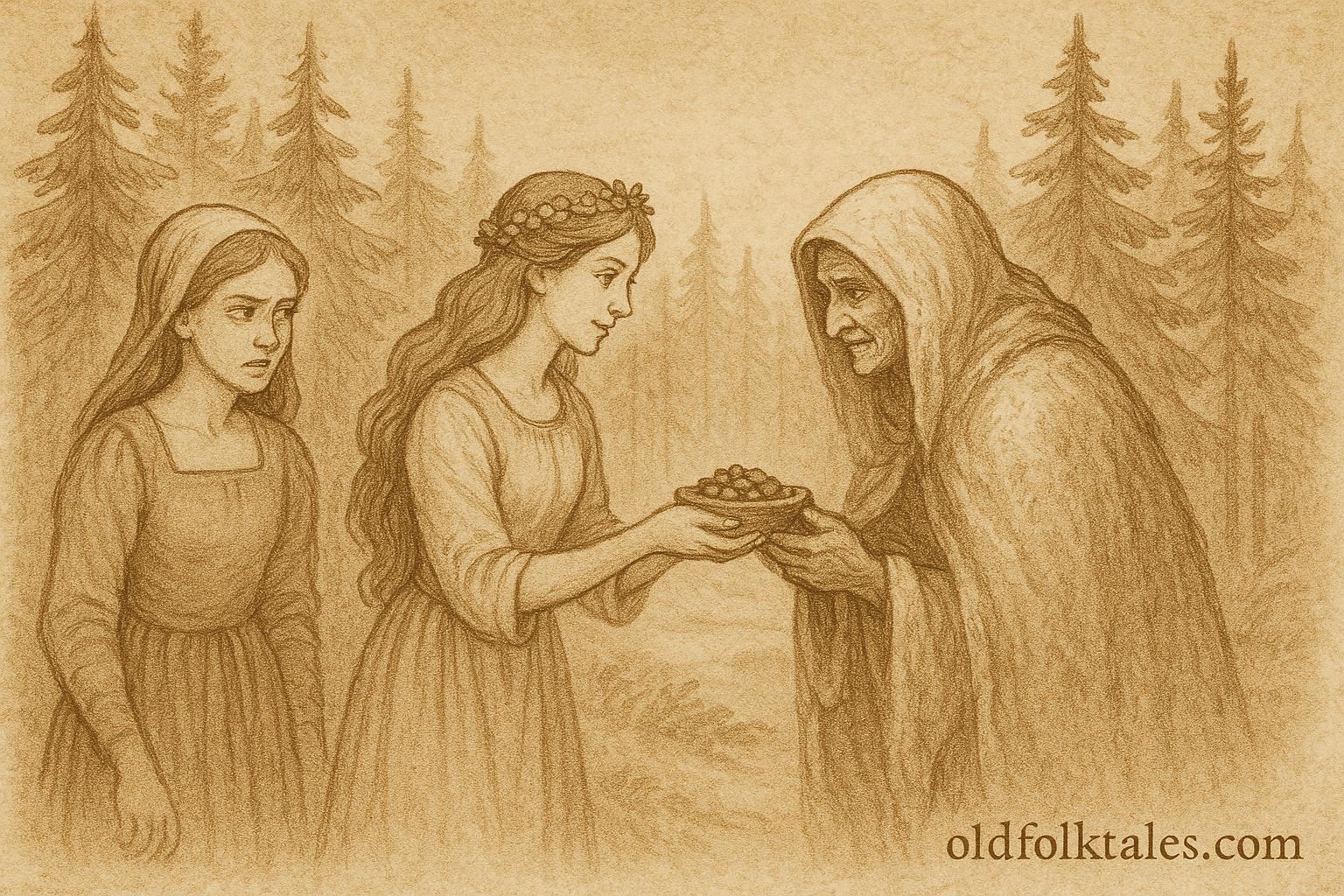
When the younger girl reached the edge of the forest, she came upon an old woman sitting on a fallen birch tree. The woman’s hair was white as snow, and her cloak shimmered like frost in sunlight. She looked weary and hungry.
“Dear child,” the old woman said, “would you share a few berries with me? I have not eaten all day.”
The kind girl smiled and offered her what little she had gathered. “You are welcome to them, grandmother,” she said. “I can always find more.”
The old woman ate gratefully, and when she finished, she looked at the maiden with kind eyes. “You have a gentle heart,” she said. “For your kindness, I shall give you a gift.”
From beneath her cloak, the old woman drew out a wreath woven of gold and green leaves, glimmering with tiny blossoms that never faded. “Wear this upon your head, and good fortune shall follow wherever you go. But remember, it will bless only a heart that stays pure.”
The maiden thanked her and placed the wreath on her head. At once, she felt a warmth spread through her, as though the sunlight itself had touched her soul. Birds began to sing overhead, and even the flowers seemed to bow as she passed.
When she returned home that evening, her basket overflowed with berries more beautiful than any her mother had ever seen, round, ripe, and glistening like jewels. The widow gasped in astonishment.
“Where did you find such a bounty?” she demanded. “And what is that shining on your head?”
The girl told her the story of the old woman and the golden wreath. Her sister listened from the doorway, her eyes narrowing with envy.
The next morning, the elder daughter declared, “I shall go to the forest too, and if that old woman appears, I’ll see to it that I get a wreath finer than my sister’s.”
So off she went, dressed in her best gown and carrying a silver basket. When she reached the forest, she soon found the same old woman sitting on the birch log.
“Good morning, dear,” the old woman said. “Might you spare a few berries for a hungry traveler?”
The girl curled her lip. “I’ve only just begun picking,” she snapped. “Pick your own if you’re so hungry.”
The old woman sighed but said nothing. The maiden went on her way, plucking berries greedily and muttering about her luck. When her basket was nearly full, she noticed something glimmering in the moss, a wreath, just like her sister’s, but darker and strangely cold to the touch.
With a greedy smile, she snatched it up and placed it on her head. At once, the sky grew dim, and a chill wind swept through the trees. The berries in her basket shriveled and turned black. Startled, she tore off the wreath and fled home.
When she burst into the cottage, the golden wreath upon her sister’s head shone brighter than ever, while her own hands were stained with soot that no washing could remove. The widow turned pale and cried out, but the old woman’s voice echoed faintly through the wind:
“Kindness brings blessing, pride brings shadow.”
From that day on, the kind daughter lived in peace and plenty, her wreath glowing softly whenever she helped others. Her sister, however, learned to live with the mark of her greed, a reminder that true beauty shines only from a kind heart.
Discover the moral heart and wild spirit of the north through timeless Nordic storytelling
Moral Lesson
This Swedish folktale teaches that gentleness, humility, and generosity bring lasting reward, while selfishness and pride lead only to loss. True grace lies not in wealth or beauty, but in kindness freely given.
Knowledge Check
- Who are the main characters in The Enchanted Wreath?
The widow’s two daughters, one kind and one unkind, and the mysterious old woman who tests their hearts. - What gift does the kind maiden receive?
A golden wreath that brings good fortune and beauty wherever she goes. - What lesson does the elder sister learn?
That greed and pride bring only misfortune and shame. - What does the wreath symbolize in Swedish folklore?
It represents purity, kindness, and divine blessing for those with good hearts. - Where does the story take place?
In the rural forests and valleys of South Småland, Sweden. - What universal theme does this folktale share with other European stories?
The “kind and unkind girl” motif, teaching that goodness and compassion triumph over vanity and cruelty.
Source: Adapted from The Enchanted Wreath (“Der Kranz” / “Kransen”) in Svenska folk-sagor och äfventyr collected by Hyltén-Cavallius & Stephens (mid-19th century).
Cultural Origin: Sweden (Småland region).