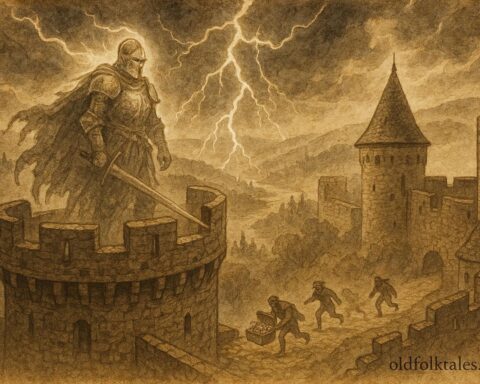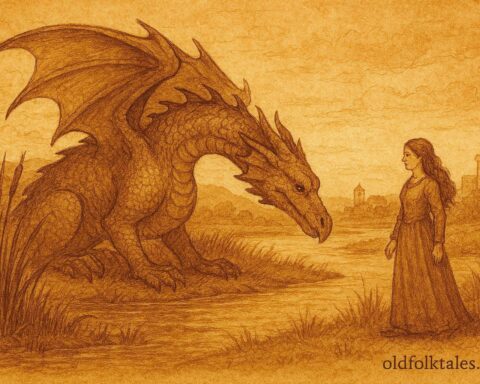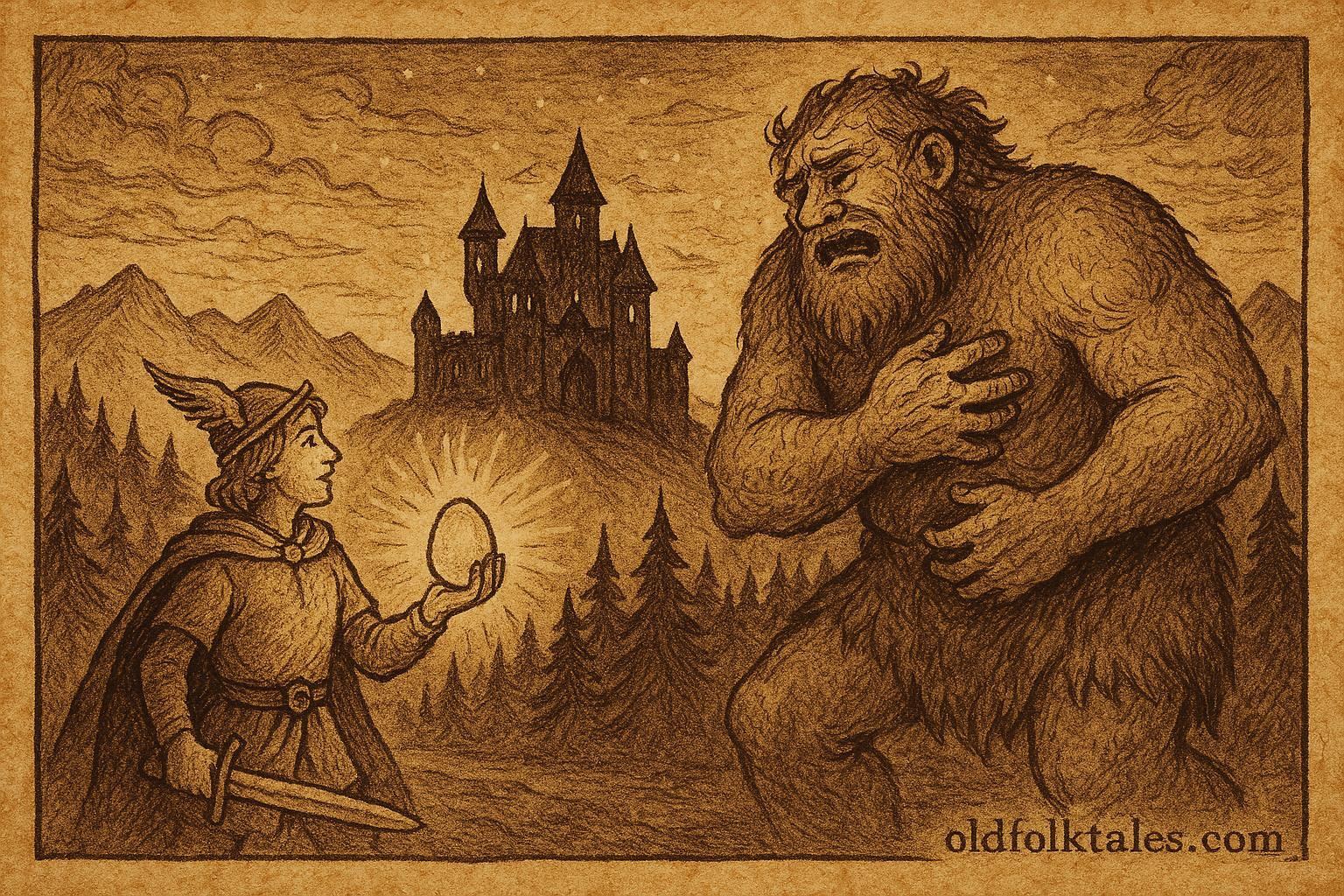
Far to the north, where the mountains rise like jagged crowns and the valleys lie deep beneath veils of mist, there once lived a giant whose cruelty was known across all the lands. This giant had no heart in his body. Because of that, he could never be wounded, never grow weary, and never die. His power struck fear into every kingdom nearby, for he turned to stone all who dared oppose him. Yet, as every tale of darkness has its light, so too did this one, for there was a brave prince who would not rest until the giant’s wickedness was ended forever.
The king’s heart grew heavy with sorrow. His youngest son, though still young, stood before him and said, “Father, let me go and find my brothers. I will not rest until they are returned.”
The king tried to dissuade him, fearing to lose his last son, but the youth’s resolve was unshakable. Armed with only his sword and courage, he set off toward the rugged lands where his brothers had last been seen.
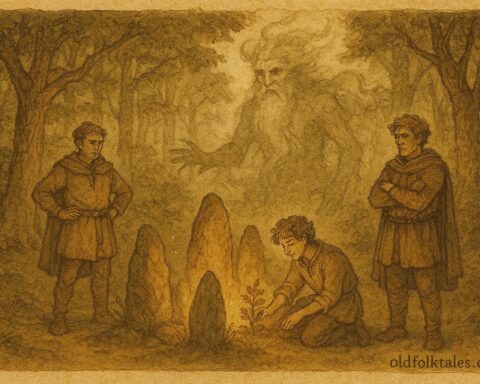
He traveled through forests so dense that no sunlight reached the ground, and across frozen rivers that groaned under the weight of ice. At last, he came upon a castle so vast and ancient that its towers seemed to pierce the clouds. But around the castle stood statues, men and women turned to stone, their faces frozen in terror.
When he drew near, the massive doors opened with a deep, echoing creak. Out stepped a giant, taller than any tree, with a voice that rolled like thunder. His eyes burned like coals, and his face was twisted in cruelty.
“Ha!” the giant roared. “So another fool comes seeking glory. Do you not know that all who enter here are turned to stone?”
The youth drew his sword, but the giant merely laughed. “Strike if you wish, but it will do no good. You cannot harm me, for I have no heart in my body!”
With that, the giant turned him to stone, just as he had done to countless others.
But fate is never still for long. Not far from the castle lived a kind-hearted princess who had also been taken captive by the giant. Though trapped in his dark halls, she learned many of his secrets. One evening, as she brought the giant his supper, she said softly, “Tell me, great one, why you never sleep soundly.”
The giant grinned, his teeth like boulders. “Sleep soundly? How could I? My heart is far from here, safe where no one will ever find it!”
The princess feigned curiosity. “Surely no one could harm you then. But where is it hidden, my lord?”
“Far, far away,” the giant said, his voice heavy with pride. “Beyond many hills and valleys lies a lake. In that lake is an island, and on that island stands a church. Beneath the altar is a well, and in the well swims a duck. Inside the duck is an egg, and in that egg lies my heart.”
The princess listened carefully, pretending not to care. But that night, when the giant fell asleep, she crept to the courtyard where the youngest prince, still turned to stone, stood near the gate. She whispered a prayer, and tears rolled down her cheeks. Suddenly, her tears touched the prince’s hand, and he stirred. The enchantment was weakened by her compassion.
“Be still,” she whispered. “I know where the giant’s heart lies. Go, seek it, and you will save us all.”
The prince awoke fully, his courage burning bright once more. He thanked her and set out on his perilous quest.
He journeyed far and wide, asking every creature he met for help. At last, he came upon an old raven sitting by the roadside. The bird croaked, “Where do you travel, young prince?”
“To find the giant’s heart,” he replied.
The raven cawed, “Take this feather. When you need me most, burn it, and I shall come.”
Grateful, the prince continued until he met a salmon gasping in a drying pond. He helped the fish back into the water, and in thanks, it said, “Take this scale. If you are ever in danger, cast it into the water, and I will come to your aid.”
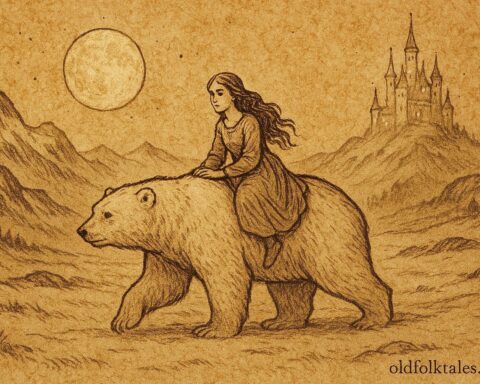
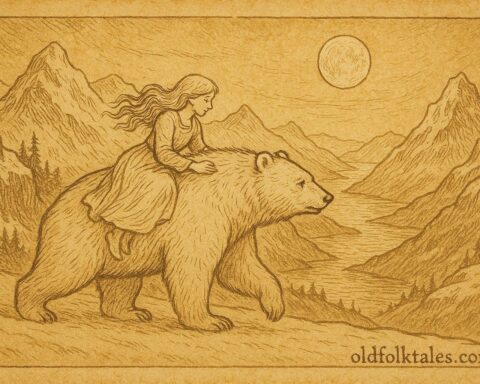
Later still, he found a starving wolf caught in a trap. He freed it, and the wolf said, “Climb on my back when the time comes, and I will carry you where no man can go.”
The prince thanked them all and pressed on. Finally, he reached the lake the giant had spoken of, vast, cold, and endless. The wolf appeared beside him, as if by magic. “Climb on,” said the wolf, “and hold tight.”
They swam across the dark waters to the island, where the lonely church stood. Inside, the prince lifted the altar and found the well. He dropped the salmon’s scale into it, and the fish appeared, driving the duck from its depths. The prince caught the duck, but it dropped the egg into the water.
Before despair could take him, he burned the raven’s feather. In a flash, the raven swooped down, caught the egg in its beak, and dropped it safely into the prince’s hands.
The moment he held it, the sky darkened and thunder shook the earth. Far away, in his castle, the giant cried out in pain, clutching his chest. The prince squeezed the egg gently. The giant’s voice echoed, begging for mercy.
“Spare me, and you shall have all I own!” he wailed.
But the prince remembered the stone figures and his captive brothers. He crushed the egg, and with that, the giant’s power ended forever.
The prince hurried back to the castle, where the stone figures began to stir, his six brothers among them. The princess ran to meet him, and the spell that had bound her broke like morning light.
They all returned home together, bringing peace to the kingdom once more. And though the youngest son had set out alone, he returned not just as a prince, but as a hero.
Moral Lesson
Evil cannot endure forever; no power is greater than courage, kindness, and persistence. True strength comes from a brave heart guided by compassion and wisdom.
Knowledge Check
- Who was the main hero of the story?
The youngest prince, who sought to free his brothers and defeat the giant. - Why was the giant invincible at first?
Because he had hidden his heart outside his body, making him impossible to kill. - What magical creatures helped the prince?
A raven, a salmon, and a wolf each aided him with gifts and guidance. - Where did the giant’s heart lie hidden?
Inside an egg, within a duck, in a well, under an altar, on an island, in a lake, far from the giant’s castle. - What happened when the prince destroyed the egg?
The giant died, and all his victims, including the stone figures and the princess, were freed. - What is the main moral of the tale?
Courage, kindness, and perseverance can overcome even the darkest evil.
Source: Adapted from the Norwegian folktale “The Giant Who Had No Heart in His Body” in Norske folkeeventyr, collected by Peter Christen Asbjørnsen and Jørgen Moe (1840s).
Cultural Origin: Norway (Traditional Norwegian folklore)