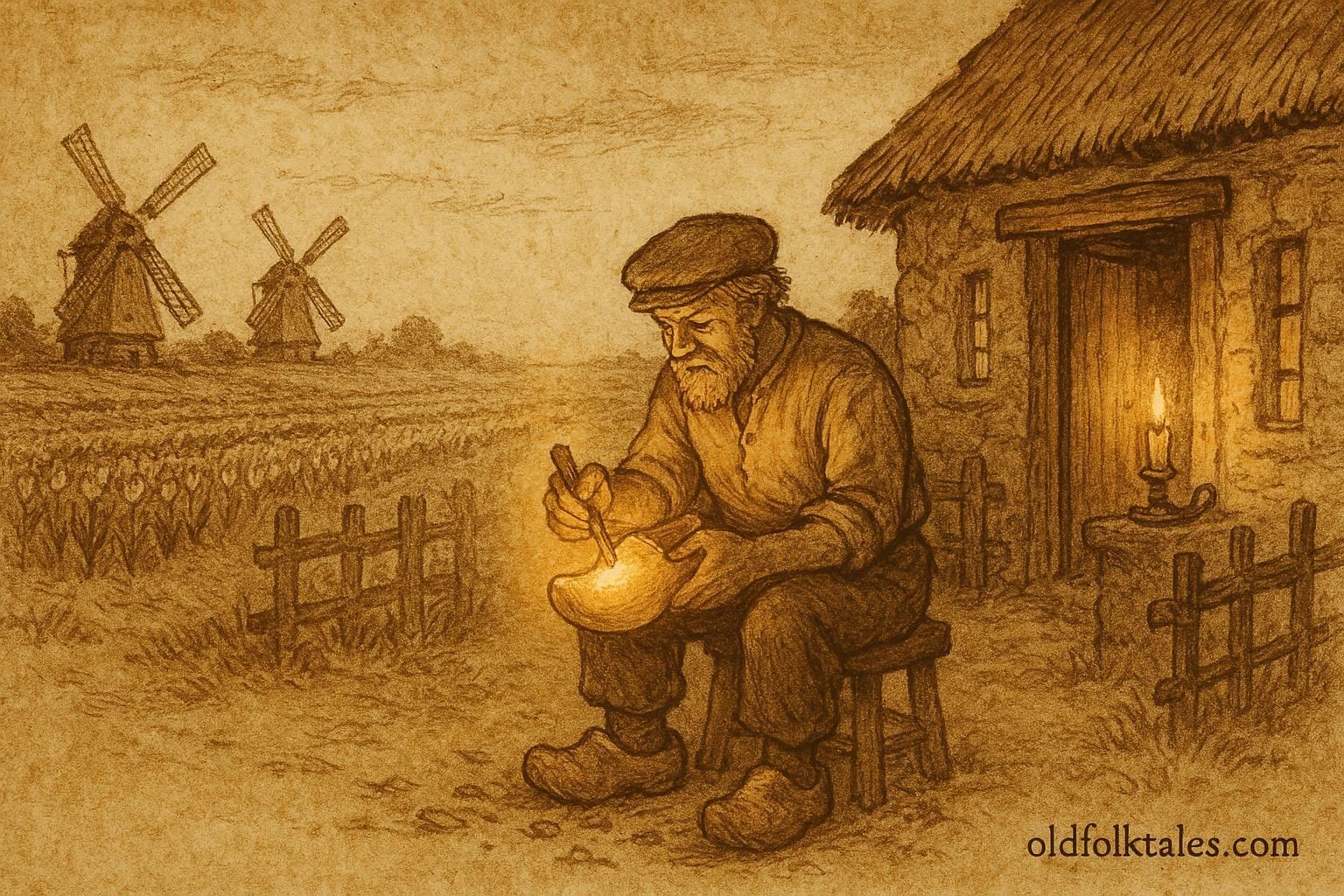
In a quiet Dutch village surrounded by windmills, tulip fields, and glistening canals, there once lived a poor carpenter named Hendrik. His small wooden cottage stood near the edge of the forest, where tall pines and oaks met the open farmlands. Though Hendrik worked hard, his earnings were meager. Still, his heart was rich with patience and pride in his craft, for his hands could turn rough wood into something both useful and beautiful.
Discover the timeless charm of French, Dutch, and Belgian stories filled with cleverness and heart
Each day, he shaped planks into stools, benches, or shoes, the sturdy wooden clogs that every villager wore. His tools were few, but his care was great. Hendrik would often say, “A good shoe must fit not just the foot, but the life that walks in it.”
One autumn evening, as the sun dipped low over the dikes and the sky burned with the colors of a ripe tulip, Hendrik went into the forest to gather wood. He searched for hours, but every log seemed too hard, too knotted, or too brittle. Just as he was about to return home, his gaze fell upon an odd piece of wood lying half-buried in the earth. It gleamed faintly in the twilight, smooth as if polished by unseen hands.
Curious, he picked it up. The wood felt warm and light, unlike any he had ever handled. It gave off a faint fragrance, like spring blossoms after rain. Hendrik carried it home, wondering what he might craft from such a gift of nature.
That night, by candlelight, he began carving. The blade of his knife moved easily through the wood, almost guiding itself. In a few short hours, Hendrik had shaped a single wooden shoe, finer than any he had ever made. Its grain shimmered softly in the glow of the flame, and though it was perfectly balanced, he could not find the heart to make its pair. Somehow, the shoe felt complete on its own.
When he set it by the window to dry, the candle flickered strangely, and a light breeze swept through the cottage though the night was still. Hendrik thought little of it and went to bed.
At dawn, he awoke to the sound of voices outside. Villagers had gathered near his window, whispering in astonishment. Hendrik rushed out to find that his single wooden shoe was filled to the brim with fresh, golden coins.
“Where did this come from?” asked his neighbor, a fisherman.
Hendrik could only shake his head. “I carved it from a piece of wood I found in the forest,” he replied, still dazed. “I do not know how this happened.”
The villagers marveled, and word spread quickly through the town. Some said it was a reward from the forest spirits for his honesty and hard work. Others believed the shoe was blessed by Saint Joseph, the carpenter’s saint.
Hendrik, humble as ever, did not boast or grow greedy. Instead, he used the money to repair the roofs of the poor and to buy new tools for the apprentices who worked with him. Yet every night, he placed the wooden shoe by his window again, and every morning, it was filled anew with gold.
Seasons passed, and Hendrik’s fame grew beyond his village. People came from distant towns to see the miraculous shoe. Some offered him large sums to buy it, but he refused. “It was given freely,” he said, “so freely it must remain.”
One winter, a terrible storm swept through the Netherlands. The canals froze, crops failed, and hunger threatened many. Hendrik prayed earnestly that the magic of the wooden shoe would continue to help the people. But the next morning, when he looked out his window, the shoe was gone. Only a small mound of snow remained where it once stood.
The villagers searched everywhere, but it was never found. Though Hendrik was saddened, he accepted its disappearance with grace. “The shoe has done its work,” he said softly. “Perhaps it has gone to another who needs it more.”
In time, the storm passed, and spring returned. Flowers bloomed again, and prosperity followed. Hendrik continued his trade until his hands grew too weak to carve. Yet his story, and the legend of the wooden shoe, spread across the land.
To this day, Dutch children are told that when they place their wooden clogs by the fireplace on Saint Nicholas Eve, they honor the spirit of Hendrik’s kindness and the miracle of the shoe that rewarded a pure heart. And so, the wooden shoe, once a symbol of humble labor, became a lasting emblem of hope, generosity, and the magic that dwells in honest work.
Discover the timeless charm of French, Dutch, and Belgian stories filled with cleverness and heart
Moral of the Story
True wealth lies not in gold or magic, but in honest labor, generosity, and faith in the goodness of life.
Knowledge Check
- What is the main setting of “The Legend of the Wooden Shoe”?
The story takes place in a Dutch village surrounded by windmills, tulip fields, and canals, representing traditional life in the Netherlands. - Who is the main character in this Dutch folktale?
Hendrik, a humble carpenter known for his craftsmanship and kindness. - What made the wooden shoe special?
It was carved from a mysterious piece of wood that magically filled with gold each night. - What does the wooden shoe symbolize in Dutch culture?
It represents hard work, simplicity, and the connection between human labor and divine blessing. - What is the moral lesson of the tale?
That honesty, humility, and generosity bring true fortune, while greed and pride lead to loss. - How is the wooden shoe tradition preserved today?
Dutch children still place wooden clogs by the fire during Saint Nicholas Eve, echoing the spirit of gratitude and giving found in this legend.
Source: Adapted from Dutch Fairy Tales for Young Folks by William Elliot Griffis (1918).
Cultural Origin: Netherlands (Dutch folklore)