Once upon a time, in a land of misty mountains and green valleys, there stood a royal garden unlike any other. In the heart of that garden grew a wondrous tree whose branches bore golden apples that shone brighter than the sun. The tree belonged to a mighty king, and its fruit was the pride of his kingdom. But one morning, when the king went to admire the golden apples, he discovered that one was missing.
The next day, another golden apple vanished. The king was furious and demanded that his sons guard the tree and catch the thief. The eldest son took the first watch, but he grew drowsy as midnight approached. By morning, another apple was gone. The second son watched the next night, but he too fell asleep and failed.
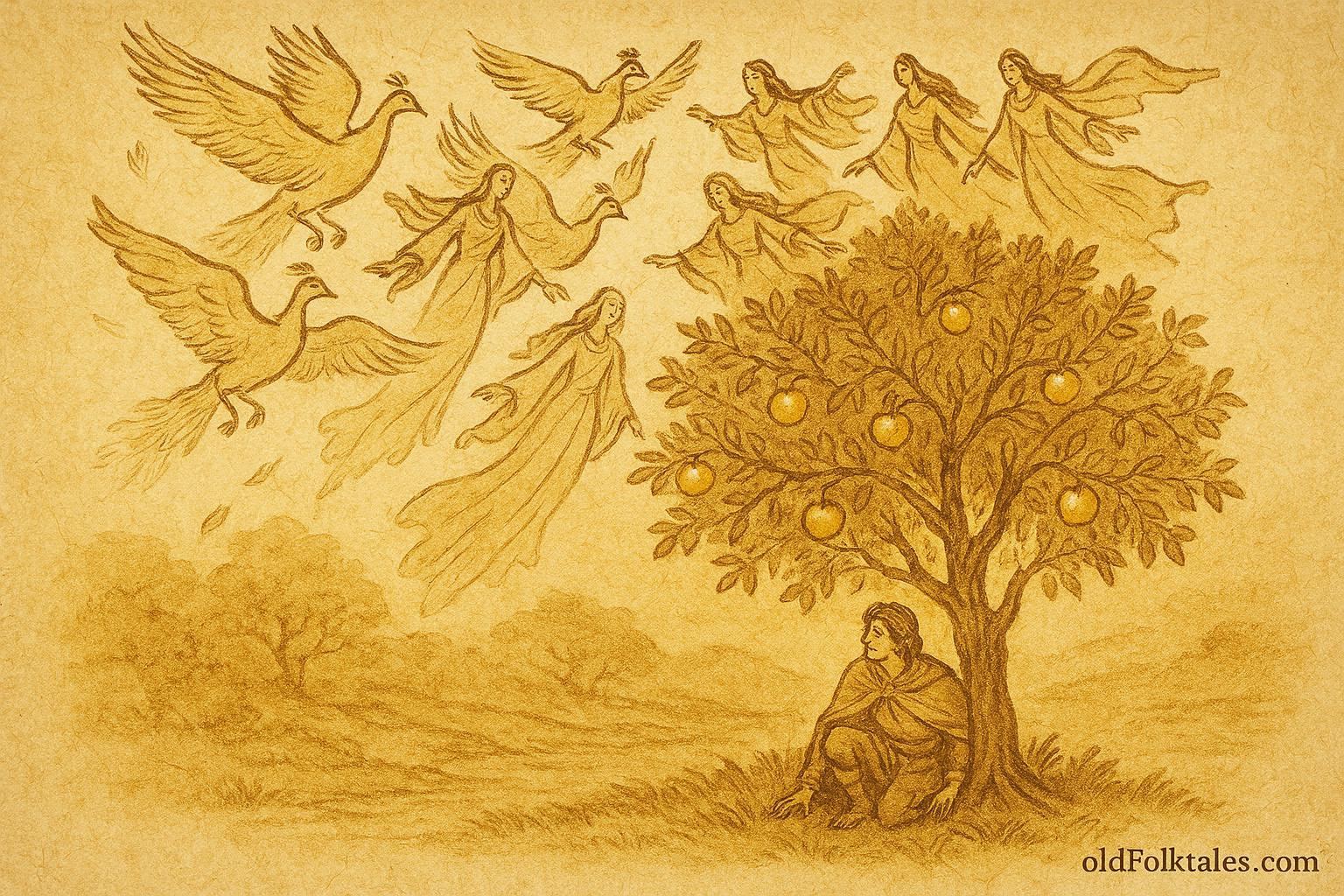
Finally, the youngest prince, known for his courage and gentle heart, offered to keep watch. When darkness covered the land, he hid beneath the tree, his eyes fixed upon the shimmering fruit. Just as the moon reached its highest point, he heard a soft rustling in the air. He looked up, and beheld nine magnificent peahens descending from the heavens. Their feathers glistened like emerald and sapphire, their eyes like stars. They landed near the tree, and as their wings touched the ground, they transformed into nine radiant maidens, each more beautiful than words could describe.
The prince watched, entranced, as the maidens plucked the golden apples and laughed among themselves. One of them, the youngest and fairest, noticed him and smiled. When their eyes met, the prince felt his heart tremble with wonder.
When dawn approached, the maidens turned back into peahens, spreading their jeweled wings to fly away. The prince stepped forward, grasping the youngest by her wing. “Do not leave me,” he pleaded. “Tell me who you are.”
The peahen-maiden looked at him kindly. “We are enchanted maidens,” she said softly. “We come from a faraway land, cursed to live half as birds, half as women. Release me now, and I will return tomorrow night.”
The prince let her go, his heart filled with both joy and longing.
Each night thereafter, the peahens came again, and each night the prince spoke with the youngest maiden. Soon, they fell deeply in love. When the king learned of this, he gave his blessing for them to wed. The maiden agreed, warning that her happiness could be fragile: “If I am ever lost, you must seek me, no matter how far the road.”
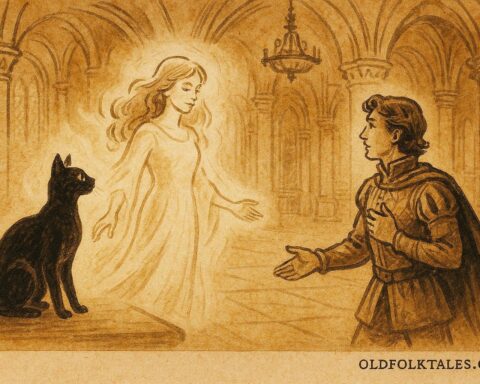
For a time, the young couple lived in peace. But not all hearts in the kingdom were kind. A jealous servant, envious of the maiden’s beauty and the prince’s joy, plotted against them. One day, when the prince was away hunting, the servant burned the enchanted robe that allowed the maiden to change form. When the maiden saw what had been done, she wept bitterly. “Without my feathers, I cannot stay,” she said, and before anyone could stop her, she vanished in a swirl of golden light.
When the prince returned and found his bride gone, his grief was unbearable. He swore not to rest until he found her.
He set out across mountains and deserts, through forests and unknown lands. He met many strange beings, an old hermit, a talking horse, and a kind witch, each offering him guidance. Finally, after countless trials, he reached a faraway kingdom where he found the nine peahens once more. The youngest sat by a lake, weeping softly.
When she saw him, her sorrow turned to joy. “You came for me,” she whispered. “You kept your promise.”
Their reunion broke the enchantment that bound her. The curse was lifted, and the peahens were freed forever. Together, the prince and his bride returned to his homeland, where the golden apple tree bloomed brighter than ever before. From that day on, no fruit was ever stolen again.
Moral of the Story
True love is not measured by ease or beauty, but by devotion, courage, and faithfulness. The prince’s unwavering love restored what was lost, reminding us that perseverance can overcome even the deepest sorrow.
Knowledge Check (Q&A)
1. Who guarded the golden apple tree in this Bosnian folktale?
The youngest prince guarded the golden apple tree after his elder brothers failed to protect it.
2. What magical event happened each night in the story?
Nine peahens descended from the heavens, turned into maidens, and plucked the golden apples.
3. What causes the heroine to disappear from the prince’s life?
A jealous servant burns her enchanted feathers, forcing her to vanish.
4. What themes are central to “The Golden Apple Tree and the Nine Peahens”?
The story explores love, loyalty, perseverance, and the triumph of good over envy.
5. What is the cultural significance of the peahens in South Slavic folklore?
Peahens symbolize beauty, purity, and transformation—common motifs in South Slavic and Balkan storytelling traditions.
6. What is the main moral lesson of the tale?
Love and courage can overcome separation, magic, and misfortune.
Cultural Origin: Bosnian folktale, Bosnia and Herzegovina.
Source: Adapted from “Zlatna jabuka i devet paunica” (The Golden Apple Tree and the Nine Peahens), traditional South Slavic folklore, as collected in Yugoslav and Bosnian tale anthologies.