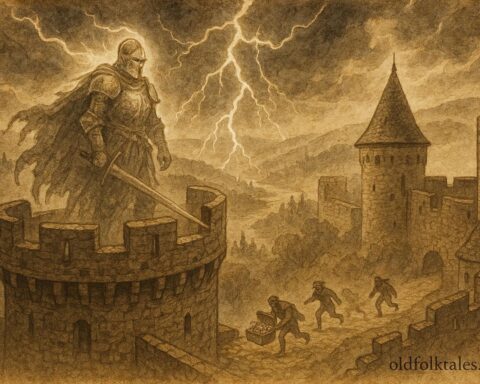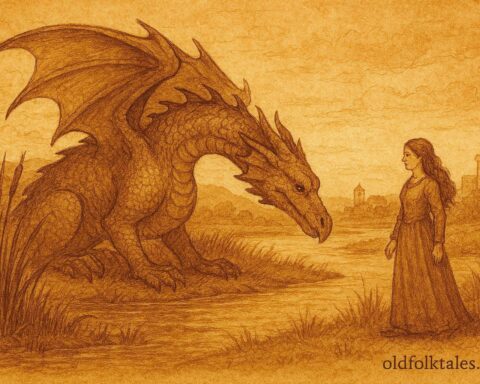
Long ago, in a vast land of rolling hills and deep forests in the South Slavic region, there lived a king who had three sons. On his deathbed, he called them to his side and gave them a solemn charge: “My sons, you must heed my last wish. Marry off our three beloved daughters, no matter to whom they are given.” The older brothers were uneasy, but the youngest bowed and promised. None of them knew that this vow would one day lead to a fateful encounter with Baš-Čelik, the Steel-Headed Prince of legend, a being whose power was hidden far beyond mortal reach.
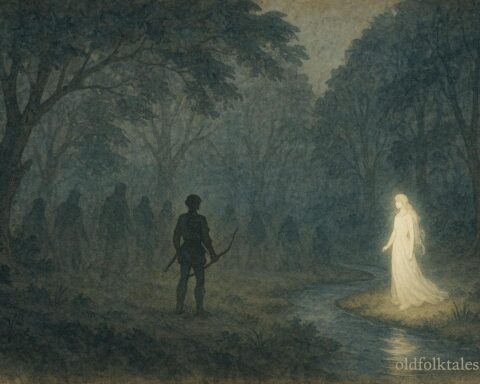
Not many nights after, there came a thunderous voice from the forest. On the first night, it demanded the first princess; the second night, the second; and the third night, the youngest daughter. Each time the two elder princes hesitated, but remembering their father’s dying words, the youngest consented. Thus the three princesses were married away, though their bridegrooms were mysterious strangers, hidden deep in that wild realm.
Experience legends where mountains breathe magic and heroes face moral choices that shape destiny
When the king’s sons awoke to find their sisters gone, they set out into the woods. Each journey brought trials: they fought many-headed serpents, they passed through dark valleys, always the younger brother pressing onward when his siblings faltered.
At length, the youngest reached a faraway kingdom and rescued a princess from the clutch of a fierce giant. He won her hand and lived in her castle, welcomed by her people. But the princess set one condition: her husband might explore every room in the castle, save for one locked chamber, sealed with heavy chains. Immediately, curiosity stirred in him.
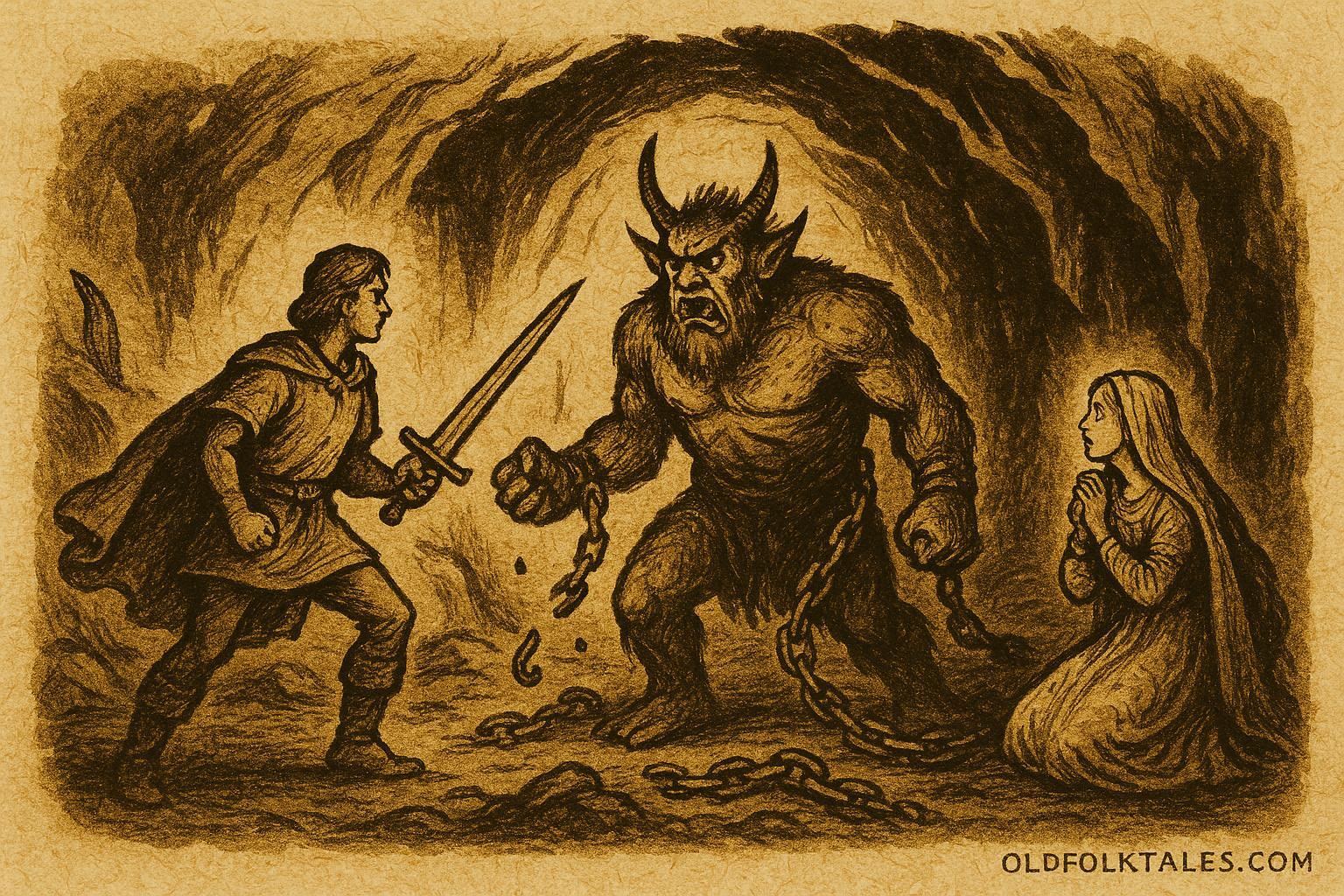
One day, when his wife was absent, the prince slipped into the forbidden chamber. In its gloom he saw a man bound in chains, pale but fierce, the man called himself Baš-Čelik, “Steel-Headed.” The man begged for three glasses of water. The prince, pitying the figure, fetched and handed over the first glass. Instantly a strange light shone, and the prince felt a secret life being added to his own. The second glass brought another surge of life. The third glass, as the prince drank the last, released the prison’s magic. Baš-Čelik broke his chains, spread great wings, and swept away the princess, flying into the night’s storm-clouds.
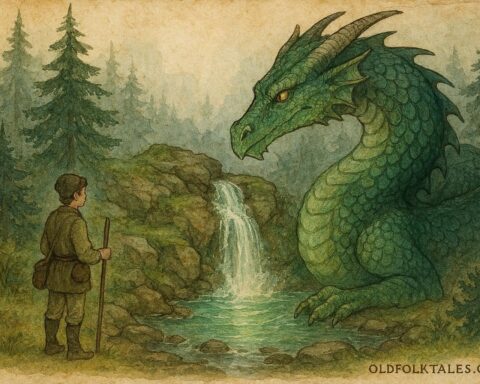
The prince was devastated. With heavy heart he recalled how his sisters had each married otherworldly lords: one to the king of dragons, one to the king of eagles, the third to the king of falcons. He set out to seek them, to beg their aid. One by one he arrived at their strongholds: the dragon-king’s cavern, the eagle-king’s crags, the falcon-king’s high nests. Each brother-in-law received him kindly though they warned: “Baš-Čelik’s power is immense. You risk your life.” Yet each also gave the prince one magical feather, and pledged: “If you burn this feather when you are in dire straits, I will come with my hosts to your aid.”
Armed with three feathers and burning hope, the prince attempted three times to rescue his wife. Each time he confronted Baš-Čelik, and each time he failed, losing one of the precious lives he had been granted. On his fourth attempt he burned all three feathers at once, summoning the dragon, the eagles, the falcons. They surged after Baš-Čelik, but even such overwhelming force could not save the princess. Baš-Čelik captured her once more, and in that moment the prince’s body was struck down, torn asunder, yet not dead, thanks to his brothers-in-law. They carried him and poured on him water drawn from the sacred river Jordan. As the water touched his wounds the body mended, life returned, and the prince rose again.
Now he had but one life left. The brothers-in-law looked at him gravely and warned: “Go no more against Baš-Čelik. You walk on the edge of doom.” But the prince would not be turned from his love. He resolved at least once more to try, and this time, with a new task. His wife, held captive, devised a plan: she would ask Baš-Čelik, in his own cave, where his strength lay. When he answered truthfully she would tell her husband, and they would act.
So the captive princess questioned Baš-Čelik. At first he misled her: “My strength lies in my sword.” She pointed to his sword. He laughed: “Foolish woman! It lies in my bow and arrows.” She turned, waited. He scorned again. On the next visit, after a few days, Baš-Čelik, thinking her sly, revealed the full truth: “Far away there is a high mountain. In the mountain dwells a fox. In the fox is a heart. Inside the heart is a bird. That bird holds my life, seize it and you will conquer me.”
The prince hurried to his brothers-in-law, and together they mounted on dragons, falcons, and eagles to the lofty mountain. They reached the shimmering lake at its heart. There the fox shifted shape, then became a six-winged golden bird, soaring above the clouds. The falcons pursued, then the dragons, then the eagle-hosts enveloped the beast. Finally they caught the fox, cut out her heart, took the bird from within, and cast it in the great fire. Instantly Baš-Čelik collapsed like steel melting under flame. The prince released his wife, and they returned home, triumphant, love-bound, and free.
Moral Lesson
True strength lies not in outward arms or fearsome form, but in the hidden secret one trusts in. Courage anchored in love and wisdom can free the captive heart — and show that even the seemingly invincible can be undone when their concealed cornerstone is exposed.
Knowledge Check
-
Who is Baš-Čelik?
He is the fearsome captive man of steel, whose strength lies hidden in an external object, and who kidnaps the prince’s wife. -
What vow do the king’s sons make at their father’s deathbed?
They promise to marry off their three sisters to whoever asks, even if the suitor is strange, honouring their father’s dying wish. -
What are the roles of the three brothers-in-law?
They are the kings of dragons, eagles, and falcons, married to the prince’s sisters, and they offer him magical feathers and their armies for his rescue attempts. -
Where is Baš-Čelik’s strength hidden, and how is it destroyed?
Hidden on a distant mountain: a fox, whose heart contains a bird, and the bird holds his life. The prince and his allies capture the bird and burn it, thus defeating Baš-Čelik. -
What does the repetition of rescue attempts (and the loss of extra lives) symbolize?
It symbolizes the hero’s perseverance, the cost of unwise gambles, and how true victory often requires knowledge and support, not just brute strength. -
What cultural origin does this tale have, and what does it illustrate about folk-traditions in the South Slavic region?
The tale originates in the South Slavic (Bosnian/Serbian) oral tradition, illustrating how themes of external power-objects, enchanted adversaries, and heroic rescue quests are central in that folklore.
Cultural Origin:
Bosnia and Herzegovina (South Slavic / Bosnian-Serbian oral tradition)
Source: South Slavic (Bosnian-Serbian) folktale, adapted from versions in Vuk S. Karadžić’s Serbian Folk Tales (1853)