Once upon a time, in a quiet village on the rolling hills of Bosnia, there lived a woman steeped in sorrow. Year after year she longed for a child, but no babe came to her arms. Finally, in a fit of desperation, she clasped her hands to the sky and prayed: “O Lord, grant me a child, even if that child should be a serpent.” And lo, her prayer was answered.
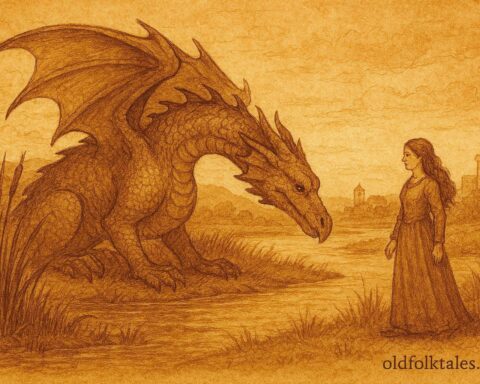
When the time came, she gave birth, not to a human infant, but to a snake. The mother, despite her initial shock, raised the creature tenderly as any mother would raise a child. The snake grew among the grasses, silent and secretive. One day it vanished into the meadow, and though the mother searched and wept, she never found it. She remained in that lonely home, longing for her son.
Twenty years passed like shadows across the hills. Then, one evening, the snake returned to his mother. He spoke in a human voice: “Mother, I am your snake-child, born of your longing. Now I have come to you so that you may ask the emperor for a bride for me.” The mother’s heart surged with joy to see him, yet trembled with dread at the task. How could she ask a princess to marry a serpent? But the snake reassured her: “Fear not, mother. Go to the emperor’s court. If the emperor should refuse, he will not take your head. And once you depart from the court, do not look back until you have reached home.” So she gathered her courage and went.
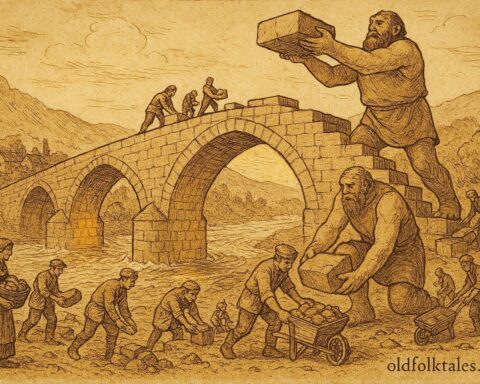
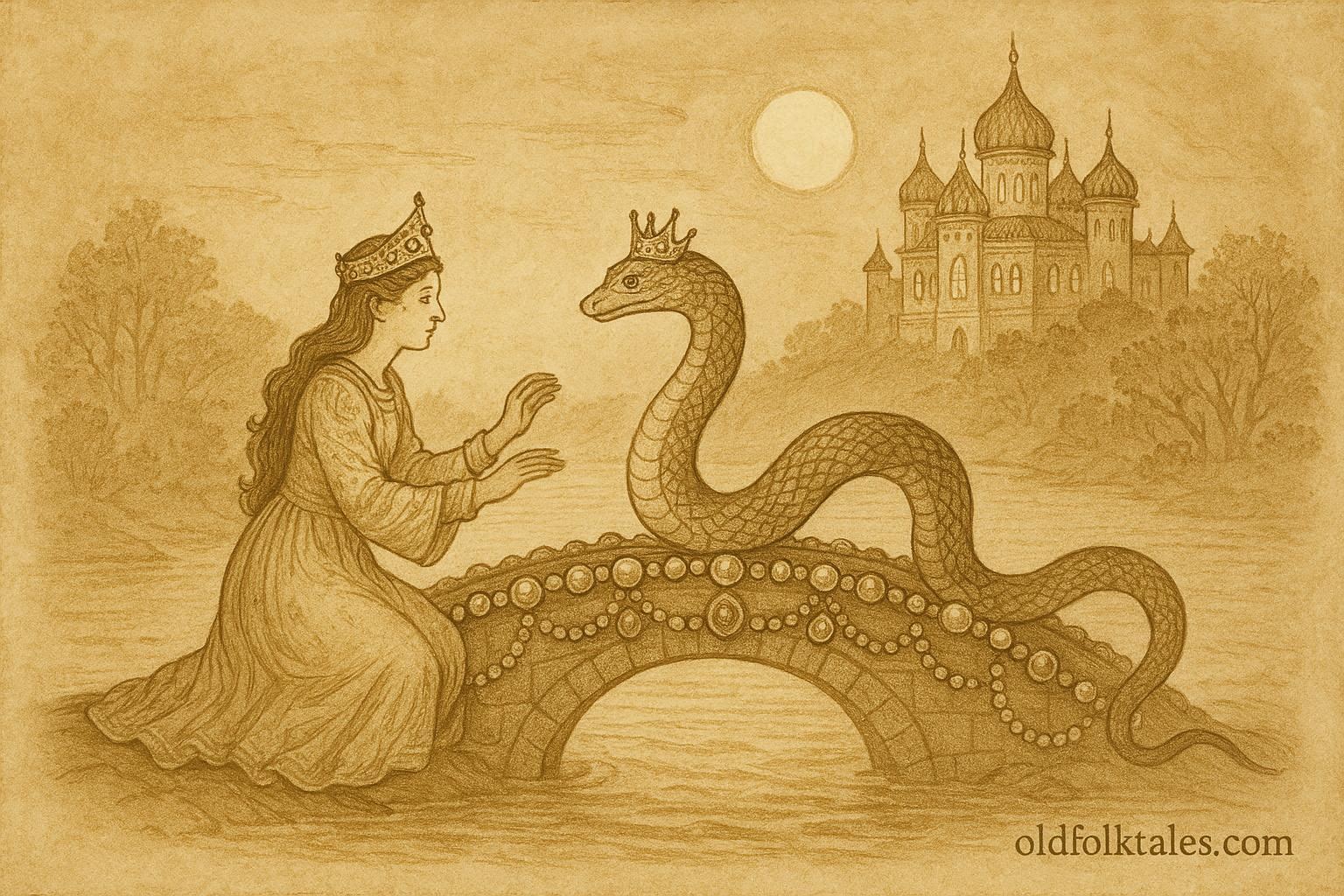
At the imperial palace, the mother knelt before the emperor and spoke: “Most high emperor, here is your sabre, and here is my head. I had no child for many years and prayed to God, even for a serpent. He granted me this snake, born of me, which then vanished. Now this snake-child has returned and bids me seek you for his bride.” The emperor listened and smiled. He said: “I will give the hand of my daughter to your son, but first let him build a bridge of pearl and precious stones from my palace to your house.” The mother returned home, certainly cringing at the task. Yet as she journeyed back, a dazzling bridge rose behind her: pearls glimmering in moonlight, gemstones sparkling like fireflies in dusk. The snake then told her: “Now mother, go to the emperor and claim the maiden for me.”
And so the wedding was arranged. The princess married the serpent and the festivities rang through the court. But on the wedding night the bride was gripped by dread. As she lay beside her scaled husband she shivered; yet at the stroke of midnight the serpent shed his skin and became a young man of shining countenance. The bride was amazed, and when morning light crept in, the man took up the serpentine guise again. Weeks passed in this secret turn.
At length the prince’s mother visited and her curiosity got the better of her. She pressed her daughter-in-law: “Why does your husband hide his true self from me?” And the bride, with trembling honesty, revealed the nightly transformation. The aged mother whispered: “Steal his snake-skin tonight and burn it; then he will remain human forever.” Trusting her mother-in-law, the bride did so. But as the skin crackled in the fire the next dawn, the young man vanished. Before he disappeared he cursed her: “Because you have betrayed me and burned my outer shell before the time, you shall not give birth to our child until you find me again and I place my right arm over your body.” Then he departed, leaving the bride in her bridal robes, heavy with longing and unfulfilled promise. Variants of the tale even say she walked out wearing iron shoes from the grief of her quest.
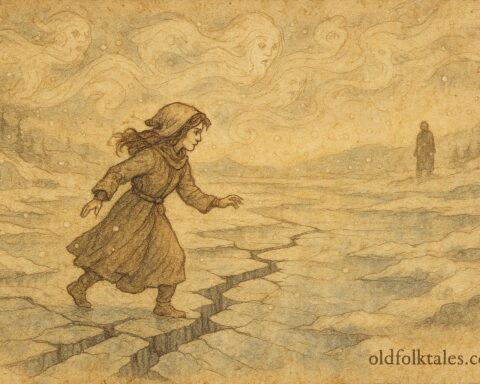
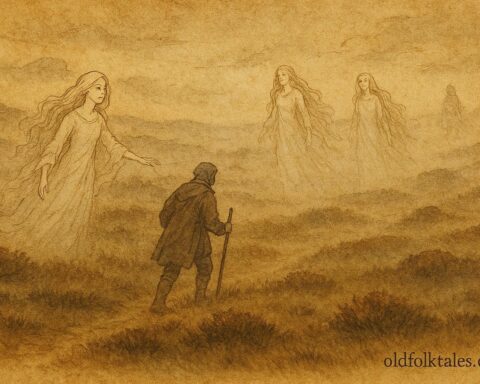
Now the princess set out into the wide world, her heart both heavy and resolute. She passed through forests and over high ridges, until she reached the dwelling of the Mother of the Sun. There she was given a golden distaff with golden flax. Then she came to the home of the Mother of the Moon, who gifted her a golden hen with golden chicks. Finally she came to the House of the Winds, where the Mother of the Winds bestowed a golden loom woven with golden thread. With these magical gifts she pressed on, guided by whispered winds and moonlit paths.
At last she arrived at the palace of the one who held her husband captive, or at least, where he had taken residence far away. The princess offered her golden gifts in exchange for one night with her husband. Each evening she came close, took hold of his hand, but each time he slept under a spell and did not awaken. On the third night she managed to wake him; he recognised her, placed his right arm over her, and in that moment the long stalemate was broken. She gave birth to their child and they returned home together, joyous at last.
And so the serpent bridegroom was redeemed, and the princess restored to her rightful place. Their union, marred by fear and betrayal, was rooted anew in trust, perseverance, and the bond they shared beyond outward shape.
Moral Lesson
True love often transcends appearances and fears, but trust must be mutual and patience unwavering. It warns that betrayal, however well-intentioned, can bring long separation, and that redemption is earned through endurance, faith and courageous action.
Knowledge Check
-
Q: Who first prays for a child “even if a serpent” in the tale?
A: A childless woman prays to God for a child, even if it is a snake. -
Q: What is the serpent’s special request once grown?
A: The serpent asks his mother to go to the emperor and ask for a bride for him. -
Q: What task does the emperor set before granting his daughter?
A: To build a bridge of pearls and precious stones from the palace to the mother’s house. -
Q: What transformation does the bridegroom undergo at night?
A: He takes off his snake-skin and becomes a handsome young man at night. -
Q: Why does the bridegroom disappear after his skin is burned?
A: Because his skin was burned prematurely, he curses the bride that she will not bear their child until she finds him again and he places his right arm over her. -
Q: What gifts does the princess receive on her quest, and what do they symbolize?
A: She receives a golden distaff (Sun-mother), a golden hen with golden chicks (Moon-mother), and a golden loom (Wind-mother), symbols of light, life and fate that help her earn a reunion with her husbands.
Source: Adapted from the Bosnian (South Slavic) folktale Zmija mladoženja (“The Snake Bridegroom”).
Cultural Origin: Bosnia (South-Slavic folklore)