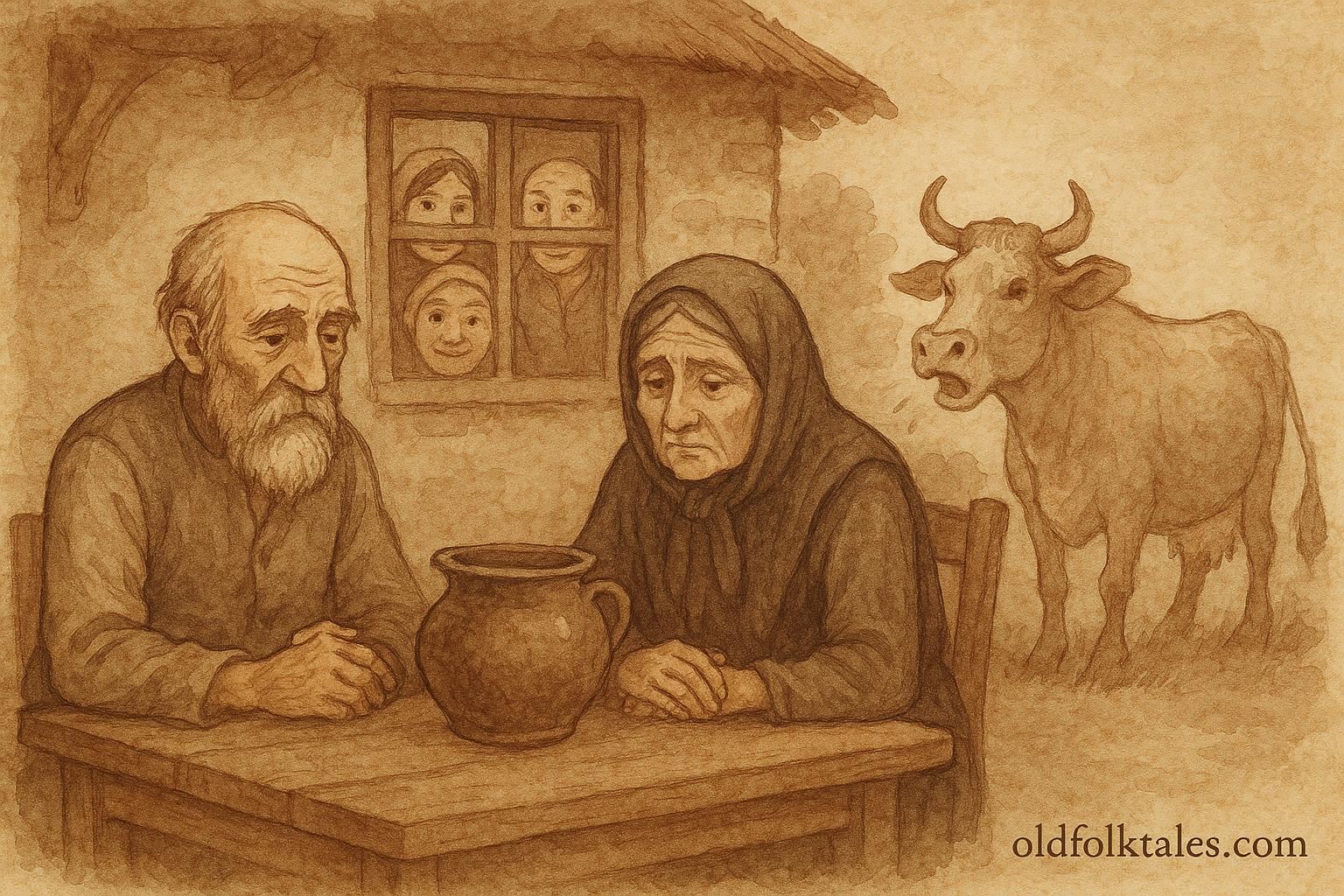
In a peaceful Bulgarian village, where the air was sweet with the scent of hay and woodsmoke, there lived an old couple, Grandfather Petko and Grandmother Pena. They were cheerful and content, always eager to enjoy a hearty meal, sleep warmly through the cold winters, and nap lazily under the cool shade in summer.
There was, however, one thing they both despised: work.
“Work is not for me,” Grandfather Petko often declared, stretching out on the bench by the door. “Better to rest a while and let the world turn without me.”
One afternoon, Grandmother Pena cooked a steaming pot of bean soup, thick, fragrant, and delicious. The two sat down to eat and, spoon by spoon, emptied the entire pot until not a single bean remained. Their bellies full, they leaned back, sighing with satisfaction.
After a while, Grandmother Pena broke the silence.
“I cooked the soup,” she said, “so now it’s your turn. Roll up your sleeves and wash the pot. I’ll need it in the morning to milk the cow.”
Grandfather Petko scowled. “Wash the pot? That’s women’s work. You wash it yourself.”
“I won’t!” snapped Grandma Pena.
“Then let it stay dirty!” grumbled Petko, folding his arms.
And so, the pot remained unwashed.
Night came. The old couple climbed into bed, each turning their back on the other. The moonlight fell across the kitchen table, where the greasy pot sat in silence, waiting for dawn.
In the darkness, Petko spoke again. “Listen, Granny, get up early tomorrow and boil some milk for me. I’ll have milk soup before I go to the field.”
“And what shall I milk the cow into?” she shot back. “The pot’s still dirty. If you want milk, you wash it yourself.”
“I won’t,” he insisted. “Let’s make a bet instead.”
Grandma Pena turned toward him. “A bet? What kind?”
“We’ll both stay silent. Whoever speaks first has to wash the pot.”
“Agreed,” said Grandma Pena firmly.
They both fell silent, and soon sleep crept over them.
Morning came. The roosters crowed. The village stirred to life. Farmers headed to their fields; shepherds led their flocks to pasture. But in Petko and Pena’s yard, the cow stood tied up, mooing sadly. No one came to milk her.
The couple sat inside, facing each other at the table, both silent, both stubbornly guarding their pride.
Time passed. The sun climbed higher. The neighbours began to notice something strange. The cow was still tied up, crying for milk, and no smoke rose from the old couple’s chimney.
“What’s going on at Grandpa Petko’s?” one neighbour asked.
The curious villagers peeked over the fence and saw the old man and woman sitting stiffly, their faces frozen like statues.
They rushed inside. “What’s the matter, Grandma Pena? Why aren’t you milking the cow?”
Pena said nothing.
“Grandpa Petko, why is your wife silent? Speak, man!”
Petko only shook his head, lips sealed tight.
The neighbours looked at one another in alarm.
“By the saints! The old folks have gone mute!” one gasped.
“Quick! Someone fetch the doctor!”
A boy named Ignatka ran through the village to find the doctor at the far end of town. Meanwhile, the crowd grew. Some whispered, some laughed nervously, others fretted. But no matter what anyone said, neither Petko nor Pena made a sound.
One by one, the villagers drifted away, some to the fields, others to their homes, until only two people remained: an old woman and the village priest.
The priest sighed. “I’ll have to stay until the doctor comes. We can’t leave them like this.”
But the old woman shook her head. “I can’t stay for free, Father. No one works without pay.”
“Pay you?” said the priest indignantly. “I am a man of God, not a merchant!”
He glanced around the room. A tattered coat hung on the wall. “I’ll give you this old coat, then.”
He reached for it, but before his fingers touched the fabric, Grandma Pena leapt to her feet, shouting, “What are you doing? You want to give away my coat to that lazy woman? What will I wear when the cold comes?”
Hearing her shout, Grandfather Petko grinned from ear to ear. He rose slowly, stretched, and said, “Well, Grandma, you spoke first. You lost the bet. Now go wash the pot.”
The priest and the old woman stood there, speechless for a moment—then both burst out laughing. Shaking their heads, they left the house, muttering, “So that’s what all this fuss was about!”
From that day forward, the tale of Grandfather Petko and Grandmother Pena spread through the village like wildfire. And the villagers often chuckled, saying, “Better to wash the pot than lose your peace.”
Moral Lesson
Stubbornness may win a bet, but it rarely brings peace. True wisdom lies not in pride, but in knowing when to yield.
Knowledge Check
-
Who are the main characters in “Grandfather Petko and Grandmother Pena”?
The story centres on an old Bulgarian couple, Petko and Pena, known for their laziness and stubbornness. -
What sparked the argument between Petko and Pena?
A dirty pot left unwashed after eating a pot of bean soup. -
Why did the villagers think the couple had gone mute?
Because both refused to speak, keeping silent to win their bet. -
What caused Grandma Pena to break her silence?
She shouted when the priest tried to give away her old coat. -
What is the humorous twist at the end of the folktale?
Petko wins the bet because his wife spoke first, proving his stubbornness greater than hers. -
What cultural lesson does the Bulgarian folktale teach?
It humorously warns against pride and laziness, highlighting the value of cooperation and humility.
Source: Adapted from the Bulgarian folktale “Grandfather Petko and Grandmother Pena” on Detskie-Skazki.com (English translation).
Cultural Origin: Bulgaria (Bulgarian folklore)