Long ago, in the heart of Serbia, there lived a poor widow in a small cottage on the edge of a vast, dark forest. The winters there were harsh and endless, the snow so deep it buried the fields and silenced the world. That particular winter was the cruelest she had ever known. Her food was gone, her firewood dwindling, and hunger gnawed at her bones. She had no one to help her, and she prayed each night for mercy.
One stormy evening, as the wind howled through the chimney and snow pressed hard against her door, she heard a heavy knock. Trembling, she opened it, and there stood a great brown bear, its fur thick with snow, its eyes deep and gleaming.
The poor woman froze in terror. But instead of growling, the bear spoke in a low, gentle voice:
“Good woman, I am cold and weary. Will you give me shelter this night?”
Out of both pity and fear, the widow stepped aside and let him in. The bear entered, shook off the snow, and lay quietly near the hearth. To her surprise, he did no harm. In the days that followed, he helped her fetch wood, mended the roof with his claws, and brought fish and honey from the forest. The widow began to see that beneath his fearsome size lay a kind heart.
All through the long winter, the bear remained by her side, guarding the cottage and keeping her warm through the bitter nights. But when spring returned, melting the snow and filling the air with birdsong, the bear stood at the door and said,
“Your kindness has saved my life. Now I must return to the forest. Remember me.”
And with that, he was gone, leaving the widow both sorrowful and grateful.
Months passed, and the widow discovered she was with child. When her time came, she gave birth to a strange and wondrous boy. His shoulders were broad as tree trunks, his hands powerful, and his body covered with soft brown hair. His eyes gleamed like a forest creature’s, yet his heart was tender and good. She named him Medvedić, which means The Bear’s Son.
From childhood, Medvedić’s strength was extraordinary. He could lift stones that ten men together could not move. Yet he was gentle with his mother, helping her with every chore, cutting wood, and hunting only what they needed. Still, he longed to see the world beyond the forest.
When he came of age, he said to his mother,
“Dear Mother, you have cared for me all my life. But now I must seek my fortune. I wish to serve the good and fight the wicked. Bless me and let me go.”
With tears in her eyes, she blessed him and gave him a pouch of bread and cheese. Medvedić set off into the wide world, walking until the forest gave way to open fields and faraway mountains. Everywhere he went, people whispered about the wild man whose hands were as large as shovels and whose steps left marks in the earth.
One day, he came upon a village in mourning. The people told him that a terrible giant had taken their king’s castle and imprisoned his daughter. Many had tried to rescue her, but none had returned.
“I will face him,” said Medvedić.
The villagers warned him, “The giant’s strength is beyond measure!”
“So is mine,” replied the Bear’s Son.
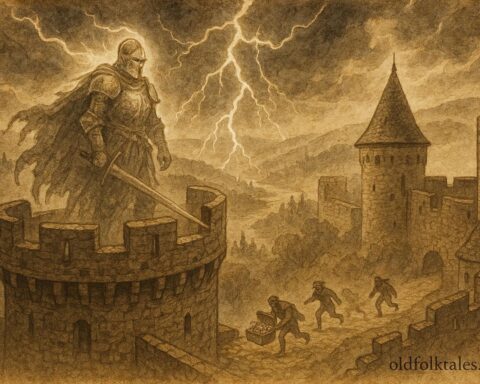
He marched straight to the giant’s fortress, where thunder rolled and clouds hung low. The giant’s laughter boomed as he saw Medvedić approach. They fought from dawn till dusk, shaking the hills with their blows. Medvedić’s bear-born might prevailed; with a roar, he struck the giant down and freed the king’s daughter.
The king, astonished by his bravery, welcomed him to the royal court. But peace did not last long, for far to the east, the Dragon of the Black Mountain terrorized the land, breathing fire upon villages and demanding tribute in gold and maidens.
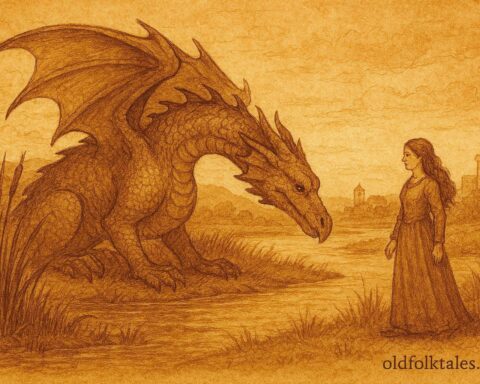
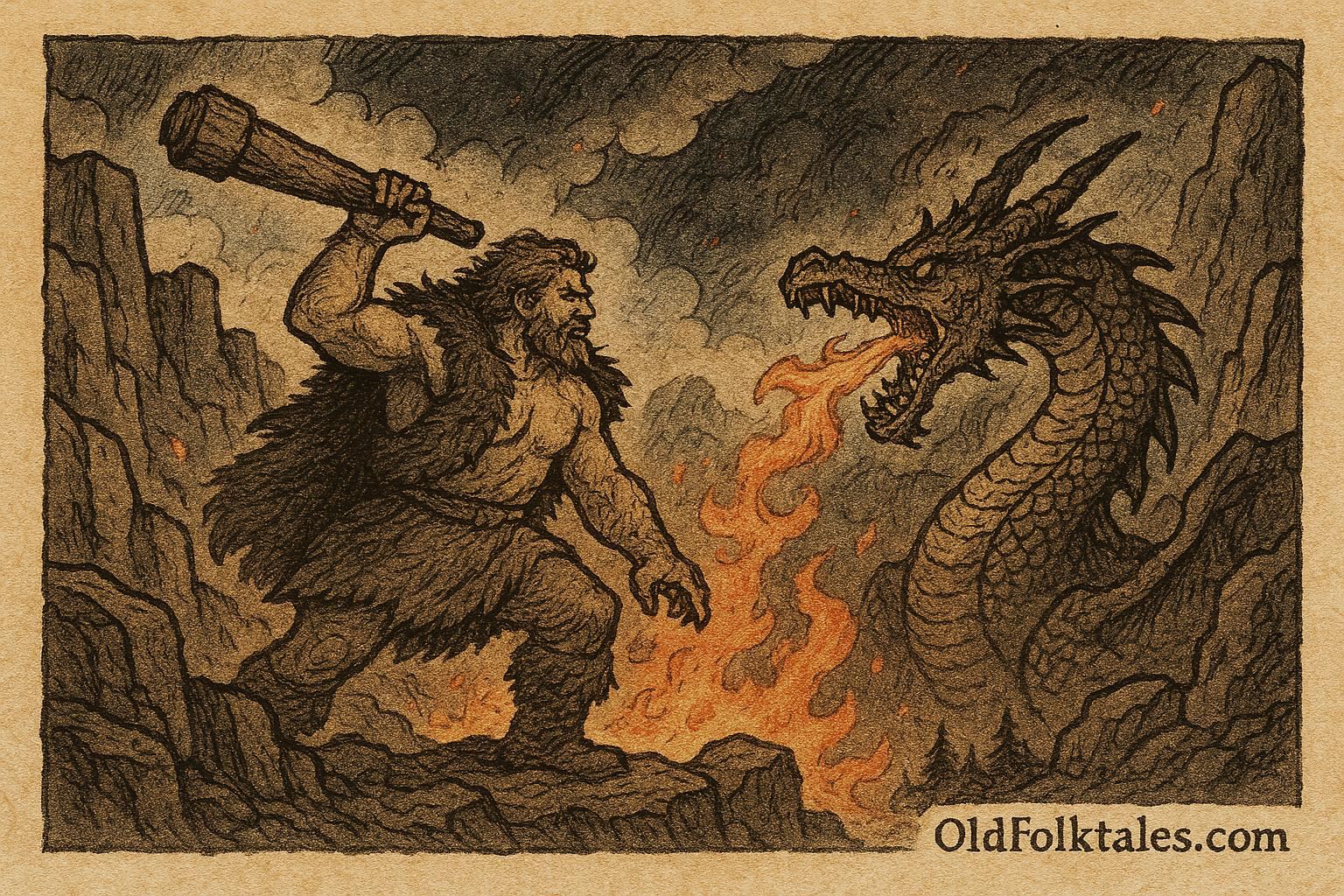
Medvedić vowed to end the dragon’s reign. Armed with an iron club the size of a plough, he climbed the dark mountain, where fire and smoke veiled the sky. For three days and three nights, he battled the monstrous serpent, its scales harder than steel. At last, with one mighty blow, he crushed its head and cast it into the abyss.
The kingdom rejoiced. Bells rang, and the king embraced him before all the people. “You have saved us,” he declared. “Take my daughter’s hand and half my kingdom!”
At the wedding feast, Medvedić stood before the guests and laid aside the bears’ skin that covered him since birth. To the astonishment of all, he became fully human, tall, strong, and noble. The spell of his birth was lifted.
From that day on, Medvedić ruled wisely beside his queen. Though he never forgot the wild forests of his youth, he lived as a man of honour, strength, and compassion, proof that greatness may rise from the humblest and strangest of beginnings.
Moral Lesson
True strength lies not only in might but in kindness and humility. The Bear’s Son teaches that courage born of compassion can transform one’s fate and bring peace to others.
Knowledge Check
-
Who is Medvedić in “The Bear’s Son”?
Medvedić, meaning The Bear’s Son, is a hero born of a woman and a bear from Serbian folklore. -
Why did the bear visit the widow’s cottage?
The bear sought shelter from the cold winter and was kindly given refuge by the widow. -
What qualities define Medvedić’s character?
He is strong, brave, and noble, yet gentle and compassionate, a true hero’s heart. -
What monsters did Medvedić defeat?
He defeated a terrible giant and later the Dragon of the Black Mountain. -
How did Medvedić become fully human?
During his wedding, he shed his bearskin, symbolizing transformation and acceptance of his dual nature. -
What cultural lesson does this Serbian folktale convey?
It reflects values of courage, gratitude, and humility, central to Serbian folk tradition.
Source: Adapted from the Serbian folktale “The Bear’s Son” in Serbian Folk-Tales, collected by Vuk Stefanović Karadžić; trans. Elodie Lawton Mijatovich (1915), London: George Allen & Unwin.
Cultural Origin: Serbia (Serbian folklore)