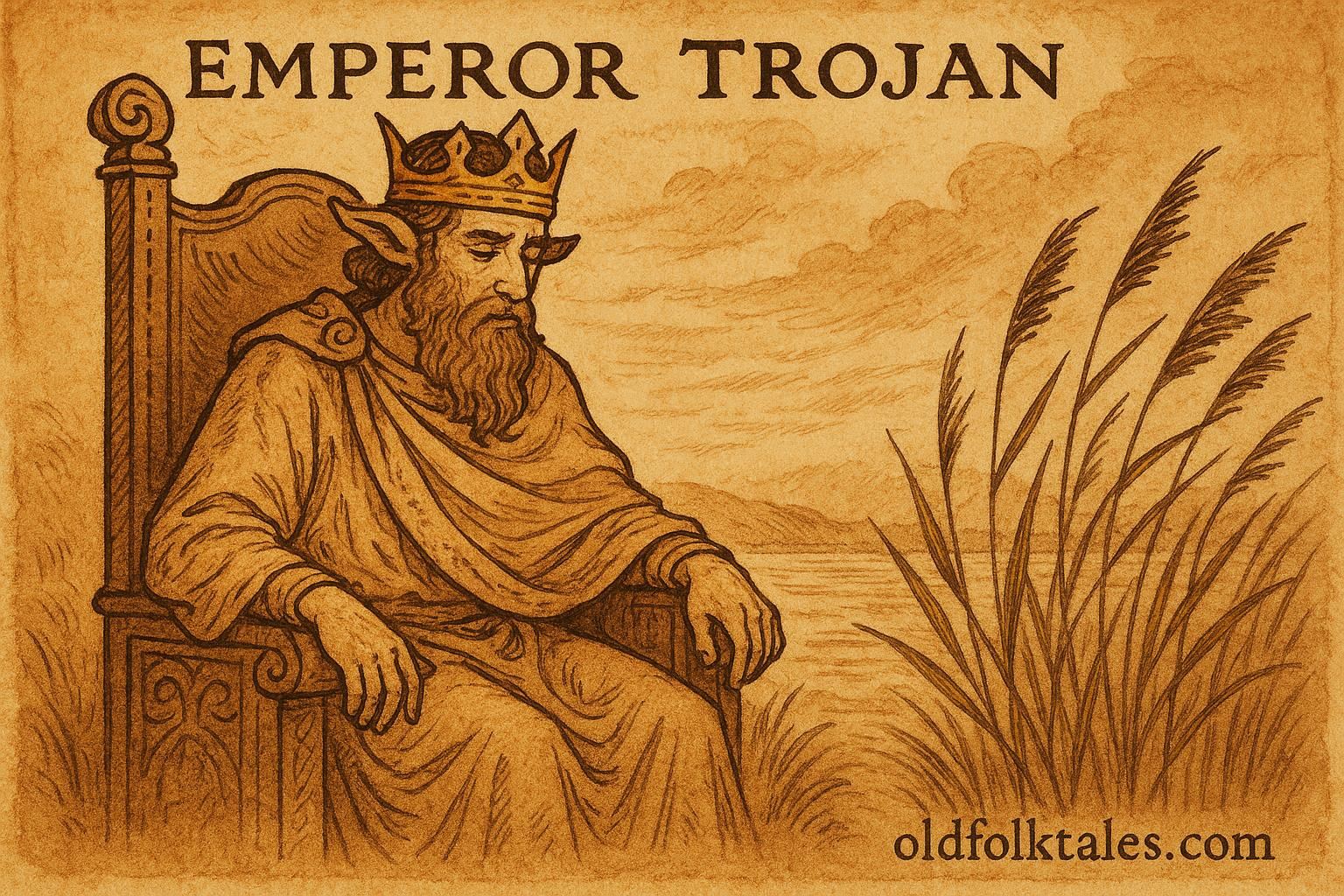
Long ago, in the ancient lands of Serbia, there reigned a powerful emperor named Trojan. His realm stretched across rich valleys and silver rivers, and his subjects praised his wisdom, courage, and fairness. Yet beneath his golden crown lay a secret so strange and shameful that he guarded it more fiercely than his throne.
Emperor Trojan had goat’s ears.
Born under a rare celestial sign, it was said that the stars had marked him with this curious feature to remind him that no ruler is entirely above the creatures of the earth. But Trojan saw it as a curse, a flaw that could undo his dignity. To all but himself, his head appeared regal beneath his royal hood, for he never removed it in public. Only the court barbers, who trimmed his hair, ever saw the truth, and they never lived to speak of it.
So it came to pass that whenever the emperor needed a haircut, he would summon a new barber. Once the deed was done, the poor man was led away and never seen again.
The people whispered among themselves, wondering why every barber who entered the palace disappeared. Yet none dared question the emperor, for his wrath was as swift as it was final.
The Young Barber’s Fate
One spring morning, a new decree spread across the city: a fresh barber must be chosen. None volunteered. At last, the king’s servants seized a young barber’s apprentice, gentle in heart and skilled with his hands. His mother wept bitterly as he was taken away.
When the emperor sat before him, the young man’s hands trembled, but he did his duty. As the final locks of hair fell, he saw what all others before him had seen, the goat’s ears of Emperor Trojan.
“Listen well,” the emperor said, his voice low and heavy. “What you have seen must never be spoken. If a single word escapes your lips, you shall die.”
The young barber bowed deeply. “Your Majesty, I swear upon my life that I shall never tell.”
Trojan dismissed him, but unlike his predecessors, the emperor felt a strange pity for the youth’s fear. He decided to spare him, on one condition: silence forever.
The Weight of the Secret
Days turned into weeks, and the young barber returned home alive but tormented. The secret gnawed at his heart like a worm in the wood. He could not eat or sleep, for the weight of what he knew grew heavier with every passing day.
At last, he fell ill. A wise old man, seeing his distress, said gently, “My son, if you cannot tell another soul, tell the earth. It listens and never speaks.”
So one quiet morning, the young barber walked to the riverbank, where the breeze whispered through the willows. He dug a small hole in the soft soil, leaned close, and whispered with trembling lips,
“The Emperor has goat’s ears!”
He felt his chest lighten, his mind calm. He covered the hole and walked away, feeling at peace for the first time in months.
The Singing Reeds
Seasons passed. From that very spot by the river, a cluster of reeds began to grow, tall, slender, and green. When the wind blew through them, they made a strange, melodic whisper that echoed across the fields:
“Emperor Trojan has goat’s ears! Emperor Trojan has goat’s ears!”
Shepherds passing by heard the strange song. They told the townsfolk, who told the merchants, who told the courtiers. Soon the whole kingdom hummed with the tale, though no one knew how it had spread.
When the news reached the palace, Emperor Trojan was furious. “Who dares mock me?” he thundered. His guards brought the barber before him, trembling once more.
But as Trojan looked upon the young man’s pale face, he saw no malice, only fear and sorrow. Then, faintly through the open window, came the sound of the reeds singing once again.
The emperor’s anger melted into shame. He realized that no secret, no matter how carefully hidden, can stay buried forever. He turned to the barber and said softly, “You have suffered more from this secret than I. Go in peace. I forgive you.”
The Emperor’s Change of Heart
From that day forward, Emperor Trojan cast away his pride. He ordered that no one should ever again die for a secret. He ruled more humbly, wearing his goat’s ears openly, and the people came to love him not for his perfection, but for his honesty.
The reeds still whispered by the river, though now their song was gentle, a reminder that truth, once spoken, cannot be silenced, and that forgiveness heals more deeply than fear.
Moral Lesson
The tale of Emperor Trojan teaches that truth will always find its voice. Pride and secrecy can bring pain, but humility and forgiveness restore peace. Even kings must learn that wisdom lies not in hiding their flaws, but in accepting them with grace.
Knowledge Check
-
Who was Emperor Trojan in this folktale?
A wise Serbian ruler who hid his goat’s ears from his people. -
Why did Emperor Trojan kill his barbers?
To keep his secret, his goat’s ears, from being revealed. -
What did the young barber do with the secret?
He whispered it into a hole by the river, unable to bear the burden. -
How did the truth about the emperor spread?
Reeds grew from the hole and whispered his secret in the wind. -
What lesson does the folktale teach?
That truth cannot be hidden forever, and humility brings peace. -
Where does this legend originate from?
Serbia, drawing from Balkan mythology and similar to the Greek tale of King Midas.
Source: Adapted from “The Goat’s Ears of Emperor Trojan” in Serbian Folk-Tales, collected by Vuk Stefanović Karadžić; trans. Elodie Lawton Mijatovich (1915). Project Gutenberg #24090.
Cultural Origin: Serbia (Balkan folklore)