Once upon a time, in a faraway Polish kingdom, there lived an ageing king who had three sons. The king was wise and just, but as the years weighed upon him, he knew his days of rule were drawing to an end. Wanting to see his sons settled before he departed from this world, he summoned them to his chamber.
“My dear children,” he said gravely, resting his trembling hands upon his staff, “the time has come for one of you to rule after me. But before I divide my kingdom, each of you must take a wife. Only then will I know who is worthy to wear my crown.”
The eldest prince bowed and spoke first. “Father, I have already chosen my bride, the daughter of a neighboring king.”
The second prince smiled and said, “And I, too, have chosen, a noble lady of high birth.”
But the youngest prince, who was gentle and quiet, lowered his eyes and answered, “My father, I will take as my wife whomever fate allots me.”
The old king, pleased by the humility of his youngest son, decided to leave the choice to Providence. “Then so be it,” he said. “Each of you shall shoot an arrow into the air. Wherever it falls, there you will find your bride.”
The Arrows of Fate
The princes obeyed. The eldest took aim and shot his arrow, which landed within the courtyard of a grand palace belonging to a beautiful princess. The second’s arrow flew across the fields and fell into the garden of a noble lady.
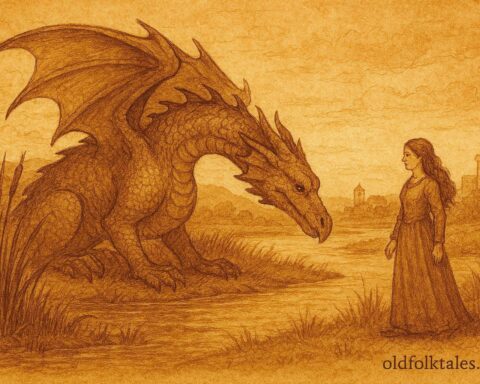
But when the youngest prince released his arrow, it soared high and far, and vanished into a swamp beyond the castle walls. The prince searched among the reeds until he found his arrow stuck in the mud beside a little green frog.
“Croak, croak!” said the frog, blinking up at him. “Take me, prince, for your bride.”
The prince was astonished. “Surely this is a jest,” he murmured, disheartened. But he remembered his father’s command and sighed. “If fate has willed it so, then you shall be my bride.”
When he returned to the palace and told his father what had happened, the court burst into laughter. The king frowned, but the prince’s words were firm. “I gave my word, Father. I cannot break it.”
Thus, the wedding was held. The eldest married a radiant princess, the second a noble lady, and the youngest, blushing with both pride and shame, was wed to a frog.
The King’s Tests
Not long after the weddings, the old king decided to test his daughters-in-law. “Each of you,” he announced, “must weave me a linen robe fine enough to pass through a ring.”
The eldest princess ordered her maidens to spin and weave. The second did the same. The youngest prince went home sorrowful, wondering what his frog wife could do.
When he entered their humble room, the frog greeted him cheerfully. “Why so sad, my dear husband?”
“My father has commanded each of his daughters-in-law to weave a robe fine enough to pass through a ring,” he explained.
“Do not worry,” croaked the frog. “Go to bed, and you shall have your robe by morning.”
The next day, the prince awoke to find a robe so delicate and shining that it seemed woven from moonlight itself. When the king compared the three garments, none could match the frog’s handiwork. “Truly,” he said, “the youngest son has the cleverest wife.”
Still, the king was not satisfied. He devised a second test. “Now, let each of your wives bake me a loaf of bread fit for a king.”
Again, the eldest and second daughters-in-law called upon their servants. But the frog only smiled when her husband told her the news. “Sleep soundly,” she said. “You shall have your bread in the morning.”
At dawn, a golden loaf lay upon the table, soft and fragrant, its crust shining like the sun. When the king tasted it, he declared, “Never in all my life have I eaten such bread!”
The Enchanted Princess
One final test remained. The king ordered his sons to bring their wives to court so he might see them with his own eyes.
The youngest prince blushed. “How can I show my frog wife before all?” he lamented.
“Do not fear,” said the frog softly. “Go before me, and when you hear the sound of a carriage behind you, turn not around. When you reach the palace, stand by the gate and wait.”
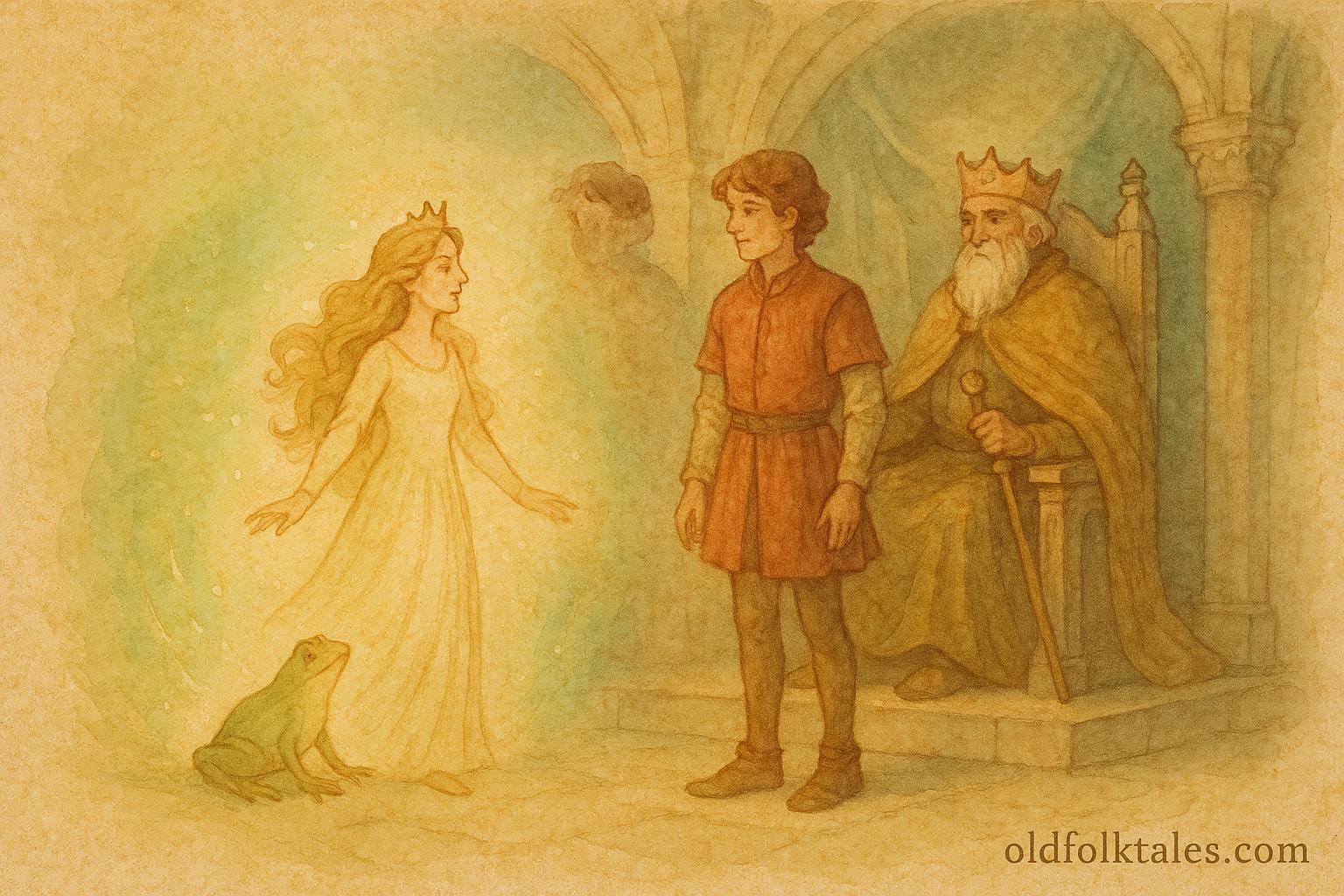
The prince obeyed. As he rode toward the palace, a chariot of gold rolled behind him, drawn by six white horses. Out stepped a maiden more beautiful than sunrise, her eyes bright as stars, her gown gleaming like the dawn.
The youngest prince could hardly believe his eyes, for the maiden was his frog wife, freed from her enchantment. She had been cursed by a wicked sorcerer to live as a frog until a man of pure heart took her as his bride.
When the king saw her, he rose from his throne in wonder. “This is no ordinary woman,” he said. “She is blessed by Heaven.”
And so, the youngest prince was chosen to inherit the throne. He and his beloved princess ruled with kindness and wisdom all their days.
Moral Lesson
The Frog Princess teaches that humility and faith in fate are greater than pride or power. True worth lies not in appearances but in character, and goodness is often hidden beneath the simplest form.
Knowledge Check
-
What did the king ask his sons to do before dividing the kingdom?
He told them to marry and seek wives chosen by fate. -
Where did the youngest prince’s arrow land?
In a swamp, beside a green frog who became his bride. -
How did the frog help her husband during the tests?
She wove fine linen, baked golden bread, and revealed her true form. -
What broke the frog’s curse?
The prince’s acceptance and love freed her from enchantment. -
What lesson does this Polish folktale teach?
That faith, humility, and kindness reveal true beauty and destiny. -
Where does this tale originate?
From Poland, particularly the eastern provinces near Lithuania and White Russia.
Source: Adapted from The Frog Princess in Polish Fairy Tales, collected by Antoni Józef Gliński; trans. Maude Ashurst Biggs (London: J. M. Dent, 1920). Project Gutenberg eBook #36668.
Cultural Origin: Poland (Eastern provinces, oral tradition)