In the heart of ancient Poland, where green meadows touched the sky and rivers shimmered like ribbons of glass, there once lived a humble peasant and his young bride. Their love was pure and steady, the kind that weathered every hardship. Yet fate, like a sudden whirlwind, had plans to test their devotion.
One bright afternoon, as the couple worked side by side in the fields, the sky grew dark without warning. A roaring wind rose from the east, whirling faster and faster until it became a storm that split the heavens. The young man grasped his wife’s hand, but the tempest tore her from his arms and carried her high into the clouds. When the storm calmed, she was gone, lost to the mysterious power of the whirlwind.
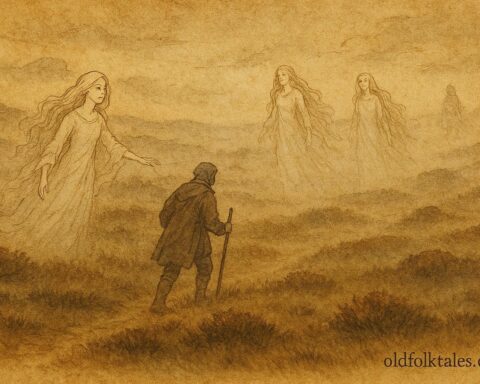
The poor husband was left broken-hearted. Days turned to weeks, weeks to years, yet his love did not fade. With nothing but hope in his chest and his faith in Heaven, he set out on a long journey to find her. He wandered through shadowed forests, crossed mountains veiled in mist, and slept beneath the stars. Wherever he went, he asked the wind if it had seen his beloved, but no answer came except the whisper of leaves.
One night, weary and footsore, he came upon an old hermit who lived in a stone hut on a lonely hillside. The hermit’s beard was white as frost, and his eyes gleamed with a wisdom that seemed to pierce the very soul. The young man bowed low and told his sorrowful tale.
The hermit listened silently, then drew from his robe a small golden ring.
“This ring,” he said softly, “holds power over the very wind that took your bride. Turn it once, and the whirlwind shall come before you. But beware—use it with a pure heart, for only love untainted by pride can command its power.”
The peasant thanked the old man and journeyed onward until he reached a wide plain. There he turned the ring.
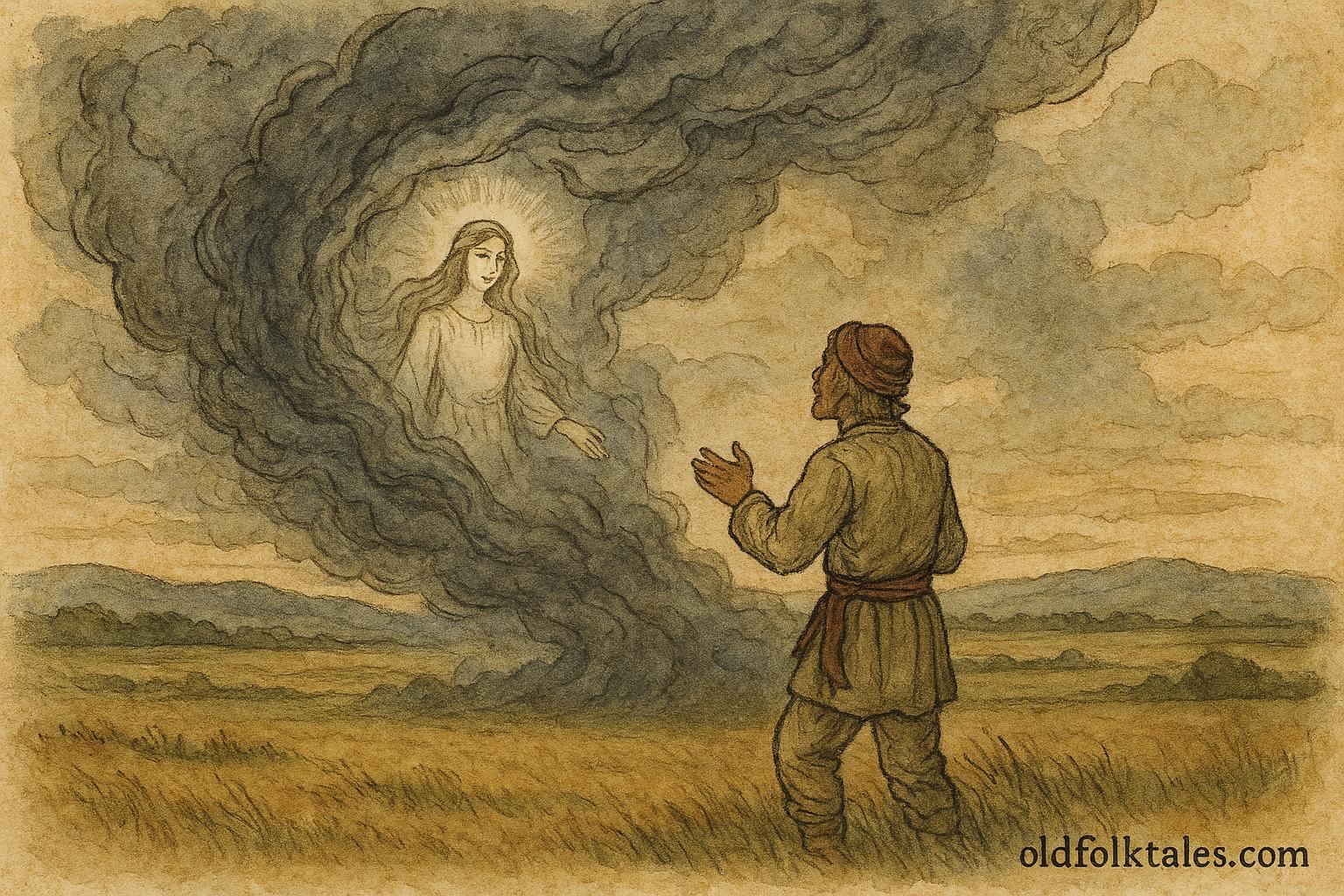
At once, the earth trembled, and the wind rose again, howling, circling, and taking shape before him. Out of the storm came a voice, deep and distant: “What seek you, mortal?”
Summoning all his courage, the man cried, “I seek my wife, whom you carried to the clouds!”
The whirlwind paused, its fury softening to a gentle breeze. From within the swirling air, light shimmered, and before his eyes appeared his beloved, unchanged, radiant, and tearful. The spell was broken. The storm that had once torn them apart now bowed to the power of faithful love.
Hand in hand, the couple returned to their village. They rebuilt their cottage, lived simply, and gave thanks to Heaven each day. Their story spread far and wide, reminding all who heard it that love, true and steadfast, can conquer even the fiercest storm.
Moral Lesson
Love’s power is strongest when guided by patience, humility, and faith. Even the greatest storm cannot separate hearts bound by truth and devotion.
Knowledge Check
1. What does the whirlwind symbolize in this Polish folktale?
It represents fate and the trials that test love’s strength and endurance.
2. How did the peasant regain his wife from the whirlwind?
With the help of a hermit who gave him a magic ring to summon and command the wind.
3. What moral lesson does the story teach?
That love grounded in faith and humility can overcome even the most impossible obstacles.
4. Who assists the hero in his quest?
An old hermit, symbolizing wisdom, spiritual strength, and divine guidance.
5. Why is the story culturally significant to Poland?
It reflects Polish rural beliefs in natural forces as expressions of destiny and divine will.
6. What object serves as the key to breaking the enchantment?
A magic ring that grants the power to summon the whirlwind and undo its spell.
Source: Adapted from the Polish folktale The Whirlwind in Polish Fairy Tales, collected by Antoni Józef Gliński and translated by Maude Ashurst Biggs (Project Gutenberg eBook #36668).
Cultural Origin: Poland (Polish folklore)