High above the winding waters of the Rhine, near the town of St. Goar, rises a towering slate cliff. It glows golden at sunset and echoes with a mysterious sound when the wind blows across its crags. This is the Lorelei Rock, and for centuries, travelers have whispered tales of the maiden whose sorrowful song haunts the river below.
Long ago, before steamboats and bridges, a young woman lived near the Rhine whose beauty was said to outshine even the morning sun. Her golden hair shimmered like riverlight, and her eyes carried the deep, shifting colors of the current itself. Men who saw her were enchanted, some said bewitched, and many lost both reason and rest for love of her. Her name, they say, was Lorelei.
Lorelei’s heart belonged to one man, a knight of proud bearing and handsome face. But knights are not always faithful, and one day her beloved betrayed her for another. When word reached Lorelei, her spirit broke like glass. She wandered the cliffs in despair, calling his name to the waters, her cries mingling with the river’s mournful roar.
Villagers spoke of seeing her at twilight, her white dress rippling like mist, her hair undone. They feared her grief might drive her to madness, and so the bishop of Cologne summoned her to stand before him.
When she entered the great hall, her beauty filled the space with a strange, heavy silence. Even the bishop, old and stern, lowered his gaze. “Child,” he said gently, “you have bewitched too many hearts. Men lose themselves for love of you. For peace to return, you must enter a convent.”
Lorelei bowed her head. “My lord,” she whispered, “I wish only to die. My heart is already lost.”
The bishop pitied her and sent three knights to escort her to a nunnery for safety. As they journeyed along the Rhine, evening fell and the air turned gold with fading light. When they neared the great cliff, Lorelei asked, “Please, let me climb the rock once more. I wish to look upon the river that has mirrored my sorrow.”
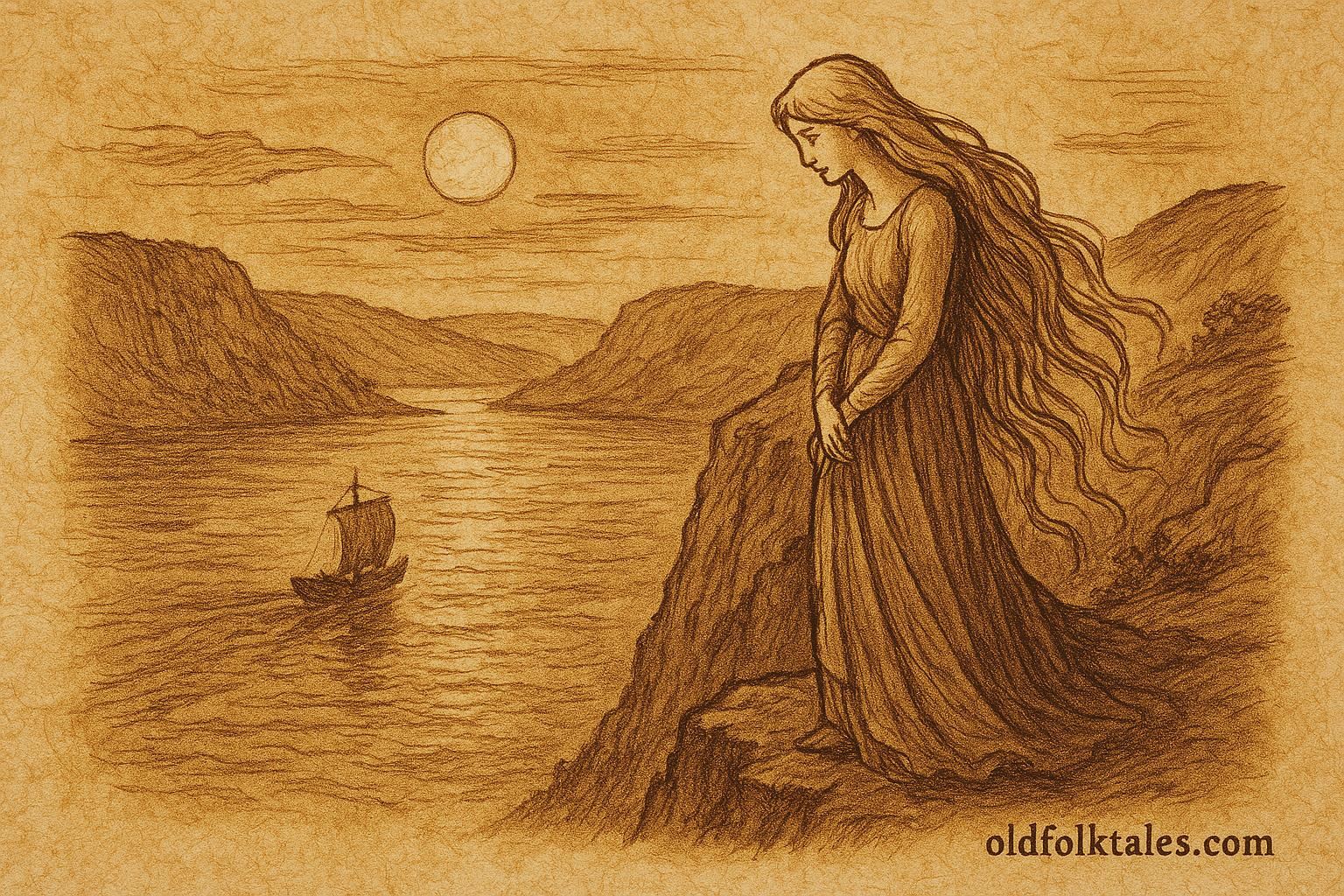
Reluctantly, the knights agreed. Lorelei ascended the steep path, her white gown trailing like foam. From the summit, she gazed down at the flowing Rhine, where the water caught the last light of day. Then, from the shadows below, she saw a ship passing, and on its deck stood her faithless lover.
A cry broke from her lips, not of anger but of heartbreak. “He sails away!” she cried. “He does not even look to shore!”
As she leaned forward, her golden hair streamed behind her like sunlight on water. The knights called out in alarm, but before they could reach her, Lorelei cast herself from the height. Her body fell like a pale bird into the darkening river, and the waves closed over her.
But the gods, or perhaps the river itself—took pity on the forsaken maiden. From that night on, a soft, sorrowful song began to rise from the cliff at dusk. Sailors drifting near would pause, listening to the haunting melody that seemed to float just above the current. Some said they saw a glimmer of gold hair among the rocks, or a figure sitting upon the edge, combing her tresses and gazing toward the horizon.
Entranced by the voice, many boatmen forgot their course. Their ships drifted too close to the rocks, splintering against the current. The Rhine claimed them as its own, and villagers whispered that Lorelei had sung them into her watery embrace.
Even now, when fog gathers on the river and the wind hums through the stones, locals say you can hear her lament, a song of lost love that the river never forgets.
Moral Lesson
The tale of the Lorelei teaches that beauty and love, though powerful, can also bring ruin when bound to betrayal and despair. It reminds us that human emotion, like the river, can be both enchanting and destructive, flowing between tenderness and tragedy.
Knowledge Check
1. Who is the Lorelei in German folklore?
The Lorelei is a maiden whose sorrow transformed her into a river spirit haunting the Rhine.
2. What event led to Lorelei’s transformation?
Her lover’s betrayal drove her to despair, leading her to leap from the cliff into the Rhine.
3. What is the main symbolism of the Lorelei’s song?
Her song represents both irresistible beauty and fatal temptation, echoing themes of love and loss.
4. How does the legend reflect German Romanticism?
It embodies Romanticism’s fascination with nature’s mystery, emotional intensity, and tragic beauty.
5. What lesson does the story teach about love?
It warns that love without faith or restraint can lead to sorrow and destruction.
6. Where is the Lorelei Rock located?
It stands along the Rhine River near St. Goar, Germany, and remains a cultural landmark.
Source: German folktale, Rhine River region.
Adapted from Deutsche Sagen, No. 145, collected by the Brothers Grimm (1816).