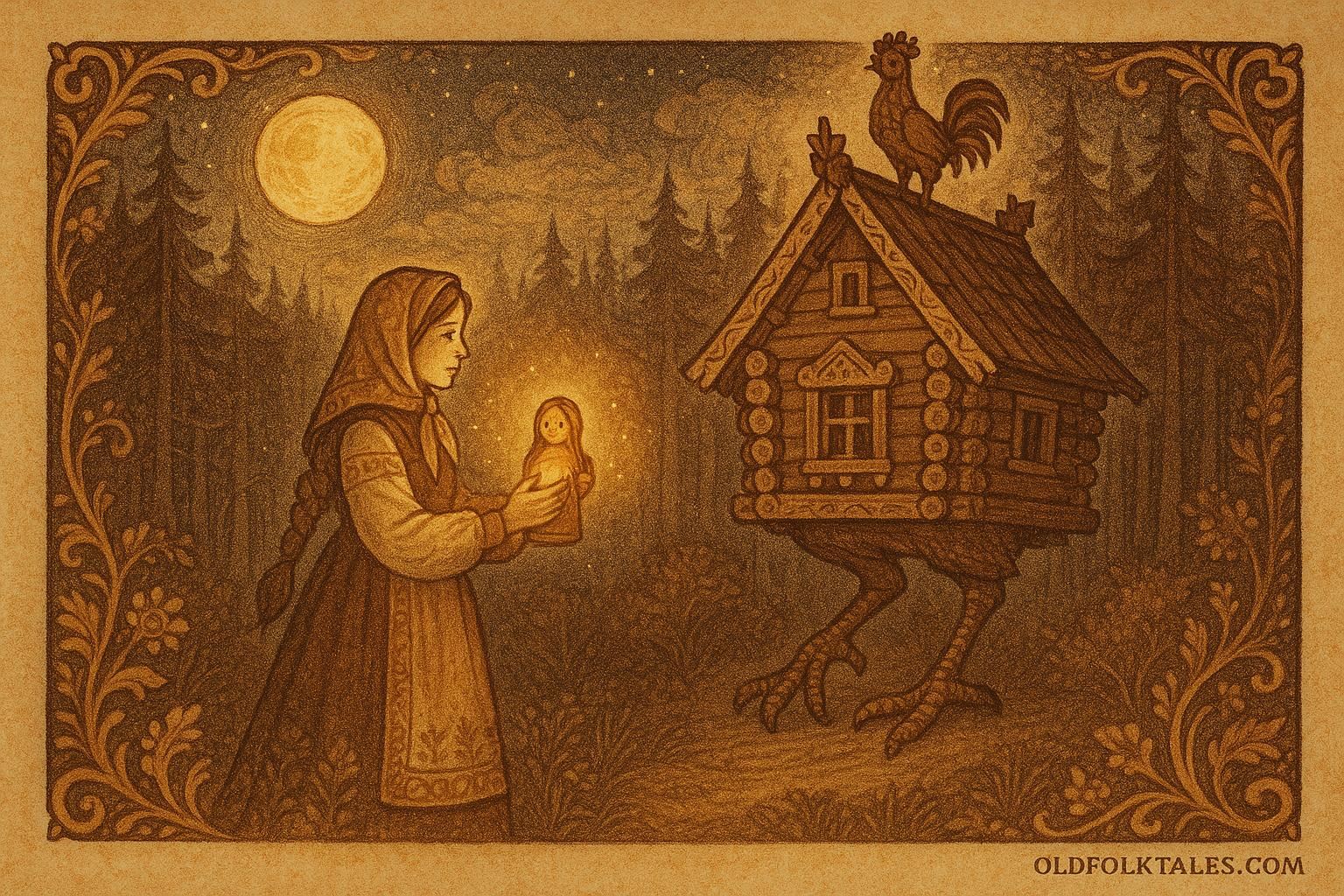
In the heart of old Russia, where forests whispered secrets and rivers gleamed under silver moons, there once lived a prosperous merchant and his beloved daughter, Vasilisa. Her mother, a kind and gentle woman, loved her deeply. But as her days drew to an end, she called the young girl to her bedside and placed in her hands a small wooden doll, carved with tender care.
“My dearest child,” her mother whispered, “keep this doll close and feed it a little bread and milk when you are in need. It will help you whenever sorrow or danger comes.” With those final words, the mother passed away, and grief fell upon the house like winter frost.
In time, Vasilisa’s father remarried. His new wife had two daughters of her own, harsh, jealous girls who despised Vasilisa for her beauty and kindness. They mocked her, made her toil endlessly, and dressed her in rags. The once-joyful home grew dark with cruelty. Yet through it all, Vasilisa found comfort in her doll, her mother’s last gift. Whenever she wept at night, she would whisper her troubles, and by morning, her burdens seemed lighter, her chores mysteriously done.
One autumn evening, as shadows lengthened over the fields, her father set out on a journey. The stepmother, seizing her chance for wickedness, said to her daughters, “Our fire has gone out! Someone must go to the witch Baba Yaga and fetch more light.”
Her cruel eyes turned toward Vasilisa. “You shall go, lazy girl! Perhaps the old witch will teach you to work.”
Though her heart quaked with fear, Vasilisa obeyed. Before leaving, she fed her doll a crumb of bread and whispered, “Dear little one, help me find my way.” The doll nodded and slipped quietly into her pocket.
The night was black as ink, and the forest loomed vast and cold. Twisted roots caught her feet, and unseen creatures cried out in the dark. But her doll guided her faithfully, whispering, “Do not fear. Keep walking straight ahead.”
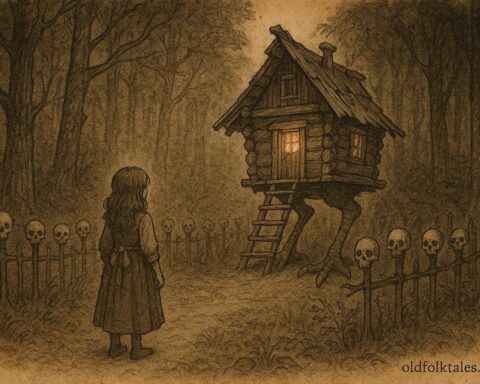
Soon, strange sights appeared among the trees: a horseman dressed in white galloped past, then another in red, and finally one in black, each marking the passing of day, dusk, and night. At last, through the tangled woods, Vasilisa saw a flickering glow. It was Baba Yaga’s hut, standing on chicken legs, turning slowly and creaking as if alive. Its windows shone with fiery light, and a fence of human bones surrounded it, their skulls gleaming with pale flame.
Gathering her courage, Vasilisa cried, “Little house, little house, turn your back to the forest and your face to me!” The hut obeyed, creaking to a halt. Then out came Baba Yaga, tall and bony, her long nose touching her chin. “Ah,” she croaked, “so you are the foolish child who dares to seek my fire! Why have you come?”
“My stepmother sent me,” Vasilisa said softly. “Our fire has gone out, and I came to ask for light.”
Baba Yaga’s eyes gleamed. “Very well. You shall have it, if you can earn it. Stay here and serve me. If you fail, I shall eat you!”
At dawn, she set Vasilisa impossible tasks: sorting a heap of mildewed grain from dirt, cleaning the hut, and preparing a great meal before nightfall. The girl’s hands trembled, for the pile of grain was larger than a hill. But when she took out her doll and whispered her fear, the doll sprang to life and finished every task before sunset.
When Baba Yaga returned, she sniffed the air suspiciously. “Someone has helped you!”
“No one but my mother’s blessing,” said Vasilisa.
The witch frowned. “A blessing? I want no blessed things here!” And she ordered Vasilisa to work again the next day—this time spinning flax so fine it could pass through the eye of a needle. Once more, the doll worked silently until the task was done.
At last, Baba Yaga was forced to keep her word. She lifted a skull from her fence, its eyes burning with inner fire, and set it upon a stick. “Take this skull,” she said. “It will give you the light you seek. Go home and never come here again.”
Vasilisa hurried through the dark forest, clutching the fiery skull. When she reached home, her stepmother and stepsisters scolded her for taking so long. “Where have you been, you useless thing? We have had no fire and nearly frozen!”
But when they saw the burning skull, fear flickered in their eyes. The skull’s gaze blazed brighter, and before Vasilisa could look away, its fire consumed the three wicked women, leaving nothing but ashes.
Vasilisa buried the skull outside the house, prayed for her mother’s soul, and left to seek a new life. In time, her kindness and beauty brought her before the Tsar, who was struck by her grace and goodness. He married her, and they ruled together in peace and wisdom for many years.
And though Vasilisa never forgot her trials, she kept her mother’s doll always near, a reminder that faith, kindness, and courage can turn even darkness into light.
Moral Lesson
“Vasilisa the Beautiful” teaches that true beauty lies in goodness and purity of heart. Faith, obedience, and quiet strength overcome cruelty, while jealousy and wickedness destroy themselves.
Knowledge Check
1. What magical item did Vasilisa’s mother give her?
A small wooden doll that could come to life and help her in times of need.
2. Who was Baba Yaga in this Russian folktale?
A fearsome forest witch who tested Vasilisa’s courage and virtue.
3. How did Vasilisa complete the impossible tasks?
Her magical doll, blessed by her mother’s spirit, secretly helped her accomplish them.
4. What did Baba Yaga give Vasilisa as a reward?
A skull filled with burning coals that provided light.
5. What happened to the wicked stepmother and stepsisters?
The fiery skull’s gaze burned them to ashes.
6. What is the main moral of this Russian folktale?
Kindness, faith, and obedience to goodness always triumph over envy and cruelty.
Source: Adapted from “Vasilisa the Beautiful” in Russian Fairy Tales by W. R. S. Ralston (1873), based on Alexander Afanasyev’s collection.
Cultural Origin: Russia (Northern oral tradition)