In the ancient land of Ukraine, where misty forests shadowed small wooden villages and faith guarded the hearts of the humble, there lived a poor man with three sons. As death drew near, the father called them to his bedside, blessing each with what little he possessed.
To the eldest, he said, “My son, take the horse in the stable, and live by honest labour.”
To the second, he said, “Take the oxen and cart, and till the soil with diligence.”
Then, turning to the youngest, he said softly, “My child, I have nothing left for thee but this whip. Go forth into the world and earn thy bread by faith and courage.”
He blessed them, and his soul passed into the keeping of God.
The youngest son, though poor in possessions, was rich in spirit. With the whip in his hand, he journeyed far along dusty roads and over green meadows, uncertain where destiny would lead. By dusk, he reached a great city whose church bells tolled mournfully through the evening air.
At the city gate sat a man weeping bitterly. The boy approached and asked, “Why weepest thou, goodman?”
The man lifted his head. “I weep because there is no one to watch in the church tonight. Our priest has died, and this is the vigil of St. Michael. Yet no one dares keep watch, for each year on this night the Vampire comes to devour the dead.”
“I will watch,” said the youth boldly.
“Thou art but a child,” replied the man in fear. “The Vampire would drink thy blood before cockcrow.”
“Nevertheless, I will watch,” the youth said again, his eyes steadfast as flame.
That night, he entered the darkened church. He barred the door behind him and lit a single candle before the icons. The faint light flickered across the stone walls and the coffin of the dead priest, draped in black cloth. The youth knelt, praying fervently to God and to St. Michael, whose name was whispered throughout the land as the defender of the faithful.
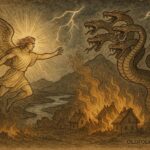
As midnight neared, the candlelight wavered. A wind howled through the keyhole, then rose to a deafening roar. The doors burst open, and in stormed the Vampire, tall, black, and dreadful, his eyes burning like twin coals.
“Ha, ha!” thundered the creature. “Another fool to feed me!”
But the youth did not falter. He raised his whip and made the sign of the Cross. “In the name of St. Michael, begone!” he cried.
At the sound of that name, the Vampire screamed and vanished into the night, leaving behind a trail of flame and ash.
When morning came, the townsfolk entered, expecting to find the boy slain. But he greeted them alive and smiling. They marvelled greatly. “Truly, thou art brave,” they said. “The priest shall be buried now, and thou shalt keep vigil no more.”
Yet the youth replied, “I will watch again.”
That second night, he returned. The air was colder, the shadows darker. When the clock struck twelve, the church trembled. The coffin stood open — the priest’s body gone. From the darkness came the hiss of the returning Vampire.
“Back again, foolish mortal?” roared the monster. “This night thou shalt be torn in pieces!”
But the youth lifted his whip once more. “By the power of St. Michael, begone!”
The Vampire bellowed and fled into the forest, but his hatred grew stronger.
On the third night, the youth prepared more wisely. He drew a holy circle around the coffin with water blessed at the altar and scattered salt upon the floor. Then he knelt to pray, his candle burning steadily beside him.
At midnight, a terrible cry rose from beyond the church. The doors burst open, and the Vampire, wreathed in fire, stormed in. His mouth gushed flame, and his fury shook the earth. But when he tried to cross the circle, he could not.
The youth’s whip blazed with heavenly light as he struck the creature thrice. The Vampire fell to his knees. “Spare me!” he shrieked. “Take gold, take power, only let me live!”
“Thou shalt have mercy only from Heaven,” said the youth, and struck once more.
A thunderclap split the air. The Vampire shrieked and sank into the ground, leaving behind only smoke and silence.
The youth knelt, trembling with awe and gratitude. “O Lord and St. Michael, I thank thee!” he cried.
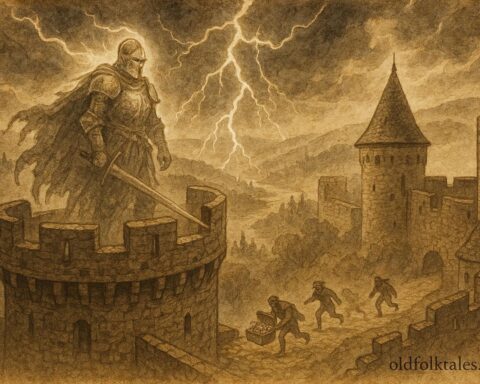
And behold — a radiant figure appeared before him, bright as the morning sun. “Thou hast done well,” said St. Michael, his voice calm and strong. “Take this sword, forged in Heaven’s light. With it, thou shalt conquer all evil that walks the earth.”
Then the saint vanished, and the youth was left holding a shining blade.
In the years that followed, he became a slayer of darkness, travelling across villages, freeing them from vampires and wicked spirits. When his hair turned white and his strength waned, he laid the sword before the altar and entered a monastery, where he lived in prayer until his last day.
And to this day, the people of that city tell how the poor man’s son, armed only with faith, a whip, and the blessing of St. Michael, delivered them from the Vampire’s curse.
Moral Lesson
Faith and courage are stronger than fear and darkness. The story teaches that even the weakest soul can overcome evil when guided by divine strength and steadfast heart.
Knowledge Check
1. Who is the hero of “The Vampire and St. Michael”?
The youngest son of a poor man, who defeats evil through faith and courage.
2. What role does St. Michael play in the story?
St. Michael symbolizes divine protection, rewarding the youth’s faith with strength.
3. What does the Vampire represent?
The Vampire symbolizes evil, temptation, and fear overcome by spiritual purity.
4. How does the youth defeat the Vampire?
He uses his faith, a holy circle, and St. Michael’s blessing to destroy it.
5. What is the moral of this Ukrainian folktale?
That true victory comes from faith, not wealth or power.
6. From which region does this folktale originate?
It originates from the Volhynia region of Ukraine.
Source: Adapted from the Ukrainian folktale “The Vampire and St. Michael” in Cossack Fairy Tales and Folk Tales by Robert Nisbet Bain (1916), London: G. G. Harrap & Co.
Cultural Origin: Ukraine (Volhynia Region Folklore)