Long ago, in a remote mountain village of Croatia, there lived a young man of kind heart and steadfast spirit. His days were spent working in the fields and caring for his widowed mother, who loved him more than her own life. Their humble cottage stood at the edge of a deep, mysterious wood known as Stribor’s Forest, a place whispered about by the elders, for strange voices and lights were often seen there after nightfall.
No villager dared cross into those woods, for it was said that Stribor, the ancient forest spirit, ruled within. Alongside him dwelled the vilas, beautiful yet capricious fairy-spirits who could enchant travelers with songs and laughter, leading them astray forever. But the young man, unaware of his destiny, would one day step into that very forest and face the powers that dwelled beyond the world of mortals.
The Serpent Maiden
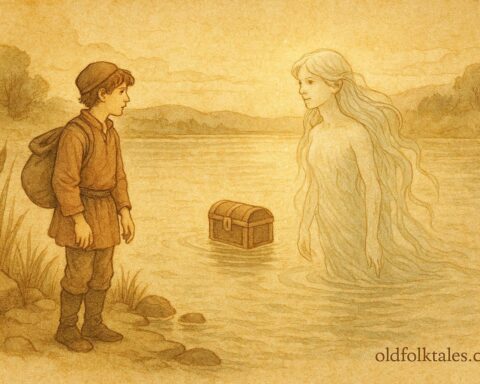
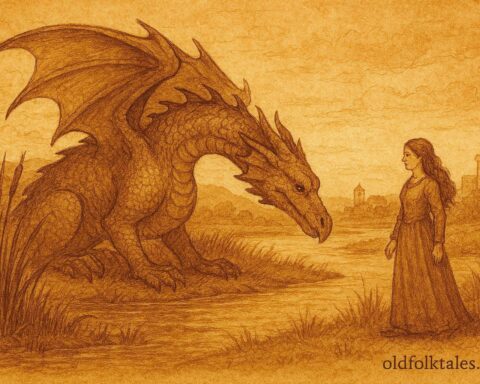
One winter morning, while gathering wood, the young man saw a serpent wriggling near his pile of firewood. It was large, with shining green scales that glimmered like emerald leaves in sunlight. Pity stirred in his heart; though most men would have killed the creature, he lifted it gently with a stick and set it free in the snow.
No sooner had he done so than the serpent vanished, and in its place stood a maiden of breathtaking beauty. Her eyes sparkled like the morning dew, and her hair gleamed like spun gold.
“Good youth,” she said softly, “you have broken my curse. I was once a maiden, but Stribor’s forest spirits turned me into a serpent for mocking their magic. You have freed me, and I wish to be your wife.”
Blinded by her beauty and unaware of her hidden nature, the young man agreed. He brought her home to his mother and told her of the strange miracle. But the old woman, wise with age and faith, felt a chill creep into her heart. Though the maiden smiled sweetly, her eyes glimmered with something sharp and cold, something not human.
“My son,” the mother whispered, “she is no ordinary woman. There is witchcraft about her. Send her away before misfortune finds us.”
But the young man, enchanted by love, rebuked his mother. “You are mistaken, Mother. She is my wife now, and we shall live in peace.”
And thus began the sorrow that would lead him into Stribor’s Forest.
The Forest’s Spell
As days turned to weeks, the maiden revealed her true temper. She mocked the old woman, turned her chores into toil, and filled the home with cruel laughter. The young man, caught between love and duty, could not see her malice. One morning, when the mother wept for her lost peace, the serpent-maiden sneered, “You are old and useless. Why not go and seek your fortune elsewhere?”
The son, at last, was filled with shame and anger. But before he could answer, a cold wind swept through the door, Stribor’s wind. The forest spirits had heard the old woman’s tears.
“Come,” said the serpent-wife. “Let us go into the forest, and I will show you where happiness lies.”
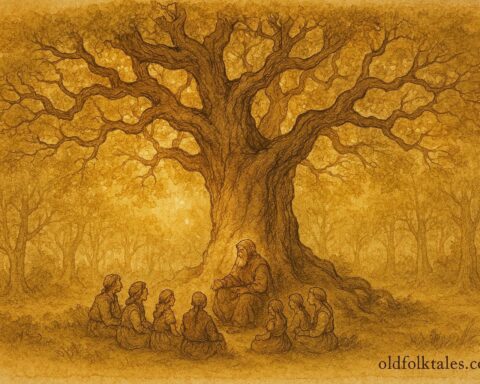
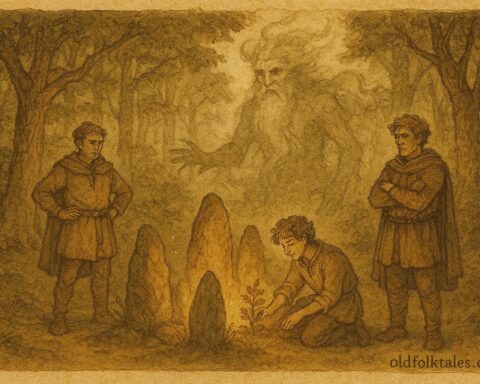
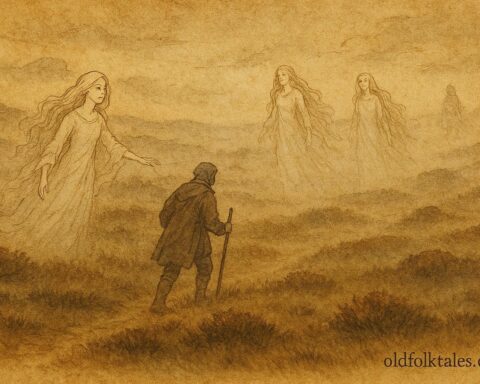
The young man followed her into the shadowed woods. Trees stood like ancient pillars, their branches whispering in voices not of this world. Fireflies danced like sparks in the twilight, and laughter, sweet and haunting, floated between the trees.
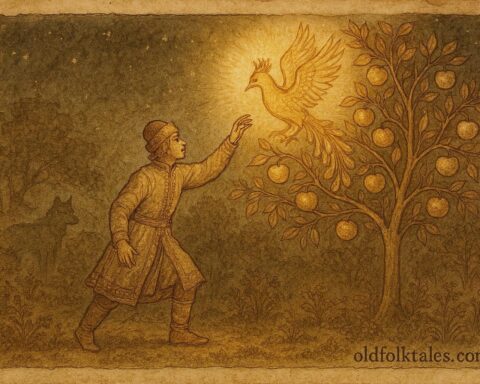
At last, they reached a glade filled with silvery mist. There stood a great oak, gnarled and hollow, glowing faintly from within. Out of its heart stepped Stribor himself, tall, bearded, and robed in forest green. Around him flitted the vilas, their translucent wings gleaming like moonlight.
“Welcome, mortal,” said Stribor. “Why do you enter my forest with one who is not what she seems?”
The mother, who had followed them despite her son’s protests, fell to her knees. “O mighty Stribor,” she cried, “my son is under a spell! His wife was once a serpent, and he sees not the evil she carries.”
Stribor’s deep eyes glowed. “Then let us show him the truth.”
The Test of the Heart
At a wave of Stribor’s hand, the vilas began to sing. The song wove visions through the air, visions of the past, of the serpent shedding her skin, of laughter that mocked the spirits. The young man saw it all and trembled, his heart breaking under the truth.
Stribor spoke again, “You have been wronged, but your heart is pure. I will give you a choice. I can return your mother to her youth, before your birth, so that she may live again in joy. But if I do, you will cease to exist.”
The forest fell silent. The mother looked upon her son and said, “O Stribor, I ask for nothing but his safety. Let me stay as I am. My son is my joy.”
Moved by her selflessness, Stribor smiled. “So be it. The forest will remember your love.”
He turned to the serpent-maiden. “You have deceived the pure-hearted and mocked what is sacred. Return to your true form and leave this world.”
At once, she screamed and dissolved into a serpent, vanishing into the earth.
The mother and son found themselves standing once more at the forest’s edge. The air was calm, and sunlight poured over the snow. The young man embraced his mother, tears streaming down his face. “I was blind,” he said softly. “But love has opened my eyes.”
Moral Lesson
True love and wisdom lie not in beauty or power but in the purity of the heart. Obedience, gratitude, and humility protect us from deception, while pride and blindness lead to ruin.
Knowledge Check
1. Who is Stribor in the Croatian folktale “Stribor’s Forest”?
Stribor is the powerful forest spirit who governs the enchanted woods and tests the hearts of mortals.
2. What curse did the serpent-maiden suffer before meeting the young man?
She was turned into a serpent by forest spirits for mocking their magic.
3. What moral does the mother’s choice represent in the story?
Her refusal of youth symbolizes selfless love and the strength of maternal devotion.
4. How does Stribor reveal the serpent-wife’s true identity?
He commands the vilas to sing a vision that unveils her deceitful nature.
5. What cultural tradition does “Stribor’s Forest” reflect?
It reflects Croatian and Slavic folklore themes of magical forests, spirit justice, and the moral power of love.
6. What lesson does the young man learn by the end?
He learns to value truth and familial love over superficial beauty and illusion.
Source: Adapted from Priče iz davnine (“Croatian Tales of Long Ago”) by Ivana Brlić-Mažuranić (1916).
Cultural Origin: Croatia (Slavic folklore).