In the wide and windswept Ukrainian steppe, where the golden grass dances beneath endless skies, there lived a young man named Ivan. He had neither father nor mother, for both had died when he was but a child. His only companion in the world was a faithful horse, a creature he had found as a foal beside his mother’s grave. The two grew together in loyalty and strength, bound by solitude and the quiet ache of loss.
One lonely evening, as the sun sank red beyond the plains, Ivan sat deep in thought. “If only I had a purpose,” he murmured. Then, to his wonder, the horse spoke in a clear, strong voice. “Master,” said the horse, “mount me, and let us ride to the house of the Sun’s Sister. There your fortune shall be found.”
Ivan’s heart leapt. Though astonished, he trusted his loyal companion. He mounted at once, and together they rode through rolling fields, over hills, and across rivers for three long days and nights. The sky darkened as they reached a vast and shadowed forest, so thick that sunlight never pierced its tangled branches.
In the centre of that forest stood a strange hut on hen’s legs, turning round and round upon its perch. It creaked as it spun, the air heavy with magic. The horse cried out, “Hut, hut! stand still, with thy back to the wood and thy face to us!” The hut shuddered, stopped turning, and settled down.
Inside sat a witch, old and terrible, with iron teeth and eyes that glowed like embers. She ground bones in a mortar, humming a tune that froze the blood.
“Good day, grandmother,” said Ivan politely, bowing low.
“Good day, fair youth,” croaked the witch. “Whither goest thou?”
“To the house of the Sun’s Sister,” Ivan answered bravely.
The witch’s lips twisted into a cruel smile. “Then thou shalt never come back! No man who passes through this forest returns alive.”
But Ivan’s horse whispered, “Ask her for three things, a brush, a comb, and a towel, and thou shalt escape her snares.”
Ivan obeyed. “Grandmother,” said he, “give me a brush, a comb, and a towel, that I may remember thee by.”
The witch laughed, her voice harsh as rusted metal, but she handed him the three items, muttering to herself, “These will serve my turn yet.”
Ivan and his horse left the forest behind and soon reached a place so bright that the very air shimmered with gold. Before them stood a palace that glowed like the sun, its walls radiant with heavenly fire.
“This is the house of the Sun’s Sister,” said the horse.
Ivan dismounted and entered. From the doorway emerged the Sun’s Sister herself, shining with celestial grace, her robes woven from beams of light. Her gaze was gentle yet powerful, as though she carried both dawn and justice within her.
“What seekest thou, mortal?” she asked.
“Thy blessing, fair lady,” said Ivan, bowing low. “I would serve thee if thou wilt have me.”
The Sun’s Sister looked upon him kindly. “Dwell with me, and tend my herds upon the plain. But beware the Witch, my ancient enemy, for she seeks my life and power.”
Ivan promised faithfully to guard her herds, and thus he remained in her service. Every day he led the cattle to graze beneath the open sky, and each evening he brought them home unharmed.
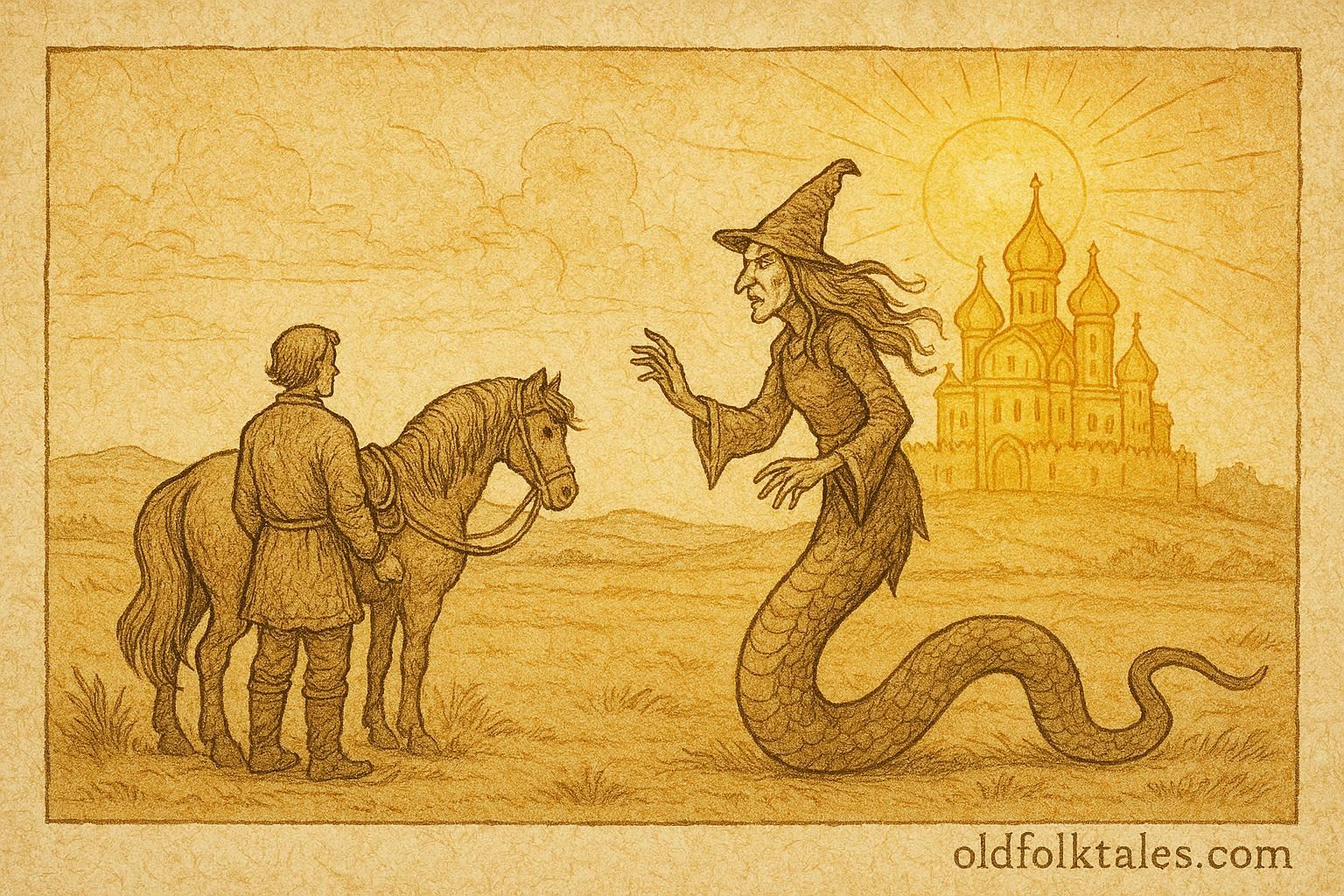
But one day, as he sat upon the plain, the Witch appeared once more, this time riding upon a great serpent that hissed and coiled beneath her.
“Good-day, fair youth!” she called mockingly. “Give me but one of the Sun’s cows, and I shall reward thee richly.”
“I dare not,” Ivan replied firmly.
“Then thou art mine!” shrieked the Witch, striking at him with her long, clawed hand.
Ivan flung down the brush, and suddenly a dense forest sprang up between them, trees so tall and thick that even the wind could not pass. The Witch screamed and clawed at the branches, but they would not yield.
The next day she came again. “Good-day, fair youth,” she said, feigning sweetness. “Give me but one cow, and I shall give thee gold beyond measure.”
“I dare not,” said Ivan again.
The Witch’s eyes blazed. She rushed toward him, but Ivan threw down the comb, and before her rose a mountain of jagged iron rocks. Sparks flew as she struck them, but she could not climb over.
On the third day she came once more, her fury greater than before. She flew upon the storm, her hair streaming like black smoke. “Thou hast escaped me twice, but this time thou art mine!”
Ivan threw down the towel, and behold, between them spread a vast sea, its waves rising high and deep. The Witch screamed and changed her shape into a monstrous bird, beating her wings to cross the waters. But Ivan drew his sword and struck her as she swooped. She fell into the sea with a terrible cry and was drowned.
When the waves stilled, the Sun’s Sister descended from her shining palace and stood before Ivan. “Thou hast saved me from the Witch’s curse,” she said softly. “Ask what thou wilt.”
Ivan bowed deeply. “Grant me only a place to rest near thee, for I have no home.”
Then the Sun’s Sister built him a golden cottage beside her palace, where he lived in peace with his faithful horse.
And even now, when the evening sun glows red in the western sky, the old people say, “Look, the Sun’s Sister smiles on Ivan, the brave youth who conquered the Witch.”
Moral of the Story
True courage lies not in power, but in faith and obedience to wisdom. Those who trust in goodness and face evil with a pure heart shall always find light.
Knowledge Check
-
Who is the main hero of the story?
The tale follows Ivan, a brave orphan guided by his faithful horse. -
What magical items help Ivan escape the Witch?
A brush, a comb, and a towel, each creating barriers of nature and magic. -
What does the Sun’s Sister symbolize?
She represents light, purity, and divine protection against darkness. -
How does Ivan defeat the Witch?
He throws the towel, forming a great sea, and strikes her with his sword. -
What is the moral lesson of the story?
Courage, wisdom, and purity of heart can overcome even the darkest evil. -
What is the origin of the tale?
This story comes from Ukrainian folklore, blending ancient pagan and Christian imagery.
Source: Adapted from the Ukrainian folktale “The Witch and the Sun’s Sister” in Cossack Fairy Tales and Folk Tales by Robert Nisbet Bain (1916), Project Gutenberg eBook #29672.
Cultural Origin: Ukraine (Central Steppe region, mythological folktale blending pagan solar imagery and Christian moral motifs)