Long ago, in a quiet Croatian village surrounded by vineyards and oak forests, there lived a humble blacksmith named Luka. His forge stood at the edge of the village road, where sparks often flew like golden fireflies as he worked through the long evenings. Luka was known for his craftsmanship, yet he lived a lonely life after losing his parents in his youth. All he had to his name were his tools, his wits, and a curious lock that no key could open.
This lock, small and silver, had been left to him by his father. Its surface shimmered with faint engravings, spirals, suns, and stars, and when the moonlight touched it, the carvings seemed to move. On his deathbed, Luka’s father had whispered, “Guard this lock well, my son. It opens nothing in this world, yet it reveals everything you must know.”
Discover the spiritual depth and wisdom hidden in the ancient folklore of Eastern and Balkan Europe
For years, Luka puzzled over the lock’s mystery. He tried to craft keys of every shape and metal, but none would fit. He soaked it in oil, tapped it with his hammer, even prayed over it, but it remained firmly sealed. Villagers said it was cursed or enchanted, the work of the vile, the fairy-spirits who danced in the mountain mists.
One autumn evening, when the wind swept through the chestnut trees like a sigh, a stranger came to Luka’s forge. The man was cloaked in deep blue, his eyes gray as river stones. He asked for shelter and offered payment in a silver coin older than any Luka had ever seen. Luka, ever kind-hearted, accepted and gave the man food and warmth by his fire.
As they sat together, the stranger’s eyes fell upon the silver lock resting on a shelf. “That is no common trinket,” he said softly. “Do you know what you hold?”
Luka hesitated. “Only that it belonged to my father and that it will not open.”
The stranger smiled faintly. “It is called the Čudotvorna Brava, the Wonder-Working Lock. It does not open doors, but destinies. When the right question is spoken to it beneath the new moon, it will reveal what is hidden.”
Luka’s heart pounded. The new moon would rise the next night. The stranger stayed till dawn, then vanished before the morning bell rang, leaving behind no footprints in the dust.
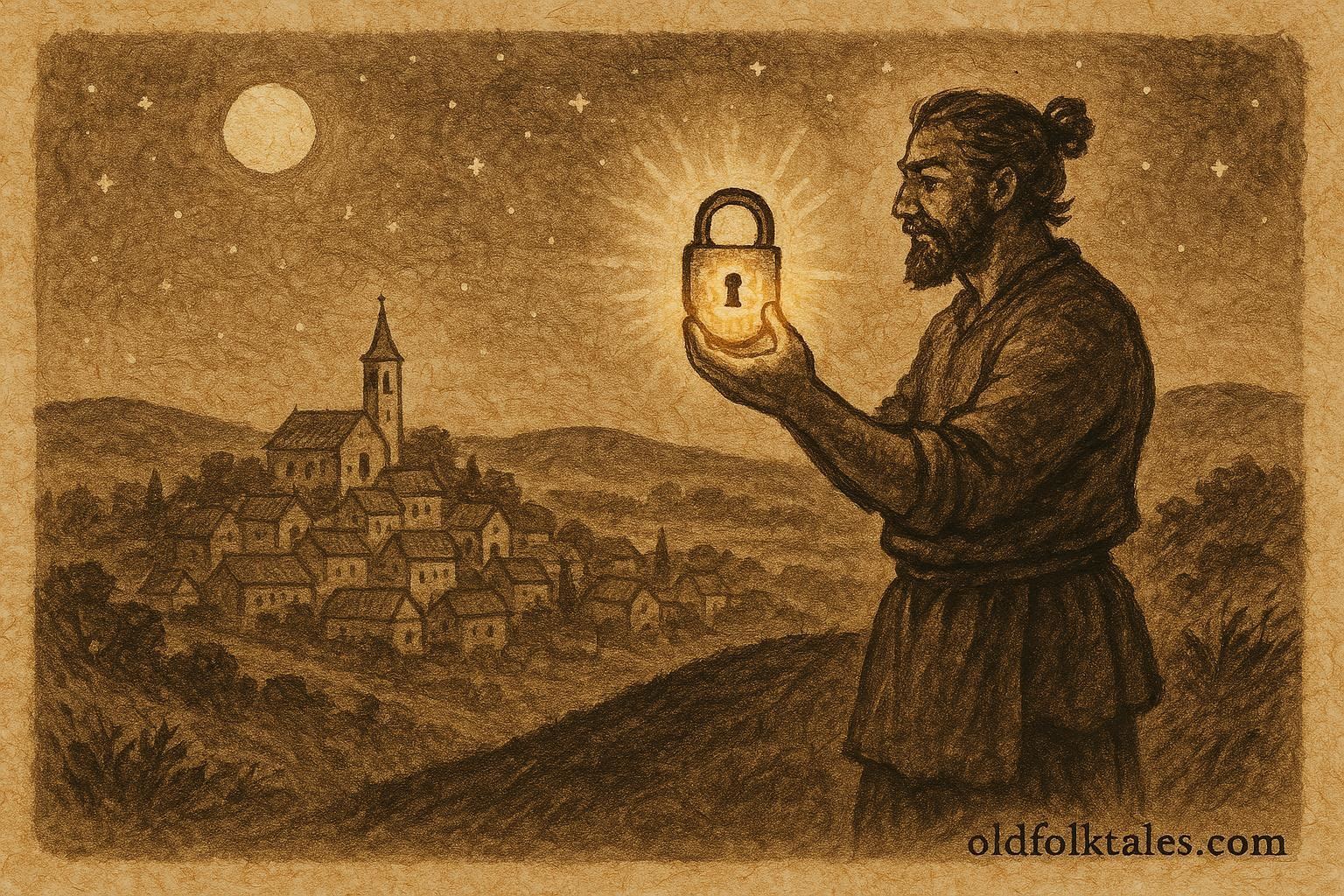
That night, Luka carried the lock to the hill above the village where the old oak stood, the place where villagers once held their midsummer dances. The sky was clear, and the new moon hung like a faint silver thread. Remembering the stranger’s words, Luka held up the lock and asked, “What is it that I must know?”
The lock began to tremble. A faint sound rose from it, not a click, but a song, like the wind through a keyhole. The engravings glowed, and before Luka’s eyes, the lock opened on its own. Inside was not a mechanism, but a tiny folded parchment.
His hands shaking, Luka unfolded it. Written in faded ink was a message:
“Seek the heart of the mountain. There lies the truth of your name and the gift of your hands.”
Luka set out at dawn. The path to the mountain was steep, lined with wild thyme and stone crosses. As he climbed, clouds gathered around the peaks like smoke. After three days, he reached a cave whose entrance glimmered with veins of silver, the very metal he had forged all his life.
Inside, the air shimmered with a strange light. Luka followed the tunnel until he reached a chamber where a spring bubbled from the rock. There, on a stone pedestal, lay an anvil made of silver, and beside it, a hammer that pulsed with warmth. When Luka touched the hammer, a voice filled the cave, the same deep voice he remembered from childhood.
“My son,” it said, “your father was guardian of the Wonder-Working Lock. It hides not treasure, but truth. Your gift is not only to forge metal, but destiny. Take this hammer, with it, you shall shape not iron, but the fortune of men.”
When the voice faded, the light dimmed, and Luka found himself alone. The hammer lay in his hand, solid and real. He returned to the village, where his work soon became renowned, not merely for its beauty, but for its strange power. Those who came to him seeking tools or charms often found their lives changed for the better.
In time, Luka grew old. The lock remained with him until his last days, when it sealed itself once more and vanished from his workshop. Some say the Čudotvorna Brava still travels the world, waiting for another who dares to ask the right question under the new moon.
Moral of the Story
The Wonder-Working Lock teaches that true knowledge cannot be forced, it reveals itself only to those with patience, faith, and the courage to seek beyond appearances.
Knowledge Check (Q&A)
1. What is the main object in “The Wonder-Working Lock”?
The story centers on a magical silver lock that reveals hidden knowledge when asked the right question under the new moon.
2. Who is Luka in the Croatian folktale?
Luka is a humble blacksmith who inherits the mysterious lock from his father and later discovers its divine purpose.
3. What does the lock symbolize in Croatian folklore?
The lock represents destiny and hidden wisdom, the idea that truth is sealed within and revealed only through courage and faith.
4. What happens when Luka opens the lock?
He finds a message guiding him to the heart of the mountain, where he learns his true calling as a forger of destiny.
5. What is the central moral lesson of the tale?
Knowledge and purpose cannot be forced; they come through patience, humility, and trust in the unseen.
6. What cultural region does “The Wonder-Working Lock” belong to?
It is a Croatian folktale, rooted in the country’s oral tradition of magical objects and moral revelations.
Cultural Origin: Croatian folktale, Croatia.
Source: Adapted from regional variants recorded in Croatian folk narrative collections (Leykam International).