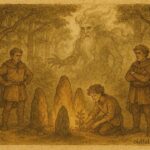
In the shadowed valleys of south-west Luxembourg, near the quiet village of Lasauvage, a story has long been whispered among miners and forest dwellers, the legend of the Wild Woman of Lasauvage. To the villagers, she was a figure both feared and pitied, a spirit caught between the worlds of the living and the damned. Her tale, rooted in the pain of betrayal and the hope of redemption, still echoes through the misty woods that border the French frontier.
The Woman Before the Curse
Long before she became the Wild Woman, she had been known simply as Marie, a woman of striking beauty and courage. Her hair shimmered like chestnut silk, and her eyes carried the calm of deep forest pools. Marie was beloved in her village, admired for her strength and grace, and was known to be the daughter of a miner who worked in the iron-rich hills surrounding Lasauvage.
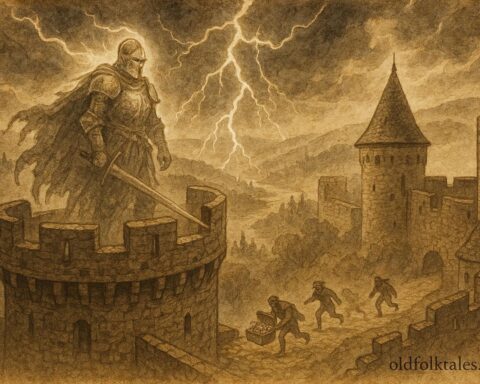
But the peaceful rhythm of the village was shattered by war. Soldiers marched through the valleys, taking what they desired and leaving fear behind. As the invaders approached, the people of Lasauvage fled into the woods, hiding their families, food, and treasure deep in caves. In their desperation, they trusted Marie, asking her to keep their secrets safe.
Yet temptation, that ancient whisperer, found its way to her heart.
The Betrayal
No one knows what drove Marie to do what she did. Some say she fell in love with one of the enemy soldiers, seduced by promises of protection and a better life. Others claim she was tortured until she spoke. Whatever the cause, she revealed the hiding places of her people’s treasures and betrayed the ones who had once called her friend.
The soldiers looted the village, burning homes and desecrating sacred places. The people of Lasauvage were left destitute, their faith in humanity shattered. When the truth of Marie’s betrayal emerged, fury burned brighter than grief.
The villagers condemned her. Some demanded her death; others, her eternal exile. The village elders, bound by ancient custom, declared that her soul would know no peace, not in life, nor in death.
And so, she was cursed.
The Curse of the Forest
Banished to the wilderness, Marie fled into the dark woods that spread over the hills. There, the curse took hold. Her beauty faded; her hair grew long and tangled, her clothes turned to rags, and her once-gentle eyes became wild and haunted. Her voice, once sweet as a songbird’s, broke into cries that echoed through the trees.
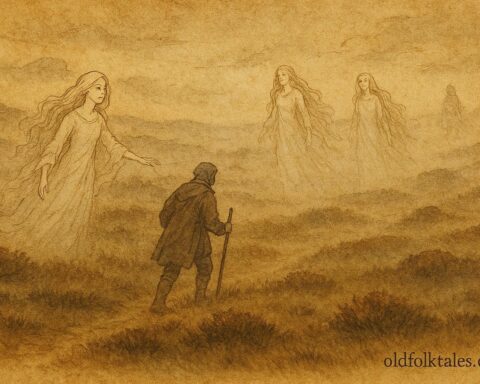
The villagers spoke of seeing her near the mines, wandering by moonlight. Her hair streamed behind her like riverweed, and her bare feet left no trace upon the earth. Some said she was searching for forgiveness, others that she sought revenge on those who had condemned her.
Children were warned never to stray into the forest after dusk, for the Wild Woman was said to lure the disobedient into the shadows. Yet, even as they feared her, the people could not help but feel sorrow.
For beneath her monstrous appearance, they sensed the ache of a heart that had once been human.
The Protector in the Shadows
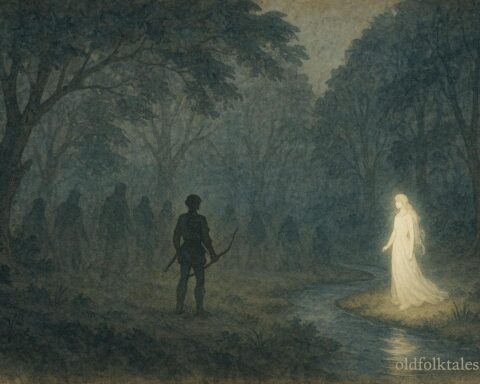
Over time, the Wild Woman’s story began to shift. Miners returning late from the iron pits spoke of a strange woman who had appeared from the mists to warn them of danger, moments before a tunnel collapsed. Travelers lost in the forest told of being guided safely to the village by a pale figure with glowing eyes.
The people began to whisper that perhaps Marie’s spirit, though bound by her curse, was trying to make amends. Perhaps her compassion had survived the darkness that consumed her body.
When storms rolled over Lasauvage, some claimed to hear her cries carried on the wind, not of anger, but of sorrow and longing. Mothers would cross themselves and whisper prayers for her tormented soul.
A Legend of Compassion and Caution
As generations passed, the legend of the Wild Woman of Lasauvage became part of the land itself. Her story was told beside hearths and in the dim tunnels of the mines. The forest where she roamed grew lush and mysterious, its silence deep and sacred.
She became more than a tale of fear; she became a symbol of guilt and grace, a reminder that even the fallen may seek redemption. Her wildness was not merely punishment, but a reflection of the turmoil that comes when one betrays what is good and true.
To this day, locals claim that on misty evenings, when the fog rolls low through the valley, a woman’s figure can be glimpsed among the trees, her long hair shimmering faintly, her eyes glowing with quiet sorrow. Some say she guards the village still, protecting it from harm in penance for her sins.
Moral Lesson
The legend of the Wild Woman of Lasauvage teaches that betrayal leaves deep scars not only on others but on the soul itself. Yet, even in punishment, there can be compassion. Redemption, though often cloaked in pain, may still find those who seek it with a pure heart.
Knowledge Check
- Who is the Wild Woman of Lasauvage?
She is a legendary figure from Luxembourgish folklore, a woman cursed to wander the forests near Lasauvage after betraying her people during wartime. - Where does the legend of the Wild Woman originate?
The story originates from the village of Lasauvage in south-west Luxembourg, near Differdange. - Why was the Wild Woman cursed?
She was cursed for betraying her people’s secrets to invading soldiers, leading to the destruction of her village. - How did the villagers describe the Wild Woman’s appearance?
They described her as half human, half spirit, with tangled hair, tattered clothes, and wild, glowing eyes. - What acts of kindness did the Wild Woman perform?
She was known to warn miners of cave-ins and guide lost travelers, showing compassion despite her curse. - What moral lesson does the tale of the Wild Woman of Lasauvage teach?
It warns of the consequences of betrayal but also reminds us that repentance and kindness can coexist even in the most broken souls.
Source: Luxembourgish folktale, Lasauvage, south-west Luxembourg.
Adapted from Chronicle.lu – “Luxembourg Myths: Wild Woman of Lasauvage.”