High in the misty peaks of the Riesengebirge, the Giant Mountains that divide Silesia from Bohemia, lives a spirit as ancient as the granite ridges themselves. His name is Rübezahl, the mountain lord, whose moods shift as quickly as the mountain weather.
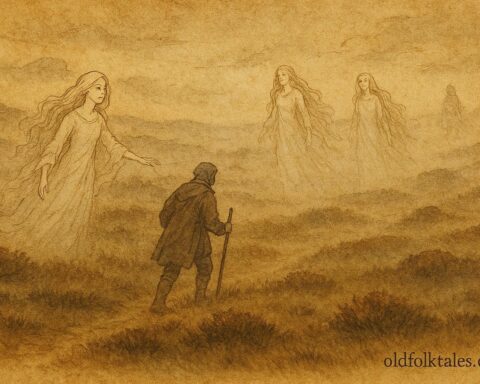
Some say he appears as a ragged wanderer, leaning on a crooked staff, his beard tangled with moss and his eyes flashing like lightning in storm clouds. Others have seen him as a mighty giant, striding across the ridges with thunder at his heels. He can be fierce and wild, or kind and playful, depending on how one treats him.
The Lonely Spirit
For centuries, Rübezahl watched over his mountains, the forests, streams, and high meadows, guarding their peace from greedy men. Yet even a spirit can grow lonely. He would wander among the villages below, sometimes taking human form to walk unseen among mortals, curious about their laughter and their songs.
Explore the wit and wisdom of Western Europe, where humor and virtue often go hand in hand
It was during one such visit that he heard of a Bohemian princess, famed for her beauty but proud and scornful. Rübezahl, longing for companionship, appeared to her one day as a nobleman of strange and distant land. His bearing was majestic, his eyes deep as mountain lakes, and his voice gentle as the wind through pines.
But the princess, quick to mock what she did not understand, laughed at him. “You, a mountain spirit?” she scoffed. “Then go count your clouds, and leave princesses to men of real kingdoms!”
Her words pierced the spirit’s heart. Yet instead of vengeance, Rübezahl decided to teach her the nature of respect.
The Captive Princess
A few nights later, a storm swept through the Bohemian valley. Winds howled like wolves, and lightning split the sky. When morning came, the princess was gone, carried away by Rübezahl to his crystal palace deep within the mountain.
Inside his realm, the air shimmered with magic. Streams of liquid light ran through caverns, and trees of quartz bore silver leaves. Rübezahl treated the princess not as a prisoner, but as a guest. He conjured servants made of mist to wait on her, and a garden where flowers bloomed from the breath of the earth itself.
For a time, the princess lived in wonder. Rübezahl spoke kindly, gave her jewels carved from the mountain’s heart, and told her stories of spirits and stars. Yet her heart remained restless. She longed for her father’s court, for sunlight and freedom, not the shadowed majesty of the underworld.
So she began to plot her escape.
The Trick of the Turnips
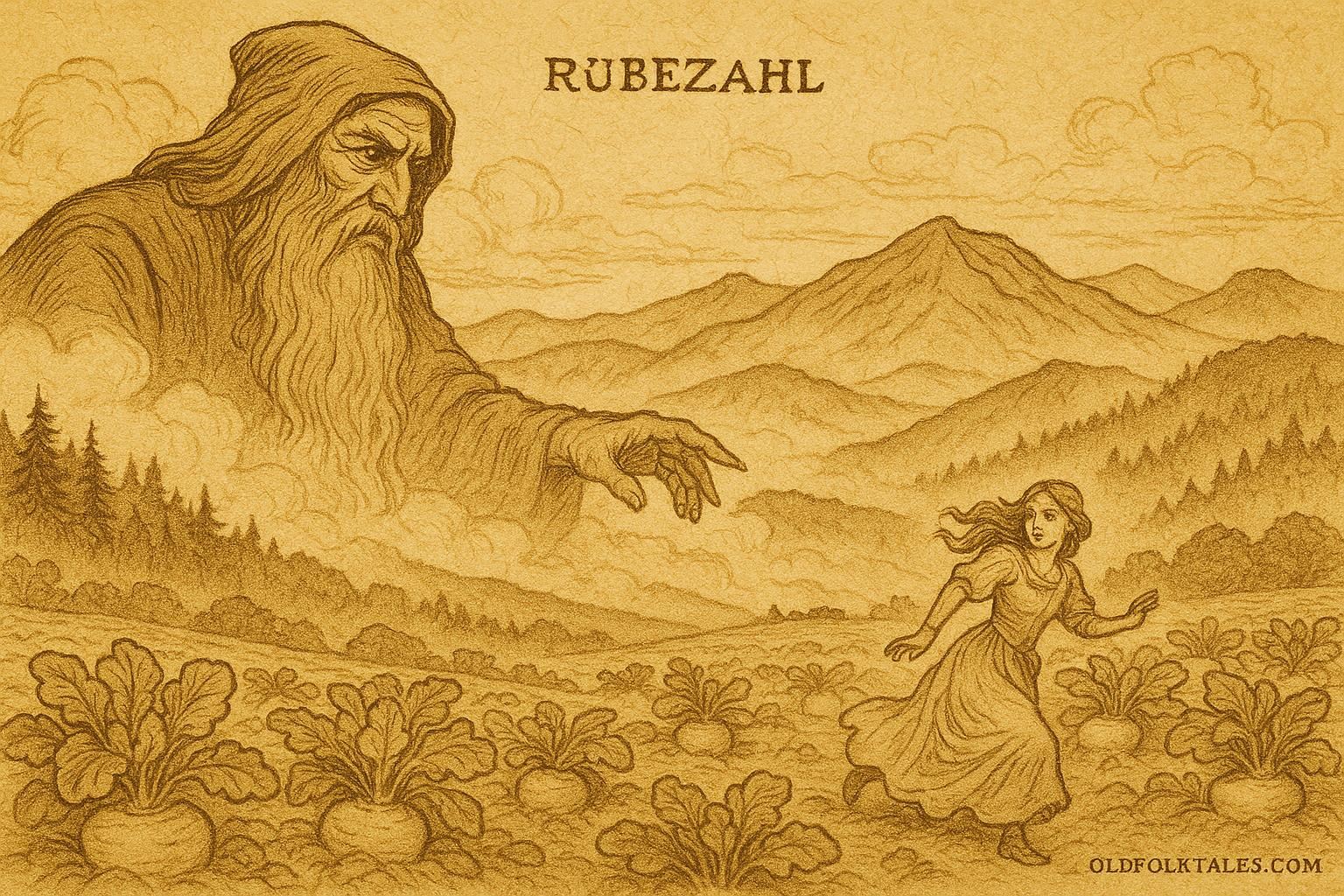
One day, the princess feigned affection. “My lord,” she said sweetly, “I will marry you if you can count all the turnips in my garden. When you finish, I shall be your bride.”
Rübezahl, delighted, agreed at once. He went out into the enchanted fields and began to count every shining root, muttering numbers under his breath. He wanted to please her, to show that even a spirit could be patient and true.
But while he bent to his task, the princess called upon the wind to guide her. She fled down the mountain path, through fog and storm, never once looking back.
When Rübezahl returned, proud of his completed count, he found the garden empty. The echo of her laughter drifted faintly through the caverns. In that moment, his joy turned to rage.
He roared, and thunder rolled through the Riesengebirge. Lightning struck the peaks, splitting rock and tree. The earth trembled beneath his fury. From that day forward, mortals called him Rübezahl, “Turnip Counter”, a mocking name that reminded him of his foolish trust.
The Spirit’s Changing Heart
Yet even anger cannot last forever. Over time, Rübezahl’s wrath softened. He forgave the princess, knowing that even prideful hearts are bound by their own fears. He returned to wandering the mountains, neither wholly kind nor wholly cruel.
To the humble traveler lost in mist, he would appear as a guide, leading them to safety before vanishing like smoke. But to the arrogant, those who mocked the wind, trampled flowers, or boasted against the mountain, he sent storms and confusion until they learned humility.
Peasants of Silesia still say that when a sudden thunderstorm rises from clear skies, it is Rübezahl reminding humankind to respect the earth and the unseen powers that dwell within it.
Moral Lesson
This tale teaches lessons on humility, respect for nature, and the limits of pride. Even the strongest spirits, like Rübezahl, reveal that kindness and wisdom matter more than power, and that those who mock what they do not understand may one day answer to the forces of the world itself.
Knowledge Check
1. Who is Rübezahl in German folklore?
Rübezahl is the mountain spirit of the Riesengebirge, known for his shifting moods and power over storms.
2. Why did Rübezahl capture the Bohemian princess?
He carried her away after she mocked him, hoping to teach her humility and earn companionship.
3. What trick did the princess use to escape?
She told Rübezahl to count all the turnips in her garden and fled while he was distracted.
4. Why is Rübezahl called the “Turnip Counter”?
The name comes from the princess’s trick, he was counting turnips when she escaped.
5. What does Rübezahl symbolize in German culture?
He represents nature’s duality, both its generosity and its fury when disrespected.
6. What moral lesson does this folktale teach?
It teaches humility, the importance of respecting natural forces, and the folly of pride.
Source: German folktale, Riesengebirge (Giant Mountains), Silesia/Bohemia border.
Adapted from Deutsche Sagen, Nos. 91–93, collected by Jacob and Wilhelm Grimm (1816–1818); also in Folk-Lore and Legends: German (1884).