In a quiet Belarusian village, there once lived an old man who had three sons. The two eldest were lazy and foolish, content to lounge in the sun and let the world provide for them, while the youngest was clever, diligent, and eager to learn the ways of honest living.
When their father passed away, he left his sons a small inheritance: a sturdy plough, a strong horse, and a gentle cow. The brothers decided to remain together, but the elder two would contribute nothing. Each morning, as the youngest son rose to tend the fields, fetch water, and care for the animals, the others stayed in bed. They laughed at his efforts and mocked him, saying, “Why do you toil so hard, fool? The earth will feed us without your sweat!”
Wearied by this life of endless labor and ridicule, the youngest son finally said one morning, “I will seek my fortune. I will find a place where a man may earn his bread honestly and not be mocked for it.”
He harnessed the horse to the plough, packed the cow’s milk in a small bucket, and set off across the fields and meadows. Soon he encountered a strange old man, draped in a grey cloak that seemed to shimmer like morning mist. The old man regarded him kindly and asked, “Where are you going, good fellow?”
“To seek my bread,” the young man replied, bowing slightly.
The old man smiled, his eyes twinkling like sunlit frost. “Then I shall help you,” he said, handing the youth a small, tightly wrapped sack. “Inside is a loaf. Whenever hunger touches you, break a piece of this bread, and it will never grow smaller.”
Grateful, the young man accepted the gift and continued his journey. Each evening, as he labored in the fields ploughing, sowing, and tending the crops, he broke a piece of the magical loaf. To his amazement, it was always whole again, a wondrous provision that kept him nourished and strong.
At last, his path led him to a magnificent house, home to a nobleman famed for both wealth and greed. The nobleman observed the youth’s strength and industry and said, “Work for me, and I will pay you well.”
The young man agreed, and for seven years he laboured tirelessly. From dawn to dusk, he ploughed, sowed, harvested, and cared for the livestock, yet when the time came for payment, the nobleman’s eyes gleamed with mischief.
“You have eaten and drunk in my house,” the nobleman said with a sly smile. “What more pay do you need?”
The young man said nothing, understanding the man’s greed, and left that night, taking his magical loaf with him. He walked through forests and valleys until he met the old man once again, standing patiently in his grey cloak.
“Why do you look so sorrowful, my son?” the old man asked.
“I have laboured for seven long years for a greedy master and received nothing for my toil,” the youth replied, his heart heavy.
The old man smiled knowingly and handed him another small sack. “Take this,” he said. “Whenever you say, ‘Sack, strike!’ it will punish your enemy. Say, ‘Sack, stop!’ and it will cease.”
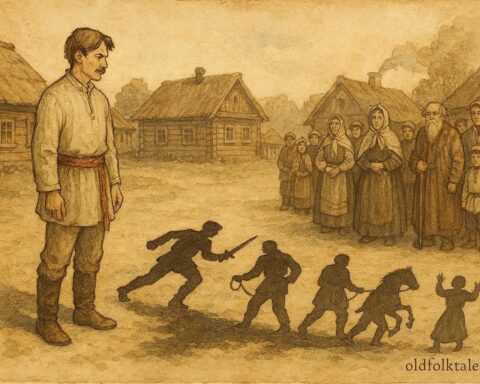
The youth thanked him and returned to the nobleman’s estate. Once more, the master refused fair payment. Frustrated but calm, the young man cried, “Sack, strike!”
The sack leapt from his hands and flew with astonishing speed, beating the nobleman soundly. Sparks of indignation and fear lit the nobleman’s eyes, and he cried aloud for mercy. “Stop, sack!” the youth commanded. Instantly, the sack obeyed. Trembling, the nobleman handed over gold, silver, and a fine horse. The young man accepted his reward and returned home, triumphant.
News of his wealth reached his two elder brothers, who were astonished and envious. They whispered among themselves, “Surely, we too can find this old man and obtain such sacks for ourselves!”
Eager for quick fortune, the two brothers set out, pretending to seek work and honest bread. They soon came upon the old man in his grey cloak. He studied them sharply with piercing eyes.
“Where are you going, lads?” he asked.
“To seek our bread,” they replied eagerly.
“You seek ‘easy bread,’ I see,” the old man said. “Take this sack, but remember: it gives a man what he truly deserves.”
Laughing at his words, the brothers eagerly opened the sack. Instantly, a swarm of wasps flew forth, stinging them on all sides. They cried, rolled on the ground, and begged for mercy. Humiliated and battered, they finally understood the old man’s warning: no wealth comes without effort, and there is no substitute for honest labour.
From that day forward, they learned that only through hard work, patience, and integrity could one earn sustenance and respect. The youngest son, clever and diligent, prospered, while the lazy ones remembered the sting of their folly.
Moral Lesson
This Belarusian folktale teaches that there is no “easy bread” in life. Only through hard work, patience, and honesty can one truly earn prosperity. Greed and laziness invite misfortune and humiliation.
Knowledge Check
-
Who are the main characters in the story?
-
The youngest son, his elder brothers, the old man in the grey cloak, and the greedy nobleman.
-
-
What magical gifts does the old man give the youth?
-
A never-diminishing loaf of bread and a sack that can punish the greedy.
-
-
Why did the youngest son leave the nobleman’s estate?
-
Because the greedy nobleman refused to pay him for seven years of honest work.
-
-
What lesson do the elder brothers learn?
-
That there is no easy bread, and wealth cannot be gained without effort.
-
-
What does the story suggest about honesty and work ethic?
-
Honest labour, patience, and cleverness lead to true prosperity, while greed and laziness lead to suffering.
-
-
What cultural origin does this folktale reflect?
-
Belarusian folklore emphasizing moral values, cleverness, and the perils of greed.
-
Source and Cultural Origin
Source: Adapted from the Belarusian folktale “Easy Bread,” Belarusian Fairy Tales
Cultural Origin: Belarus (Belarusian folklore)