In a quiet valley nestled among the green hills of the Emmental, there once stood a prosperous village surrounded by fields and forest. The people lived simple, honest lives, working hard to till their land and raise their families. But one year, their peace was broken by the arrival of a cruel knight who ruled from a nearby castle.
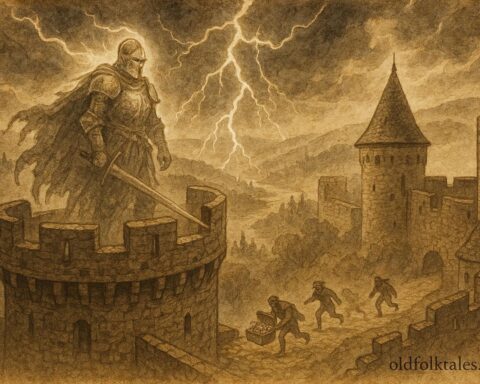
This knight demanded impossible labor from the villagers, that they build his grand estate, erect walls, and plant trees in a single season. The peasants, already burdened by taxes and toil, despaired. No matter how they worked, they could not finish his orders.
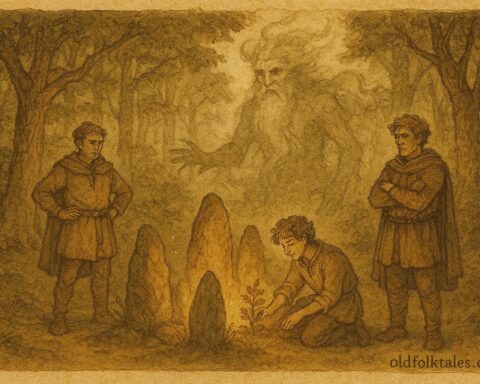
One day, as the men gathered in the forest to discuss their misery, a stranger appeared among the trees. He was tall and dark, dressed as a green huntsman with eyes that gleamed like embers beneath his hood. His voice was smooth, almost kind.
“I can ease your suffering,” he said. “I can make your trees grow in a day and your work finish itself. But in return, I ask one small favor, a gift.”
The villagers, frightened and suspicious, asked what he desired.
“Nothing much,” said the huntsman with a smile. “Only one unbaptized child from your village.”
A horrified silence fell. They crossed themselves and turned away. “Never!” they cried. “We will not give a soul to the Devil!”
The huntsman’s smile widened. “You call me names too soon,” he said, “but my offer remains.” And with that, he vanished into the mist.
The villagers returned to their fields, shaken but resolute, all except one woman. Christine, a young mother weary of endless labor and humiliation, thought of her crying children and the lash of the knight’s overseers. “If the Devil’s help could save us,” she whispered, “surely I can trick him later.”
That night, she went into the forest and called for the huntsman. When he appeared, she made the dreadful bargain, promising him the next unbaptized child born in the village.
The next morning, when the villagers awoke, their fields were transformed. The trees had grown, the walls were built, and every task the knight demanded was completed. The lord himself marveled and granted the peasants rest.
But Christine’s joy was short-lived. Her conscience tormented her, and when a child was soon born in the village, she could not bear to surrender it. She and the priest baptized the infant in secret, breaking her promise.
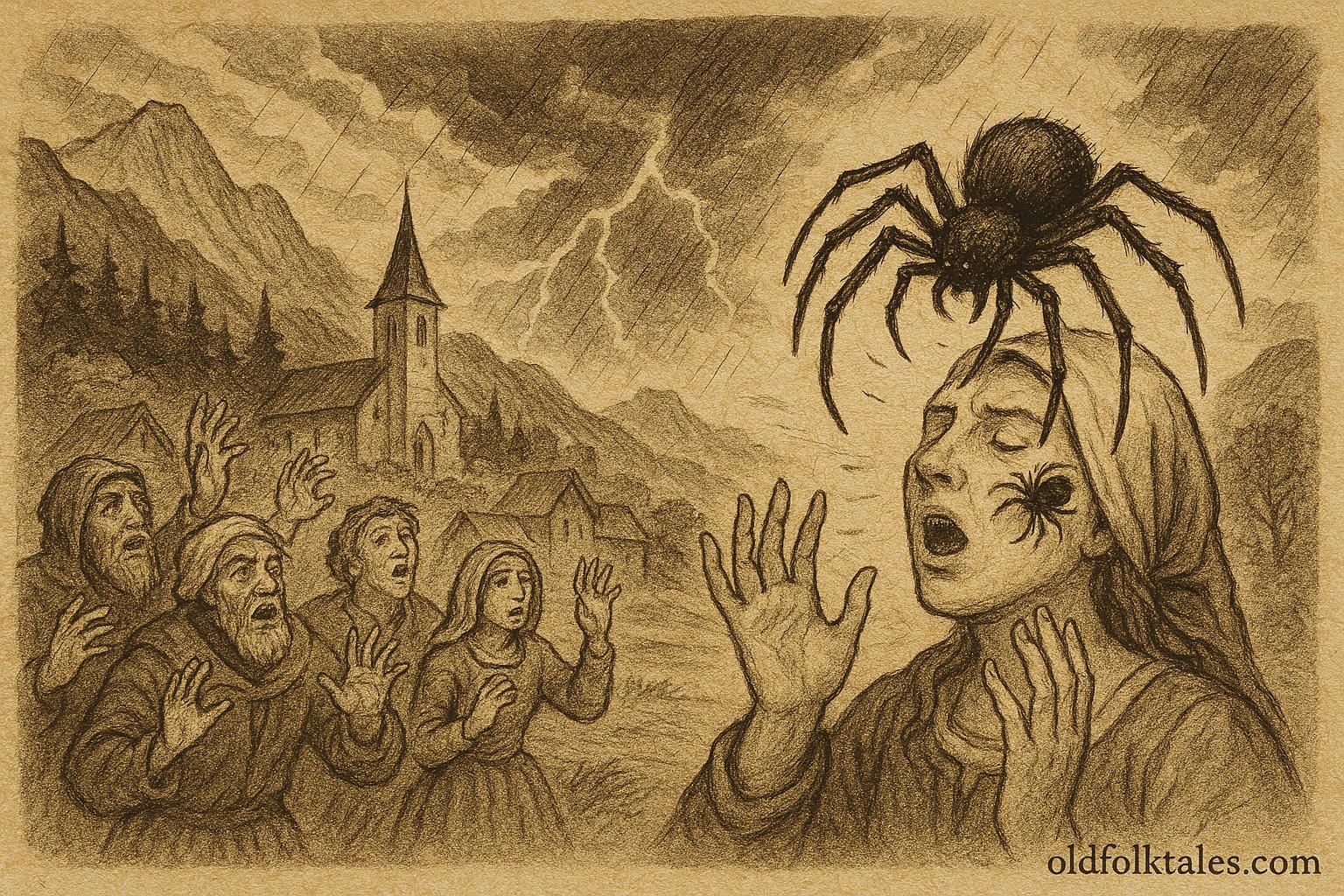
The huntsman returned in fury. “You deceived me!” he roared. He pointed at Christine’s face, and in that instant, a searing pain shot through her cheek. She screamed as a small black mark appeared, swelling and splitting until from it crawled a hideous spider, the first of many.
The creature leapt from her face and began to bite every living thing in its path. Livestock fell dead, crops withered, and infants perished in their cradles. The plague of the black spider spread through the valley like living fire.
Desperate to end the horror, a brave man, the village elder, seized Christine and forced her to confess. With the priest’s help, he trapped the monstrous spider inside a hollow post at the crossroads and sealed it shut with his own life. Peace returned at last.
Years passed, and the story faded into legend. The villagers built a new home upon the ruins, and life continued. But as generations went by, greed and pride crept back into their hearts. They forgot the warnings of their ancestors.
One day, during a feast, a drunken farmer mocked the old tale. “A spider sealed in a post?” he laughed. “Let us see if it’s true!”
Despite the pleas of the elders, he pried open the wood, and from the hollow burst the same black spider, more furious than before. It swarmed through the village, bringing death and ruin once again.
Only through great sacrifice and prayer was the evil finally contained. And so the people learned, through fire and sorrow, that bargains made in sin never fade, they only wait to be awakened.
Moral Lesson
This folktale teaches lessons on the dangers of greed, the weight of moral corruption, and the eternal consequences of bargains with evil. True deliverance never comes from deceit, only through faith, humility, and repentance can peace be restored.
Knowledge Check
1. What is the origin of “The Black Spider”?
The tale originates from the Emmental region of Switzerland, preserved in Jeremias Gotthelf’s Die schwarze Spinne (1842).
2. What moral lesson does “The Black Spider” teach?
It warns against greed, moral decay, and making pacts with evil forces for worldly gain.
3. Who was the huntsman in the story?
The huntsman was the Devil in disguise, tempting villagers with false promises of relief.
4. What does the black spider symbolize in Swiss folklore?
The spider represents sin, corruption, and divine punishment that spreads through disobedience.
5. How was the curse contained?
A brave villager sacrificed himself to seal the spider inside a hollow post, ending the plague.
6. What cultural belief does this story reflect?
It mirrors Swiss Christian moral traditions about faith, redemption, and the cost of betrayal.
Source: Adapted from Legends of Switzerland by H. A. Guerber and Die schwarze Spinne by Jeremias Gotthelf (1842).
Cultural Origin: Emmental Region, Canton of Bern, Switzerland.