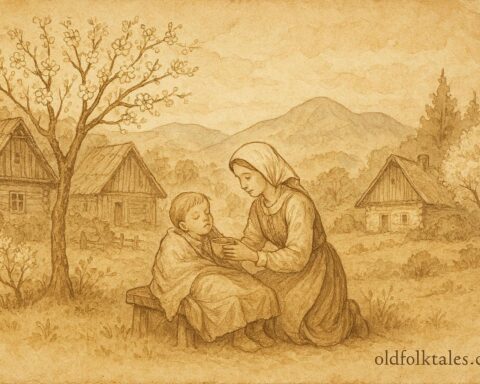
Once, in a quiet Slovak village nestled between rolling hills and thick pine forests, lived a poor shoemaker named Ján. His hands were skilled and his heart kind, but no matter how many soles he mended or boots he stitched, he could barely earn enough to keep his family warm and fed. Winter was cruel that year, the ground frozen hard as iron, the hearth cold, and his wife and children shivering beneath patched blankets.
One night, as he sat by his dim lamp staring at his last scrap of leather, despair overwhelmed him. “If only I had gold enough to buy good tools and better hides,” he murmured. “Then I could make shoes fit for kings.”
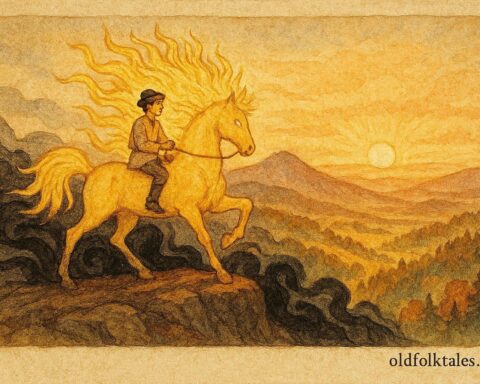
No sooner had he spoken than a cold wind swept through the room. The lamp flickered, and from the shadows stepped a tall, dark figure cloaked in smoke and flame, the Devil himself.
“Good evening, Ján,” the Devil purred, his eyes glinting like embers. “I have heard your wish. You want wealth, success, and comfort for your family, do you not?”
The shoemaker trembled but nodded.
“It can all be yours,” said the Devil smoothly. “For seven years, you shall have riches, fine tools, and fame. Your shop will never want for customers. But on the final night, when the seven years are up, your soul will be mine.”
Ján’s heart pounded. He thought of his hungry children and the empty cupboard. Against his better judgment, he took the Devil’s hand. “Seven years of good fortune,” he whispered. “After that, let it be as God wills.”
At once, a sack of gold appeared on his table. The Devil vanished with a cruel laugh, leaving behind the smell of smoke and a faint scorch mark on the floor.
From that day forward, Ján’s fortune changed. His shop became the finest in the region. Nobles and merchants came from distant towns to buy his shoes. His wife and children were clothed in warm wool, and his shelves were always full. Ján built a larger home and even hired apprentices.
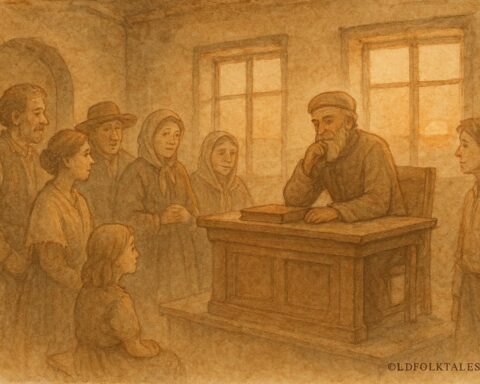
Yet, as his riches grew, so did his pride. The church bell that once comforted him now sounded distant. When the village priest visited, warning him of the dangers of his bargain, Ján only smiled. “Father,” he said, “the Devil is a fool. I have everything I need, and I still have time.”
But time, as always, passed swiftly.
The seventh year approached like a dark cloud. On the eve of the final day, Ján could neither eat nor sleep. The once-pleasant warmth of his hearth now felt suffocating. He looked at his tools, each gleaming with perfection, and suddenly, they seemed to accuse him. He heard whispers in the wind, reminding him of the promise he had made.
At midnight, thunder shook the hills. The Devil appeared again, his shadow stretching across the workshop. “Your time is up, Ján,” he hissed. “Your soul belongs to me.”
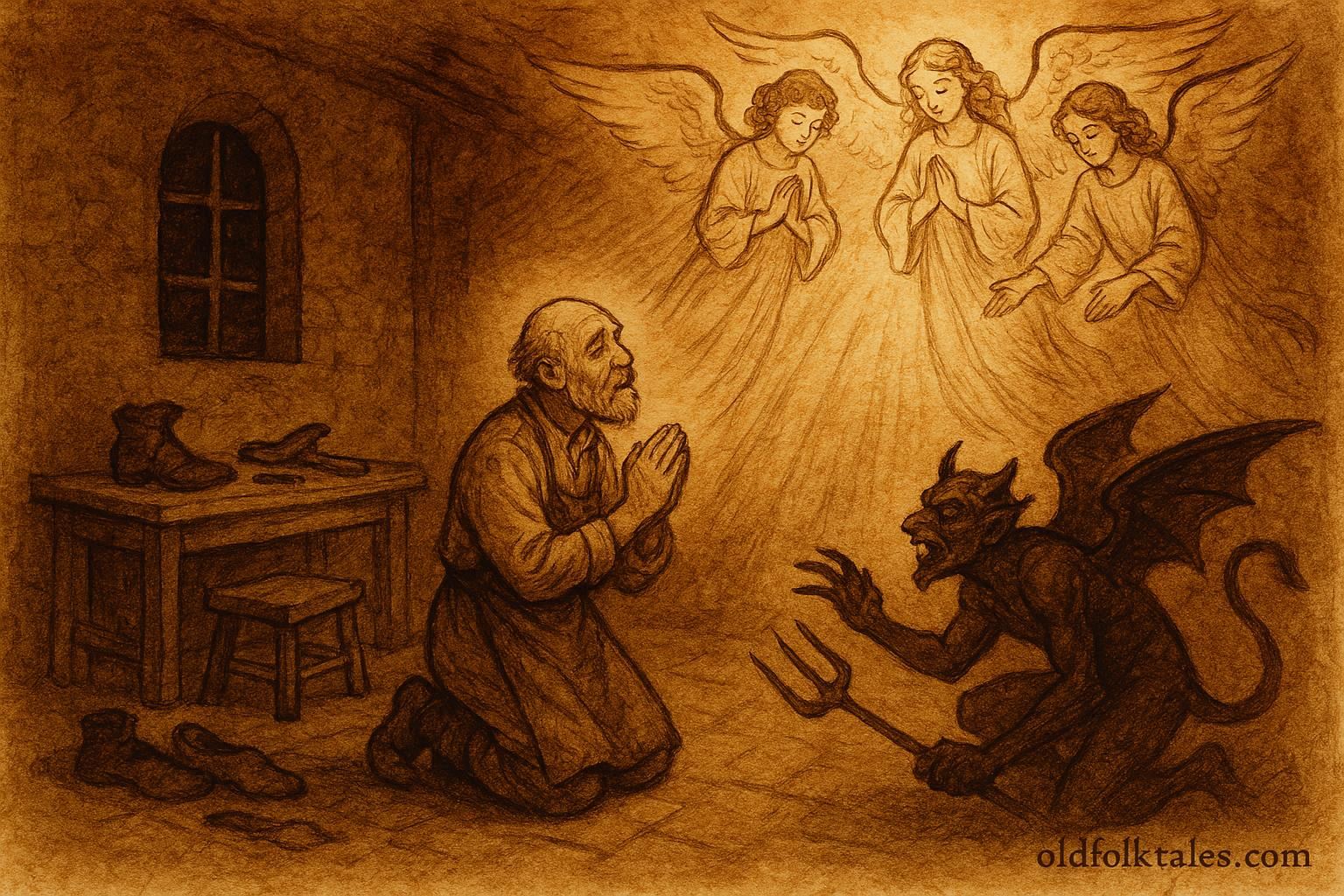
The shoemaker fell to his knees, tears streaming down his face. “Mercy!” he cried. “I have sinned. I was a fool to think wealth could bring peace. Lord, forgive me!”
The Devil’s laughter echoed through the room. “It’s too late for prayers,” he sneered, reaching out his clawed hand. But as his grip closed around Ján, a sudden light burst from the small wooden cross above the door. The glow filled the workshop, and the air rang with the sound of unseen voices singing.
From the brilliance descended two radiant angels. They took Ján by the shoulders and lifted him from the Devil’s grasp. “You have repented with a true heart,” one said gently. “Your labor and sorrow have cleansed your soul.”
The Devil shrieked in fury, his form twisting into smoke before vanishing into the cold night.
When morning came, the villagers found the shoemaker’s house silent. The door stood open, and the fire had long since died. On his workbench lay a small pile of worn shoes, each one perfectly mended, as though left behind as a sign of his repentance and toil. But of the shoemaker himself, there was no trace.
The villagers believed that the angels had taken him to heaven, his soul redeemed through honest work and humble prayer. And from that day forward, no one in the village forgot the story of Ján the Shoemaker, how even a man who struck a bargain with darkness found salvation in repentance.
Moral Lesson
Honest labor and true repentance can overcome even the darkest mistakes. No soul is beyond redemption when the heart turns sincerely toward good.
Knowledge Check
1. Who is the main character in “The Shoemaker and the Devil”?
The story centers on Ján, a humble Slovak shoemaker who bargains with the Devil out of desperation.
2. What moral lesson does the Slovak folktale teach?
It teaches that repentance and honest work can redeem even great sins.
3. How does the shoemaker escape the Devil’s claim?
Through heartfelt prayer and sincere remorse, he is saved by angels at the final moment.
4. What cultural symbolism does the pile of worn shoes represent?
It symbolizes repentance, humility, and the redemption earned through labor and faith.
5. Why is this folktale significant in Slovak culture?
It reflects traditional Slovak values of morality, hard work, and the belief that divine mercy triumphs over evil.
6. What role does the Devil play in this folktale?
He represents temptation and greed, testing the human spirit’s strength against moral corruption.
Source: Slovak folktale, Slovakia. Adapted from Pavol Dobšinský’s Slovenské Povesti (1858–1883).
Cultural Origin: Slovak Folklore, Slovakia.