Long ago, in the heart of the Bohemian countryside, there lived a gentle and kind princess named Dornička. Her beauty was matched only by her compassion; she tended the palace gardens, helped the poor, and greeted everyone with a warm smile. Her kindness did not go unnoticed, for a brave and noble knight, known throughout the land for his valor, soon fell deeply in love with her.
Dornička returned his affection, and the two spent long hours wandering the palace grounds, sharing laughter and stories. Their love was pure, yet it stirred jealousy in the heart of her stepmother and stepsister. Unlike Dornička, they were cold, calculating, and envious of the princess’s grace and the knight’s devotion.
One spring morning, under the guise of a picnic in the forest, the stepmother and stepsister led Dornička far from the palace. The sun filtered weakly through the dense trees, casting long shadows as they tricked her deeper into the woods. Then, in a cruel act born of envy, they murdered Dornička, leaving her lifeless body hidden among the roots and moss.
The stepmother quickly returned to the palace, presenting a false bride in Dornička’s place. The knight, unaware of the treachery, was heartbroken yet confused, believing his beloved had been taken by misfortune. The palace mourned in quiet whispers, and the false bride assumed her role with arrogance and deceit.
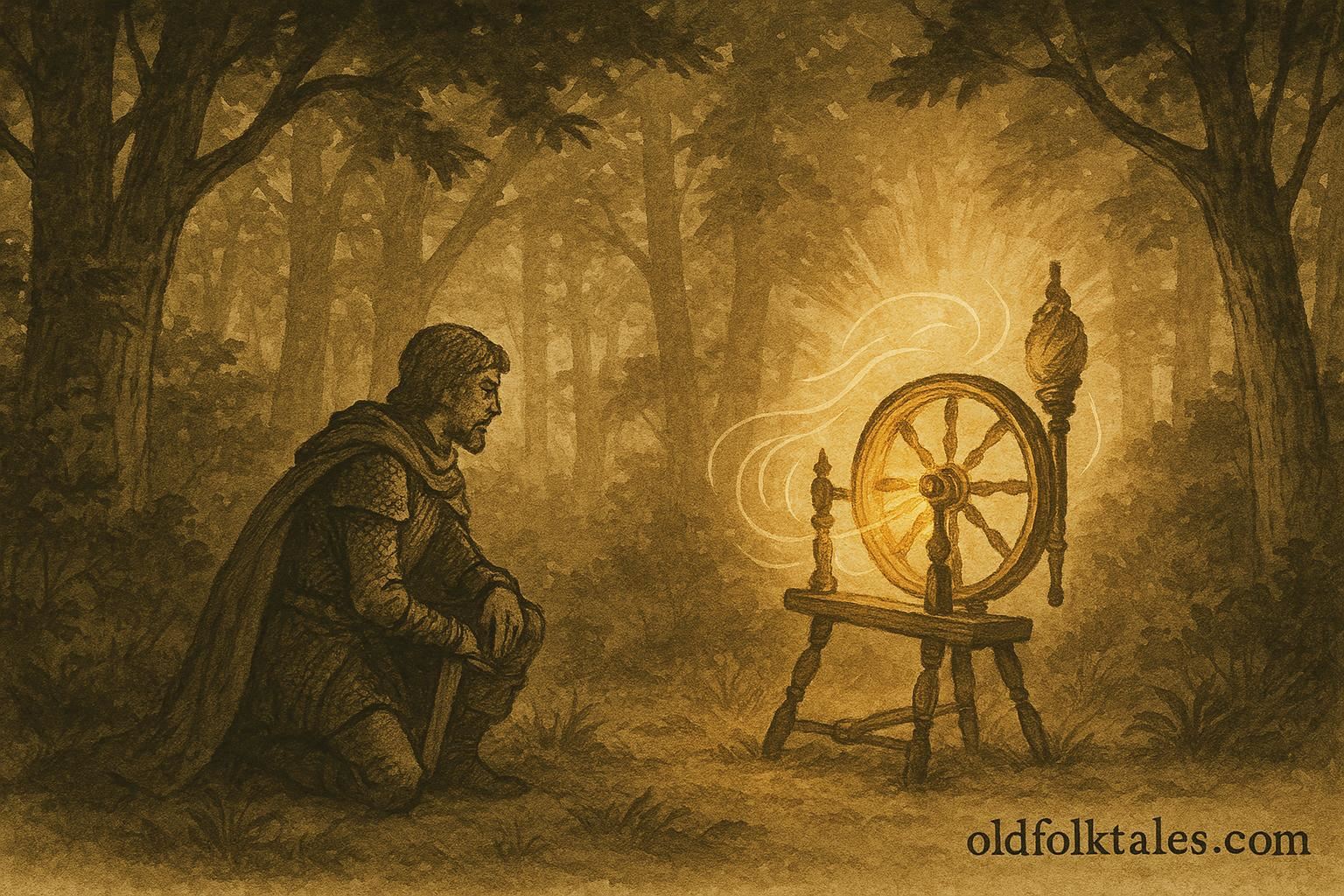
Far from the palace, in the solitude of the forest, a wise and holy hermit stumbled upon Dornička’s remains. His eyes filled with sorrow at the sight of the innocent princess so cruelly taken. He gathered her dismembered body with trembling hands, whispering prayers over each piece. Guided by divine inspiration, he transformed the fragments into a miraculous object: a golden spinning wheel. Its surface gleamed with a light that seemed alive, and when turned, the wheel spun with a melody that told the story of Dornička’s life, her virtues, and the treachery that had ended her.
News of this magical artifact spread quickly, and when the brave knight returned to the forest in grief, he heard the wheel’s song. Its haunting melody recounted every detail of Dornička’s murder, from the cold cruelty of her stepmother to the stepsister’s complicit lies. Anger and sorrow consumed the knight, his love for Dornička transforming into a righteous fury.
Determined to avenge her, he confronted the deceitful women. Their guilt became evident under his piercing gaze, and the kingdom learned the truth. Justice, long denied, was finally at hand. The knight, guided by both sorrow and devotion, carried the golden spinning wheel back to the hermit. With holy water blessed by the hermit, he performed a ritual over the wheel.
The golden wheel’s light shone brighter than the morning sun, and, miraculously, Dornička’s true form emerged from its glow, restored to life. She opened her eyes, her smile radiant and filled with gratitude. The kingdom rejoiced, and the stepmother and stepsister faced the consequences of their crimes.
Dornička and the knight were reunited, their love deepened by tragedy and triumph. Their story became a legend, a reminder that even in the face of death and deceit, truth and justice will ultimately prevail.
Moral Lesson
True love, justice, and virtue endure even beyond death. Evil deeds may deceive for a time, but ultimately, truth and righteousness are restored.
Knowledge Check
1. Who was Dornička and what made her beloved?
Dornička was a kind and compassionate princess whose virtue and grace earned the love of a brave knight.
2. Why did Dornička’s stepmother and stepsister murder her?
They were consumed by jealousy of her beauty, kindness, and the knight’s devotion, seeking to replace her with a false bride.
3. How did the hermit restore Dornička?
He transformed her dismembered body into a golden spinning wheel whose song told the truth, then revived her with holy water.
4. What role does the golden spinning wheel play in the story?
It serves as both a magical record of Dornička’s life and a vehicle for justice, revealing treachery and restoring the truth.
5. What cultural significance does this folktale hold in Czech tradition?
It illustrates the moral values of justice, love, and the triumph of virtue over envy and deceit.
6. What is the primary moral of The Golden Spinning Wheel?
Justice and love will restore truth, even when evil seems to prevail beyond death.
Source: Adapted from Kytice (A Bouquet of Czech Folktales) by Karel Jaromír Erben, 1853.
Cultural Origin: Czech Republic