Once upon a time, in a kingdom of deep fjords and shadowed pines, there lived a king and queen who longed for children. Their prayers were answered, not once, but twelve times, for the queen gave birth to twelve handsome sons. The royal couple rejoiced, and the people celebrated the twelve princes who brought joy and promise to the land.
But the queen, though happy, feared the envy of fate. “If ever I should bear a daughter,” she said one day, “and she brings harm to her brothers, I would rather she were never born.”
Those words, spoken in worry, did not fade into the wind. A witch of the forest, bitter and cunning, heard them and waited. Years passed, and one spring morning, the queen bore a thirteenth child, a daughter, small and fair as moonlight on snow. But before the mother could hold her, the witch appeared in a storm of black feathers and cursed the family.
“As the queen’s words foretold, so shall it be,” hissed the witch. “The twelve sons shall take the form of wild ducks, and only their sister’s sacrifice may set them free.”
In an instant, the twelve princes vanished from the palace, replaced by a cloud of white-feathered ducks that rose crying into the gray sky. The queen fell to her knees in grief, clutching her newborn daughter, whom she named Lise. The king ordered searchers across the land, but no trace of the boys remained, only the mournful cry of wild ducks echoing above the lakes.
As Lise grew, she sensed a shadow in the castle’s silence. She saw her mother’s tears and her father’s distant eyes, yet no one would tell her why. At last, one kind servant whispered the truth, that she had twelve brothers who lived as wild ducks by enchantment.
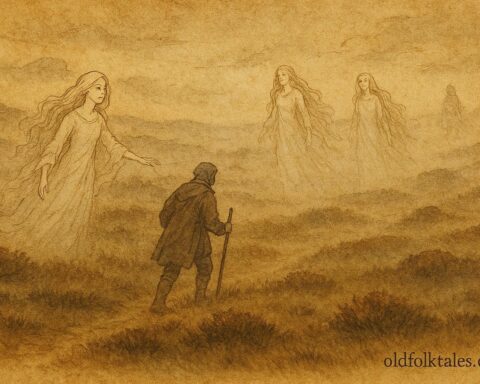
Haunted by the knowledge, Lise vowed to find them. She left the palace at dawn, following the path through forests dark with moss and mist. She crossed cold rivers, climbed steep hills, and slept under pine boughs, guided only by the cry of ducks at sunset.
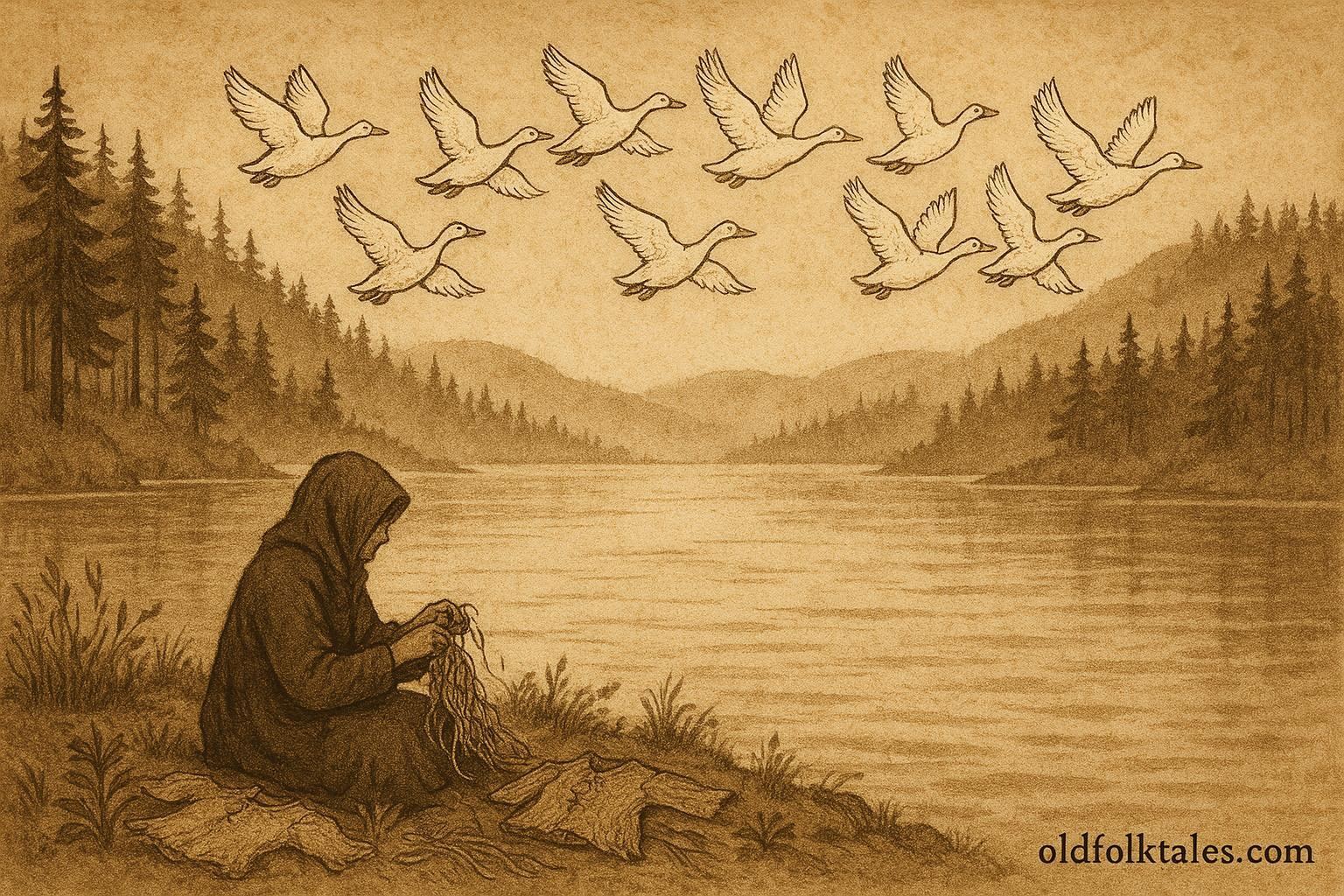
One evening, she reached a quiet lake that shimmered like glass beneath the fading light. There, twelve white ducks flew down and circled her. As they touched the ground, feathers fell away, and twelve handsome young men stood before her.
Her heart trembled with joy. “My brothers!” she cried.
They embraced her, their eyes shining with both happiness and sorrow. The eldest spoke: “Dear sister, you have found us. But our curse is cruel, at night we are men, and at dawn we become wild ducks again. To free us, you must weave twelve shirts from nettles, one for each of us. You must do this in silence, if you speak a single word before the work is done, all will be lost.”
Lise nodded. She could not bear to lose them again. “Then I shall never speak until you are free,” she promised.
She gathered nettles from the forest, their stems burning her skin until her hands bled. Each night, by the light of the moon, she spun the coarse threads and wove tirelessly. The brothers watched her work in gratitude, bringing her food and shelter in secret.
But one day, a young king from a neighboring realm found her in the woods. He saw her beauty and her quiet strength and was moved. Though she said nothing, he felt her kindness in her eyes and brought her to his castle. There, she continued her weaving in silence, even as he made her his queen.
The people whispered that their new queen was mute or bewitched. Yet the king loved her deeply and defended her against all gossip. But as years passed, envy grew in the court. A jealous noblewoman, who resented the silent queen, spread lies that she practiced dark magic, that she spun nettles to summon evil spirits.
The king’s heart was torn, for he could not ask his wife to defend herself without breaking her vow. At last, in sorrow and confusion, he allowed her to be taken to trial. As the crowd gathered, the twelve shirts lay nearly finished, all but one, which lacked a single sleeve.
At that very moment, the air filled with the sound of wings. Twelve wild ducks swooped down from the sky and landed before the crowd. Lise threw the shirts over them, one by one, and as she did, the curse broke. The brothers stood once more as men, all save the youngest, who kept one wing in place of an arm, for his shirt had been incomplete.
Then Lise found her voice and cried, “I have spoken at last, for my work is done!”
The truth was revealed, the witch’s spell broken, and the jealous noblewoman fled in disgrace. The king and his queen rejoiced, and Lise’s brothers were honored and restored.
From that day forward, peace returned to both kingdoms. The twelve brothers ruled wisely, and their sister, who had suffered in silence, became a symbol of steadfast love throughout the land.
Moral Lesson
True love asks for sacrifice, and silent devotion often speaks louder than words. Courage, patience, and faith can overcome even the darkest of curses.
Knowledge Check
- Who are the main characters in “The Twelve Wild Ducks”?
The story features a queen, her twelve sons, their sister Lise, a witch who casts the curse, and a king who later marries Lise. - What causes the brothers to turn into wild ducks?
A witch curses them after hearing the queen’s careless wish that her daughter never harm her sons. - How can the curse be broken?
Lise must weave twelve shirts from nettles and remain completely silent for seven years. - What does the incomplete shirt symbolize?
It represents imperfection in sacrifice, that even the greatest devotion may carry a trace of suffering. - What is the central moral of the tale?
The story teaches that unwavering love and patience can break even the strongest spells. - What cultural themes from Norwegian folklore appear in the story?
The tale reflects Norway’s respect for endurance, purity, and natural symbolism, blending human strength with mystical forces of the wild.
Source: Adapted from Norske Folkeeventyr (Norwegian Folktales) by Peter Christen Asbjørnsen and Jørgen Moe.
Cultural Origin: Norway (Norwegian folklore)