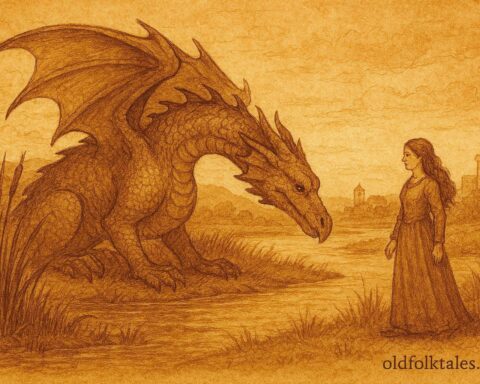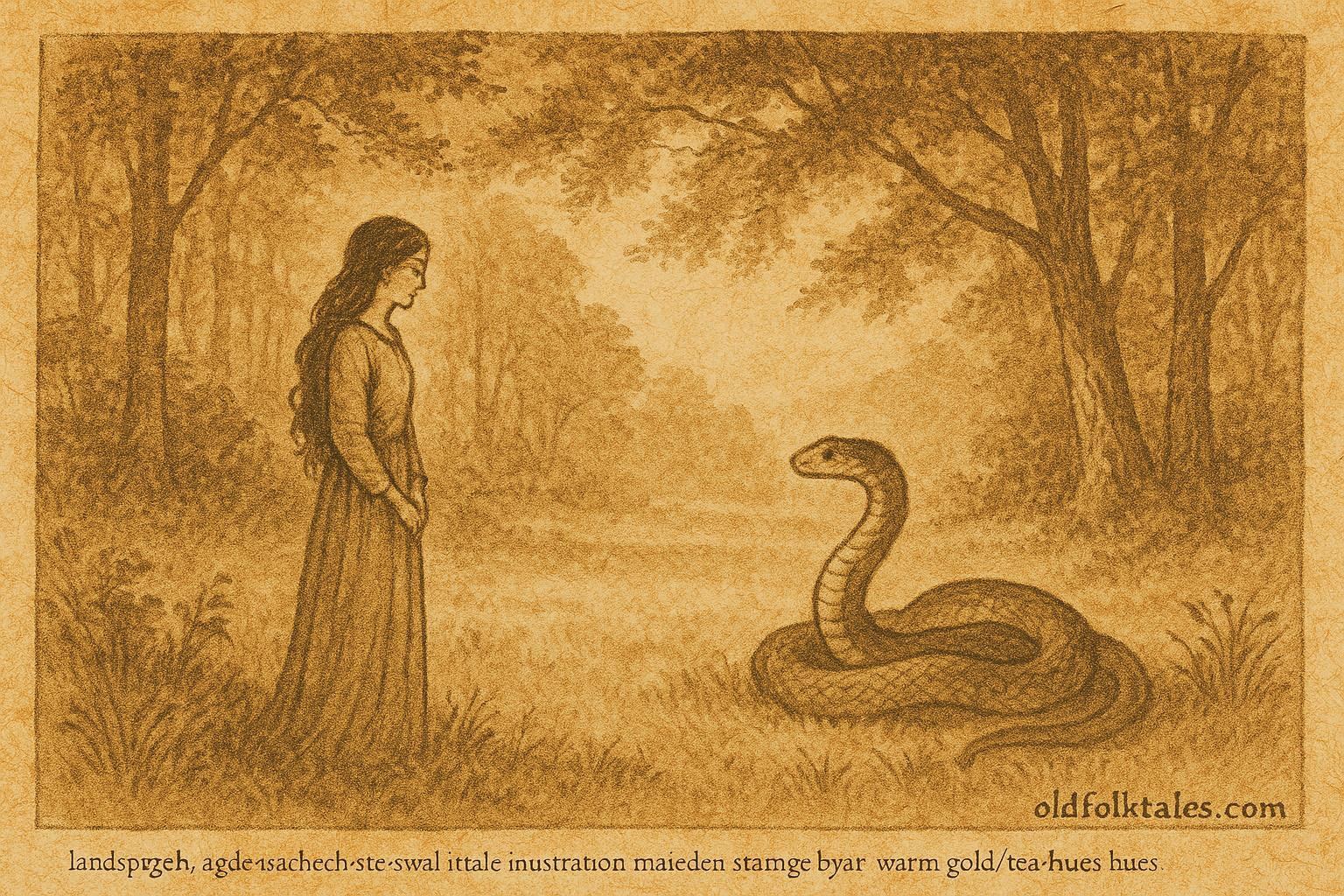
In a quiet village in the Hungarian countryside, there lived a gentle maiden whose name has been lost to time. Each morning she would wander through sun‑lit meadows and along the edge of the forest, gathering wildflowers and herbs for her mother, who was ill. One day, as she bent to pluck a blue‑bell near a moss‑covered copse, she spied a long green serpent stretched out lazily in the dappled shade. Instead of recoiling in fear, she paused, for there was something noble in the creature’s calm gaze.
To her surprise, the snake spoke in a gentle voice: “Fair maiden, I have watched you every day. Will you let me sit by you, and in time we shall be bound in marriage?” The girl’s heart fluttered with fright, yet she saw no malice in his eyes, only quiet sorrow. On her mother’s counsel, who believed in kindness to all creatures, she consented, and the snake became her husband.
The wedding was simple: the meadow glowed with twilight, fireflies danced above, and villagers marveled at the sight of the maiden walking hand-in-hand with her scaly-bodied spouse. In the evenings, when the moon was high, the snake would shed his green skin and reveal himself to her in human form. He was a handsome prince, though sorrow lingered in his smile. Only by day did he appear as the serpent, wrapped in glistening emerald coils.
For a time, they were content. The maiden brought him bouquets of wildflowers. The prince-snake offered her the sweetest honey from his hidden hive in the forest and sang ancient songs of rivers and stones. Under his wing she learned the language of the forest: the whisper of birch leaves, the laughter of brooks, the memory of the wind. Yet despite the tenderness, a caution hovered in the air, the maiden’s mother had urged her never to ask of his secret, never to demand that he shed his serpent skin by day.
One day, while the maiden gathered water from the stream in a wooden bucket, a curious neighbour approached. The neighbour, eager for gossip, hinted grimly: “Dear friend, do you truly sleep beside a serpent? Though he seems a fine husband, will he remain so? Why don’t you see him as man all day long?” Doubt, like a creeping vine, wound around the maiden’s mind. That night, when her husband lay asleep, she tip-toed to the dressing-table. Her hand trembled as she reached for the match, lit the candle, and watched the serpent-body shift and slide, and saw the shape of a man emerge beneath.
With a pounding heart, she tore away the shed skin and set it ablaze. The green scales burned with a hiss and a flare, casting shadows across the chamber. Her husband awoke, horror in his eyes: “You have destroyed my skin! I cannot remain with you until you search for me where mountains touch the sky, and rivers meet the sea.” The next moment he vanished.
Alone, the maiden wept, her tears falling like raindrops on the forest floor. She remembered his songs, his kindness, the way the moonlight shone on his dark hair. As dawn broke she resolved: she would find him again.
She travelled through forest and meadow, mountain and valley. She came to a crooked hut on the edge of the world, where the old wise woman of the woods spoke: “If you would regain your husband, you must walk barefoot over white boned soil, cross the roaring river without bridge, and climb to the summit where the eagle nests. There you will find his dwelling.” The maiden, though weary and sore, did all that was asked. She braved frost-tipped stones, deep waters, and steep slopes. At last, on the jagged peak where the wind roared, she found her husband sitting by the open window of a shining tower carved from black rock.
He was no longer serpent: in human form he looked strong and fierce, yet his eyes held the same sorrow. He ignored her pleas. She spoke humbly: “My dear husband, I have walked the boned soil, forded the river, climbed the mountain for you. I have come to ask your forgiveness, to return to your side.” He remained silent. Then the wise woman’s words echoed: “Offer him your love, your patience, and do the tasks set for you in his kingdom.”
He said: “I will give you three nights with me, but you must bring me the ring I once gave you, the token of our bond.” The maiden searched her sack and found the ring. Yet on the first night, the prince turned away and slept. On the second night, the same. She wept in secret, her love battered by despair. On the third night, the wise woman’s counsel came to her mind: “Bring him the white flower you found at the river’s edge and speak softly of your journey.” She laid the flower on his pillow, whispered of her tears, her longing, her regret. He turned at last, placed his hand in hers, and the spell broke.
Lightning flashed, thunder rumbled, and the serpent skin, charred though it was, dissolved to ash. In its place the prince stood fully human, regal and free. He greeted his wife: “Dear maiden, you have fulfilled the trials, you have suffered and loved. Let us return to the village and live in peace.” They walked down the mountain side, two figures bathed in the red-gold sunset, the forest watching their passage with gentle wonder.
Back at the village the people gasped: the once serpent-husband was now a shining prince, generous and just. Together they built a life: gardens full of honeybees, meadows bright with flowers, evenings of music by the fire. The maiden, who once feared and hesitated, now stood strong and beloved.
Moral Lesson:
True love often demands patience, humility and courageous faith. When we trust and endure even when afraid, transformation and reconnection are possible.
Knowledge Check
-
Q: Who is the husband in “The Serpent Prince of Hungary”?
A: The husband is a prince who appears in serpent form by day and human form by night. -
Q: What prompts the maiden to burn the serpent skin?
A: Doubt planted by a neighbour causes her to light a candle, see his man-form, and burn the skin in fear and impatience. -
Q: What trials must the maiden undergo to regain her husband?
A: She must walk over white boned soil barefoot, cross a river without a bridge, and climb a mountain to reach his tower. -
Q: What symbolic item does the husband ask the maiden to bring during the three nights?
A: He asks for the ring he once gave her (a symbol of their bond) and she also brings a white flower to show her love. -
Q: What is the cultural origin of the tale “The Serpent Prince”?
A: It is a Hungarian folktale collected by folklorist Linda Dégh. -
Q: What is the primary lesson or moral of the story?
A: The story teaches that love requires trust, patience and the willingness to undergo hardship to restore what was lost.
Cultural Origin: Hungarian folktale, Hungary.
Source: Adapted from the Hungarian tale “Kígyókirályfi (The Serpent Prince)”, collected by Linda Dégh.