In a distant land, deep in the heart of a great forest, stood an ancient castle with four lofty towers. In that castle lived a prince named Elkàbo and his beloved little daughter, Uletka. The castle rose in a glade so serene and golden with sunlight that it seemed touched by magic. Uletka was not an ordinary child, she was dainty, sweet, and graceful; and as she had fairy blood in her veins, tiny wings had grown on her back. In the sun they shimmered with all the colors of the rainbow.
From the outside, Uletka might have seemed nearly perfect. But she carried a dangerous fault, an unquenchable curiosity. This flaw had been given to her by a spiteful fairy named Mutà. Mutà held a bitter grudge against Uletka’s mother, Nastia. Once, while walking at the edge of a great forest lake, Nastia had heard a cry for help. Mutà, hiding beneath the water among the lilies and lotus, pretended she was drowning. Moved by compassion, Nastia stepped onto the water-lily leaves to help, and Mutà seized her hands, dragging her beneath the water, until she drowned.
When Prince Elkàbo found his beloved wife’s body floating among the lotus blossoms, it slowly transformed into a pure white water-lily. Even the birds stopped their songs in pity. A kingfisher perched nearby told him it was Mutà’s cruel doing. Heartbroken and furious, Elkàbo rode swiftly to the palace of the Fairy-Queen, which stood beyond distant mountains in a palace of gleaming crystal. There he told his sorrow, and Mutà’s deed enraged the fairy court. The Queen ordered Mutà to be transformed into a white lizard.
Yet the Queen granted Prince Elkàbo mercy: if he could catch the lizard and keep it captive until his daughter Uletka, then an infant, should release it herself, then Mutà would remain powerless. Otherwise, the fairy’s full strength would return.
Elkàbo searched far and wide for the lizard. At last, in a land far away, under a cluster of orchids, he found it hiding, captured it, and locked it in a delicate cage of silver wire. Every day he himself fed it, and kept it hidden. But knowing his daughter’s curious nature, he feared she might one day peek into the cage. To guard against that, he built a little tower by the lake and hung the cage within. Only he held the key, on a gold chain around his neck, and the tower’s secret remained known only to him.
Years passed. Uletka grew, and began wandering by the tower. She would turn the door-handle, hopeful, but it always stayed locked. She dared not ask her father, because once she had, and never seen him so angry.
One day, Elkàbo set off on a journey lasting several days. Trusting his daughter more, he handed her the gold key, with strict instructions: go to the tower each morning with a small bowl of bread, feed the lizard, and do nothing else. Uletka promised.
But no sooner had her father left than her curiosity surged. She crept to the tower, trembling, opened the lock, and inside the silver cage was the most beautiful lizard she had ever seen. It moved slowly, playfully touching a straw she offered, and spoke to her in a soft, coaxing voice.
“Such pretty wings you have,” the lizard sighed. “You must be a fairy.” Uletka, startled, but not frightened, answered that she was only a little girl, living with her father. The lizard smiled slyly. “I am Mutà,” it said softly, “and I know a magic cloak that will make you a fairy. I will wrap it around you, and you shall vanish, or become a tiny mouse, or a giant, go anywhere, see everything you wish. If only you help me escape.”
Uletka’s heart raced at the thought. She longed to be a fairy, free, magical, powerful. Against her promise, she opened the cage. The lizard leaped out, and in a shimmer, turned back into the wicked fairy Mutà: raven-haired, eyes flashing, dressed in a gown of black gauze that glittered like night. In rage she tore Uletka’s fine clothes and broke her delicate wings. Then she drove the poor girl deep into the forest, to the far side of the lake, into parts unknown, and vanished, leaving Uletka shattered on the forest floor, weeping.
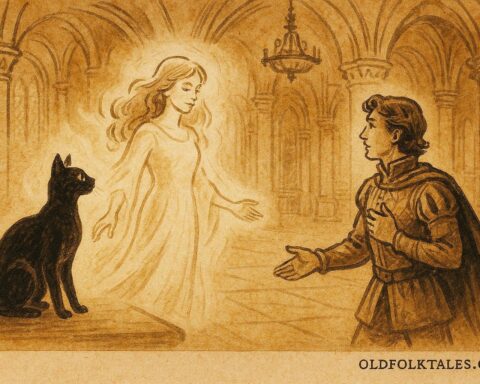
For a long while, Uletka wept and wandered, lost. Then one twilight she thought she heard a soft whisper on the wind, her name, mournfully called. She followed the sound until she reached the enchanted lake. From its depths rose a single gigantic water-lily, its petals slowly opening to reveal the pale, shimmering shape of her mother, Nastia. With a sorrowful smile, Nastia beckoned to Uletka to come, and Uletka, trembling, stepped onto the great flat lily leaves.
Nastia told her to go into the forest, through silver poplars and past an enchanted palm tree, until she found a great beech tree standing alone. There, she would find friends, protection from Mutà, who would seek her still. Uletka kissed the spirit of her mother farewell, and watched the lily petals fold, hiding her forever.
Tired, sore-footed, but guided by hope, Uletka ran through the forest until she came to the solitary beech. In the center of its trunk was a tiny, hidden door. She knocked, only squirrels chattered, a blackbird repeated, “Who is that at the Gnomes’ door?”, then she turned the handle and slipped inside.
Inside was a cozy little chamber: nine tiny chairs, a wooden table carved from the tree itself. On it lay dishes, spoons, and a feast of nuts, berries, and honey, all made by gentle hands. Hungry and exhausted, Uletka helped herself, then lay on the wooden floor and fell asleep.
When she awoke, a troop of small men with friendly but odd faces stood around her, laughing. Some gently pulled her hair. “Uletka,” they said, “you have freed the wicked fairy. If she finds you, she would destroy you, but here with us, you are safe. You must stay with us.” Outside, birds sang in chorus, “Yes, Uletka, Prince Elkàbo’s child!” The forest seemed to rejoice at her rescue.
These were the gnomes of the forest under the rule of Hobo, King of the Gnomes. There Uletka lived among them. Each day, the gnomes gathered nuts and acorns, turning their shells into cups and goblets. Sometimes the grass-elves came to dine. At night, under the glow of moonlight, the gnomes danced in rings around the tree, while a white owl perched above called “te-whit, te-whoo.”
They carved a little chair for Uletka, a plate from a hazelnut shell, a spoon from white fir-wood, and wove clothes for her from cobwebs. She helped them with their daily chores: laying the table, weaving garments from dead-leaf fibers as fine as lace (using a wild-rose thorn for a needle). Sometimes she lay on the grassy floor and spoke softly to violets, which nodded their tiny heads as though in friendship. A green-and-gold beetle carried her through the wood on its back; squirrels cracked nuts for her; but her dearest companion remained a blackbird who perched nearby, singing gentle songs for her.
Yet, despite all the kindness and forest joys, Uletka was not happy. She thought constantly of her father in the lonely castle, of her mother lost forever, and hated herself for the curiosity that had brought her here. She hid her sorrow so no one would worry, but inside she wept.
At last, her friend, the blackbird, took pity. One dawn he flew far away, beyond the forest, over mountains, to the crystal palace of the Fairy-Queen. There, in humble tones, he told how Uletka longed for home. Her sorrow touched the heart of the Queen. Her son, Prince Repto, moved by the blackbird’s pleading, asked for permission to rescue Uletka and marry her. The Queen agreed.
That night, under a moonlit sky, Prince Repto and the blackbird arrived at the foot of the pine-tree where the gnomes lived. There, medieval and magical beneath soft starlight, they found Uletka surrounded by gnomes dancing, grass-elves playing harps, bells tinkling. Repto, stunned by her beauty and misery, bowed low before her. He offered her love, safety, a golden palace in Fairyland, far away from Mutà’s reach. Though startled, Uletka, weary from sorrow and longing for love, accepted.
In joy the gnomes celebrated. Hobo was crowned King of all woods as thanks. Elves sang love-songs; birds stayed to serenade Uletka by night. The blackbird’s song, the sweetest of all, warmed her heart most.
At sunrise they rode in a shell-carriage drawn by six white doves. High above the forest canopy it glided. Along the way, Uletka asked to stop, and she kissed her dear father, still in his four-towered castle. Then they soared on until they reached the Fairyland beyond the trees, where Prince Repto and Uletka were wed. From that day on they lived happily ever after. The gnomes, frogs, squirrels, even the blackbird often visited. And as for the wicked fairy Mutà, she was never heard of again.
Moral of the Story
Curiosity, especially when driven by vanity or impatience, can lead to danger and suffering. What matters most are love, loyalty, and humility: Uletka’s longing for her home and her father, and the kindness of friends in the forest, eventually brought her safety and joy. True happiness comes not from magical powers or selfish wishes, but from compassion, care, and honest hearts.
Knowledge Check
-
Who is Uletka and what makes her different from ordinary children?
Uletka is the daughter of Prince Elkàbo; she is part-fairy, with delicate wings that shine like rainbow colors. -
Why was Uletka’s mother, Nastia, killed, and by whom?
A wicked fairy named Mutà lured Nastia to a lake by pretending to drown; when Nastia tried to rescue her, Mutà dragged her underwater until she drowned. -
What was the condition imposed by the Fairy-Queen when Mutà was turned into a lizard?
The condition was that Uletka, when grown, must release the white lizard, otherwise Mutà would remain powerless and could not regain her powers. -
What led Uletka to free the lizard, and what happened immediately after?
Her overwhelming curiosity and desire to become a fairy caused her to open the cage. The lizard turned back into Mutà, who then tore Uletka’s clothes, broke her wings, and abandoned her deep in the forest. -
Who rescued Uletka from danger and helped restore her hope?
The forest gnomes, under King Hobo, gave her shelter and care. Later the forest blackbird carried her plea to the Fairy-Queen, and her son, Prince Repto, brought her back and offered her love and safety. -
What does the story teach about curiosity and loyalty?
The tale warns that unchecked curiosity can bring great harm. But love, loyalty, and kindness, shown by Uletka’s friends and her father, bring healing and happiness that magic alone cannot give.
Cultural Origin: Hungarian folktale, Hungary
Source: Old Hungarian Fairy Tales by Baroness Emmuska Orczy