Long ago, in the rolling hills and quiet valleys of Central Bosnia, there lay a small village beside a deep, still lake, a lake whispered to be the home of the fearsome Water Dragon, Zmaj sa Vodom, whose presence haunted the villagers even when the water lay calm. The people depended on the lake for life, yet they lived in quiet dread of the creature that stirred beneath its surface.
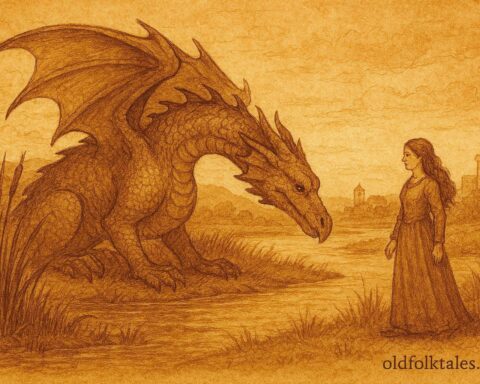
Each year, when the first spring rains fell, the Water Dragon, Zmaj sa Vodom, rose from the depths. His scales gleamed like wet slate, and his breath steamed against the cold mountain air. The moment he appeared, the lake churned and the ground trembled beneath the villagers’ feet. With a voice that echoed like thunder rolling between cliffs, the dragon demanded tribute: food, livestock, and anything else the villagers could gather. If the offerings were not enough, he threatened to drown their fields and sweep their homes into the water.
For years, the villagers obeyed, sacrificing more than they could afford. Fear shaped every household, and even the children whispered his name with dread. Among the poorest of the villagers was a young shepherd. He owned only a few thin sheep, slept beneath a patched blanket, and lived in a small hut on the far edge of the village. Yet he carried in his heart a courage that poverty could not diminish.
Every year, he watched the dragon’s visits drain the life out of the village. Children grew hungry, families struggled, and hope faded like mist over the hills. When the dragon’s next demand approached, the shepherd decided he could no longer stand by. Though his hands trembled, he stepped forward at the village gathering and offered to face the beast.
Gasps rose all around him. Some villagers begged him not to go; others simply wept, knowing what had happened to anyone who tried to defy the Water Dragon. But the shepherd’s resolve was firm. He promised that he would seek guidance first, for he did not intend to walk blindly into doom.
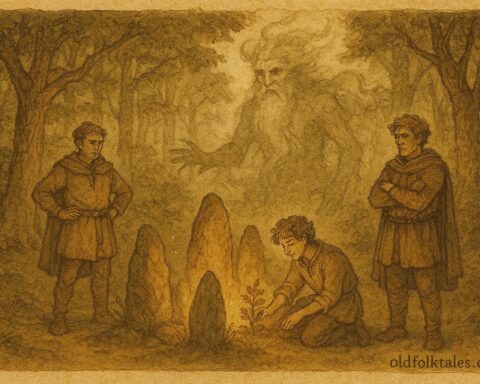
That night, he followed an old path into the surrounding forest, climbing until he reached a clearing where the ancient oaks grew thick and knotted. It was said that in these woods dwelled the spirit of a wise grandmother, a grandmother long departed from life, yet still watching over the land and its people. The shepherd knelt and called out, humbly asking for her wisdom.
A soft glow appeared among the trees, and from it emerged the grandmother spirit. She looked like a gentle elder wrapped in moonlight, her face lined with age yet warm with compassion. When she spoke, her voice rustled like wind through leaves.
“You seek to stand against the Water Dragon,” she said. “You are brave, but bravery alone is not enough. Listen closely.”
She told him how the dragon’s strength lay in its confidence, its belief that no human could match it. But if approached with calm, clear resolve, and with the right strategy, the beast could be defeated. She taught the shepherd how to face the dragon without faltering, how to anticipate its movements, and how to strike only when the moment was right.
“Remember,” she said finally, “fear feeds the dragon. Let your heart be steady, and he will falter.”
At dawn, strengthened by her guidance, the shepherd returned to the village. That same morning, the lake began to churn, the dreaded sign of the dragon’s arrival. The villagers gathered trembling, clutching their offerings, but the shepherd stepped past them and toward the water’s edge.
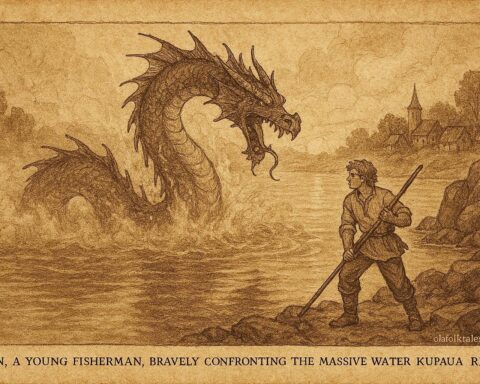
The Water Dragon rose with a roar, towering above him. Water streamed from its massive body as it glared down at the young man standing alone.
“Where is my tribute?” the dragon growled.
The shepherd lifted his chin. “I bring no tribute,” he said. “I have come to end your terror.”
The dragon bellowed in fury, sending waves crashing onto the shore. But the shepherd held his ground, just as the grandmother spirit had taught him. When the dragon lunged, he dodged quickly. When the dragon thrashed, he stayed out of reach. And in the one brief moment when the creature hesitated, surprised by the shepherd’s fearlessness, the young man struck a decisive blow.
A great cry echoed across the valley. The dragon collapsed, its power broken. At last, the lake grew still.
Silence fell over the village as the shepherd stepped back from the water, weary but victorious. Slowly, the villagers realized what had happened. Their fear melted into joy, and they rushed forward, lifting him onto their shoulders. That night, they celebrated with grateful hearts, knowing that the cruel shadow that had hung over their lives was gone forever.
The shepherd asked for nothing in return, not gold, not land, not praise. His only reward was seeing his people free from fear.
From that day on, the lake became a place of peace once more, reflecting the mountains and sky instead of the shadow of a monster. And the villagers never forgot the brave shepherd who, with the help of a wise grandmother spirit, stood against the Water Dragon.
Moral of the Story
True courage is not the absence of fear but the resolve to act in spite of it. Wisdom, humility, and bravery together can overcome even the greatest threats.
Knowledge Check
1. Who is the main hero of “Zmaj sa Vodom” (The Water Dragon)?
The main hero is a humble shepherd who volunteers to confront the Water Dragon and protect his village.
2. What does the Water Dragon demand from the villagers each year?
The dragon demands a yearly tribute of food and livestock, threatening to destroy the village if he does not receive it.
3. What role does the wise grandmother spirit play in the story?
She guides the shepherd, giving him wisdom and strategy to defeat the Water Dragon.
4. Where does the folktale “Zmaj sa Vodom” originate?
It originates from Central Bosnia, specifically the Travnik and Zenica region.
5. What is the central theme of the Water Dragon folktale?
The theme centers on courage, wisdom, and the triumph of determination over fear-based oppression.
6. What symbol does the lake represent in the story?
The lake symbolizes both the community’s dependence on nature and the hidden dangers that must be confronted with courage.
Source: Adapted from Bosnian folktale materials collected by Kosta Hörmann in Narodno Blago (late 19th century).
Cultural Origin: Bosnia (Central Bosnia, Travnik & Zenica Region)