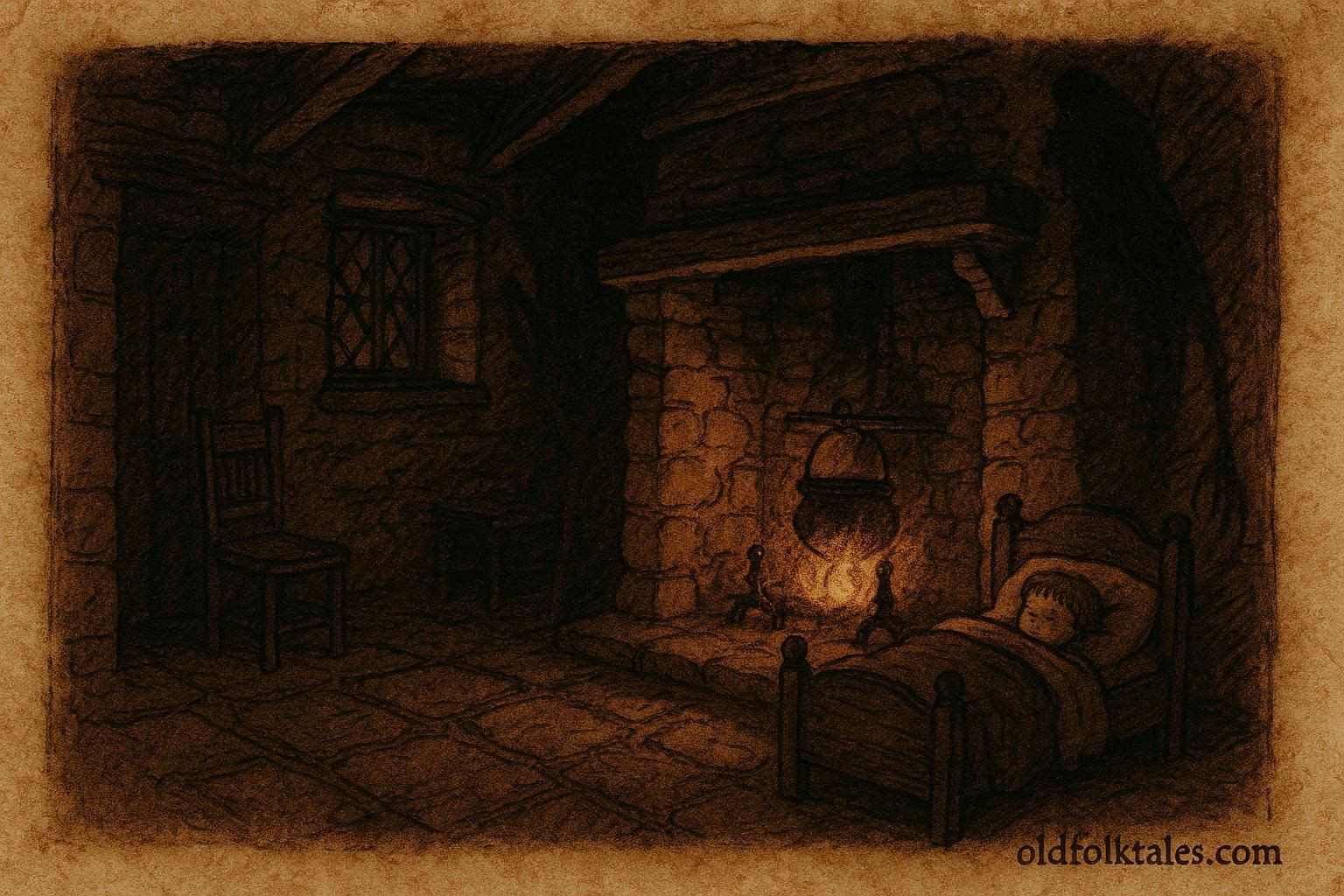
In the quiet corners of English homes, where firelight flickers against stone walls and the wind murmurs at the eaves, there has long existed a presence known not by shape, nor by name alone, but by feeling. This presence is called the Bogeyman. He is not a single creature, nor does he wear one face. He is the embodiment of fear itself, shaped by darkness, silence, and the warnings spoken in hushed parental voices.
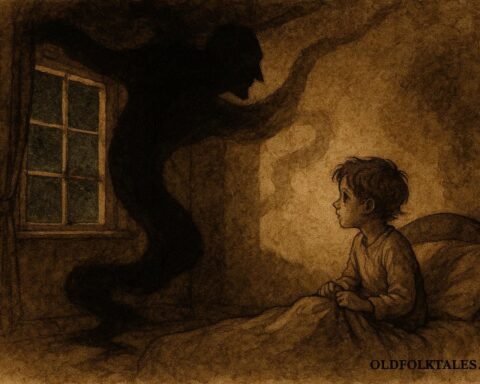
The Bogeyman belongs to no single village, nor to any one century. He is said to linger wherever fear gathers, beneath beds, behind doors left ajar, in cupboards that breathe shadows, and along narrow roads where children are warned not to wander alone. Unlike the dragons and giants of heroic tales, the Bogeyman has no fixed form. In one telling, he is tall and thin as drifting smoke; in another, he is nothing more than a sound, a presence felt but never seen. Sometimes he has claws; sometimes he has none. Often, he has no face at all.
What remains constant is his purpose.
In English hearth tales, the Bogeyman is not merely a terror meant to frighten children for sport. He is a moral force, invoked to correct misbehavior and to give weight to parental instruction. When a child lies, disobeys, or wanders where they should not, the Bogeyman is said to draw closer. Not with haste, but with patience.
Parents spoke of him when candles were blown out and bedtime came. “Mind your words,” they would say. “Speak the truth.” Or, “Do not stray from the path.” The threat was rarely explicit. The Bogeyman did not need description. Fear, after all, works best when it is undefined.
Children, lying awake in their beds, would listen to the creak of timber and the crackle of dying embers. A shadow stretching too far across the wall might become his arm. The sigh of the house settling might be his breath. In these moments, imagination and belief intertwined so tightly that the Bogeyman felt real, present, and watchful.
Unlike many folktale figures, the Bogeyman did not arrive with thunder or spectacle. He came quietly. He did not roar or demand attention. His power lay in anticipation. The knowledge that he might come was often enough to guide behavior. A child tempted to lie might hesitate, recalling the warning spoken by the hearth. A child tempted to disobey might glance toward the darkened corner of the room and choose caution instead.
In some tellings, the Bogeyman was said to punish only those who repeatedly ignored warnings. He was not cruel without cause. He existed as a final consequence, a reminder that actions carried weight even when unseen. This reflected a broader cultural understanding within English domestic life of the time: discipline was tied not only to authority, but to moral order.
The Bogeyman’s lack of form allowed him to change with each household and each generation. In farming communities, he was said to lurk near barns or hedgerows after dusk. In towns, he haunted stairwells, alleyways, and the spaces between closely built homes. Wherever children feared to go alone, there the Bogeyman was said to dwell.
Victorian folklore collectors, recording these tales in the nineteenth century, noted how consistently the Bogeyman appeared across regions, despite the absence of a shared description. This consistency suggested that he was less a monster and more a mirror, reflecting the anxieties of childhood and the values of society. He was fear given a name, discipline given a face that could never be fully seen.
As children grew older, the Bogeyman often faded. What once felt close and immediate became distant, then symbolic, then something remembered with a mixture of embarrassment and nostalgia. Yet even adults, walking alone at night or waking suddenly in darkness, might feel a trace of that old presence. A reminder that fear, once learned, never truly disappears.
Thus, the Bogeyman endured, not as a creature of flesh and bone, but as a tradition passed quietly from one generation to the next. He remained in stories told by firelight, in warnings spoken softly, and in the shadows where imagination still reigns.
He was never meant to be seen.
He was meant to be felt.
Moral Lesson
The Bogeyman teaches that fear, when guided, can serve as a tool for moral discipline. The tale reminds listeners, especially children, that actions have consequences, even when no one seems to be watching, and that self-restraint and honesty are learned first in the quiet spaces of home.
Knowledge Check
1. Who or what is the Bogeyman in English folklore?
The Bogeyman is a personification of fear, not a single creature, used to enforce moral discipline.
2. Where is the Bogeyman commonly said to appear?
He appears in dark, liminal spaces such as under beds, in cupboards, or along lonely roads.
3. What behaviors does the Bogeyman traditionally punish?
Lying, disobedience, and ignoring parental warnings.
4. Why does the Bogeyman have no fixed appearance?
His formlessness allows him to reflect personal and cultural fears.
5. What role did the Bogeyman play in domestic life?
He reinforced moral behavior and obedience within the household.
6. When were Bogeyman tales formally documented?
Primarily during the Victorian era, between 1830 and 1890.
Source: English oral folklore, documented in Victorian folklore collections (1830–1890)
Cultural Origin: England (nationwide)