In the days when London was a city of narrow lanes and towering stone buildings, when merchants’ carts rattled over uneven cobbles and the River Thames carried ships from distant lands, there lived a poor boy named Dick Whittington. He was young, alone, and possessed of little more than hope. Orphaned early in life, Dick had grown up hearing tales told by travelers and village folk, tales that London was a place where fortune smiled upon the determined, where even the poorest could rise through hard work and honesty.
These stories took root in Dick’s heart. He imagined a city where opportunity waited at every corner, where a willing hand would never go unrewarded. With this belief to guide him, he set out for London on foot, carrying no wealth, no trade, and no certainty, only the strength of his spirit.
When Dick finally reached the great city, reality struck harshly. London was vast and restless, crowded with people pursuing their own survival. The streets were not paved with gold, but with mud and stone. The air smelled of smoke, sweat, and river water. For a boy without connections or skill, life was unkind. Dick found work only rarely, and when he did, it was the hardest and lowest labor. Hunger became his constant companion, and many nights he lay awake, wondering whether his journey had been a terrible mistake.
Despite his hardship, Dick did not abandon his honesty or diligence. Eventually, his persistence brought him into the service of a wealthy merchant. The household was large, busy, and governed by strict order. Dick worked tirelessly, performing every task assigned to him without complaint. Yet even here, comfort eluded him. The house, like many in London, was plagued by rats. They scurried through walls and ceilings, gnawed at stored food, and made rest difficult for everyone within.
Dick himself suffered greatly from the vermin, for he slept in a small, bare space where rats ran freely at night. Unable to bear this, he managed to acquire a cat, his only true possession. The animal quickly proved its worth, driving away the rats and bringing Dick a measure of peace. More than that, the cat became his companion in loneliness, a quiet presence that softened the weight of his isolation.
In time, the merchant prepared a trading voyage to distant lands across the sea. Such voyages were risky but often profitable, and it was customary for every member of the household to send something aboard the ship, to be sold abroad for gain. Servants and apprentices offered what little they could. When Dick’s turn came, he stood in silence, ashamed. He owned nothing of value, nothing, that is, but his cat.
With reluctance and trust, Dick offered the animal. Though it pained him to part with his only comfort, he believed in fairness and accepted that this was his chance, however small. The cat was taken aboard the ship, and Dick returned to his daily labor, uncertain whether he would ever see it again.
As weeks passed, Dick’s spirits sank. Life in London felt endless and unforgiving. The dreams that had brought him to the city seemed foolish now. Convinced that his fortune lay elsewhere, Dick resolved to leave London altogether. Before dawn one morning, he quietly slipped away from the city, walking along the road that led outward, away from all he had known.
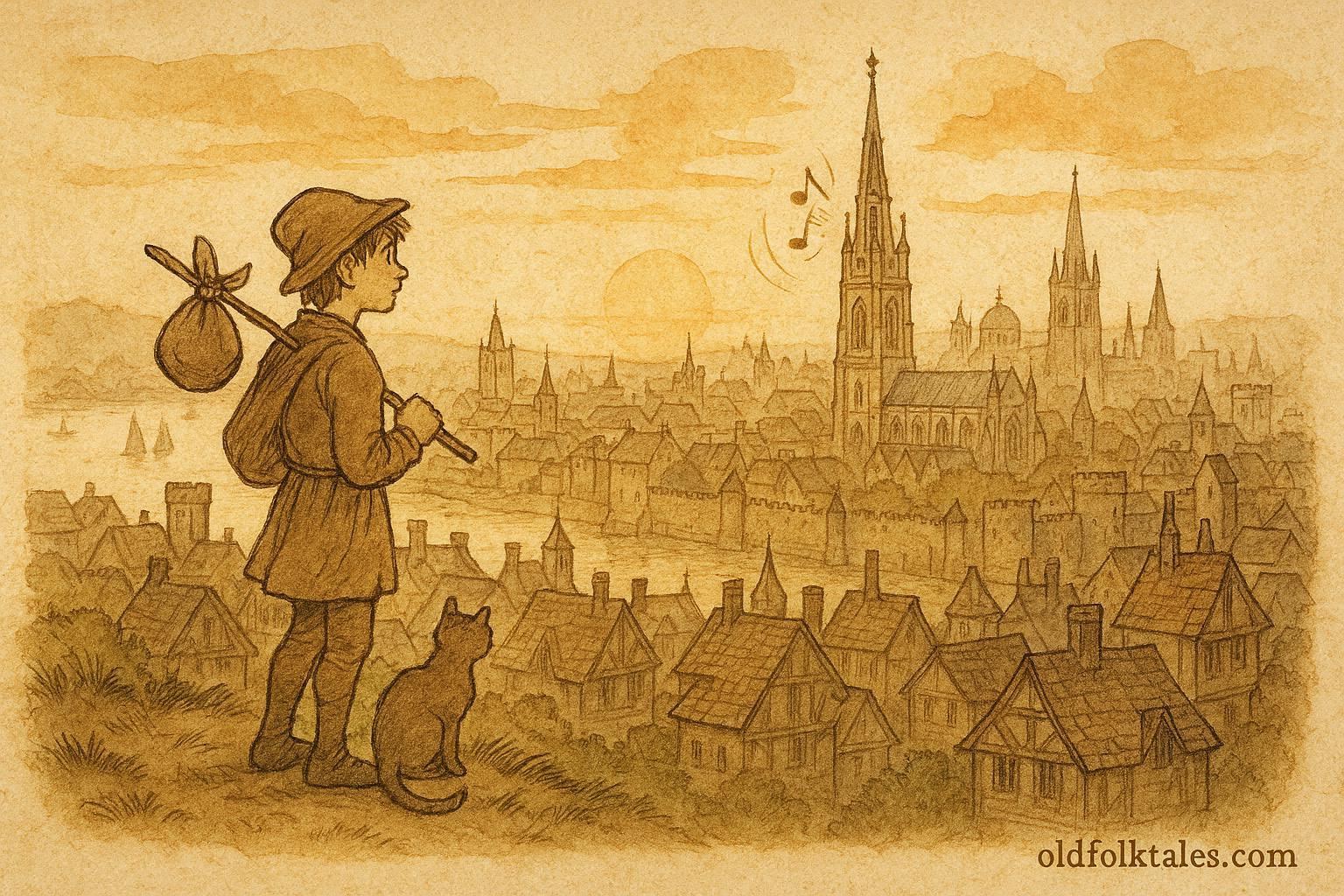
When he reached a hill overlooking London, the city lay below him in pale morning light. At that moment, the bells of Bow Church began to ring. Their sound rose clear and strong, carrying across the air. To Dick, weary and uncertain, the bells seemed to speak words directly to him:
“Turn again, Whittington,
Lord Mayor of London.”
Dick stood still, astonished. Whether the words came from the bells themselves or from his own longing heart, he could not say. Yet their meaning struck him deeply. Taking the ringing as a sign, he turned back toward the city he had been ready to abandon.
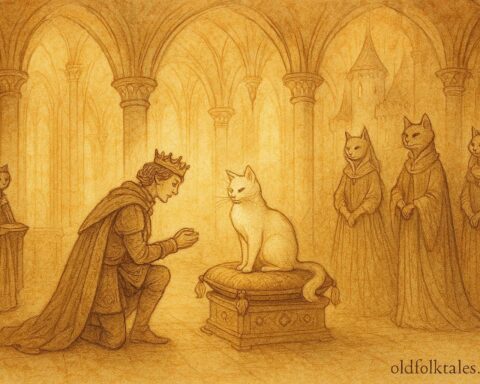
Not long after his return, news arrived from the merchant’s ship. In a faraway kingdom, the land had been overwhelmed by rats. They infested homes, destroyed stores, and even plagued the royal palace. None could rid the kingdom of them, until the arrival of Dick’s cat. Swift and tireless, the animal cleared the palace of vermin, bringing relief and wonder.
In gratitude, the ruler paid a great sum for the cat. When the ship returned to London with its profits, Dick’s life was transformed. From poverty, he rose to comfort; from comfort, to wealth. Through continued honesty, diligence, and generosity, Dick gained respect and influence. According to tradition, he eventually became a successful merchant and later rose to the honored position of Lord Mayor of London.
Thus, Dick Whittington’s story became one of England’s most enduring folktales, a reminder that perseverance, kindness, and hope can reshape even the harshest fate.
Moral Lesson
The story of Dick Whittington teaches that perseverance through hardship, paired with kindness and integrity, can lead to unexpected fortune. Even the smallest gift, offered in trust, may hold great power to change one’s destiny.
Knowledge Check
1. Who is Dick Whittington in English folklore?
A poor orphan boy who rises from poverty to wealth through perseverance and honesty.
2. Why does Dick initially leave London?
Because of hunger, hardship, and despair at his lack of opportunity.
3. What role does the cat play in the story?
The cat eliminates rats in a distant kingdom, earning Dick great reward.
4. What persuades Dick to return to London?
The ringing of Bow Church bells, which he interprets as a sign of future success.
5. What themes define this folktale?
Hope, perseverance, kindness rewarded, and social mobility.
6. When was the story first recorded in print?
In 1605, in English chapbooks and stage plays.
Source: English chapbooks and stage plays, 1605 (earliest printed version)
Cultural Origin: London, England