In the quiet countryside of the Scottish Borders, where low hills rolled gently into mist and ancient paths threaded through heather and grass, there lived a man named Thomas of Ercildoune. He was a poet by trade and by nature, known among his neighbors for his sharp tongue, clever verses, and deep love of song. In village gatherings and beside hearth fires, Thomas’s words were often repeated, for he had a way of capturing both joy and sorrow in simple lines.
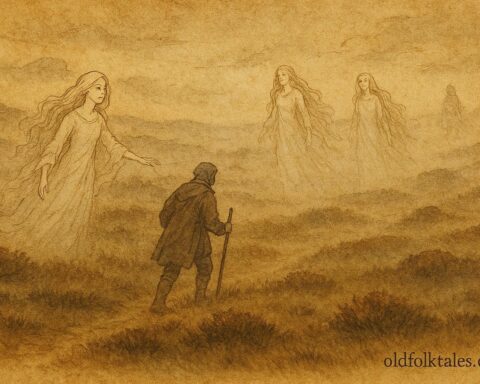
Yet Thomas was also restless. He often wandered alone beyond the safety of cottages and fields, drawn to lonely places where the boundary between the human world and the unseen seemed thin. The people of the Borders believed such places were dangerous, for fair folk were said to roam there, beings older than memory, beautiful and terrible in equal measure.
Explore the wit and wisdom of Western Europe, where humor and virtue often go hand in hand
One evening, as the sun lowered and the land softened into shadow, Thomas rested beneath a tree near the Eildon Hills. The air was still, and the hush of twilight pressed close around him. As he sat quietly, a woman appeared upon the path. She rode a white horse and wore garments of green and silver that shimmered faintly in the fading light. Her beauty was not of the human kind; it was too perfect, too distant, and carried with it an unmistakable sense of power.
Thomas knew at once that she was no mortal woman.
The lady spoke his name and told him she was the Queen of Elfland. Her voice was calm, yet it carried an authority that allowed no refusal. Before Thomas could gather his thoughts, the world around him shifted. The hills and fields dissolved like mist, and he found himself carried away into a realm unlike anything he had known.
Elfland was a place beyond ordinary time. Its meadows glowed with unnatural color, and its halls shone with gold and crystal. Music filled the air, not played by human hands but flowing freely, as though the land itself sang. Feasts appeared without preparation, and days passed without hunger or weariness. Thomas lived among the fair folk, moving through their world as a guest, neither fully captive nor truly free.
Time behaved strangely in Elfland. Moments stretched endlessly, while years slipped by unnoticed. Thomas could not say how long he remained there, only that the memory of his former life grew faint, like a dream half-forgotten upon waking. Yet even in that beautiful place, unease lingered. Elfland was perfect, but it was not gentle. The smiles of the fair folk never quite reached their eyes, and their laughter carried an echo of something cold.
At last, the Queen of Elfland summoned Thomas once more. She told him that his time among them was finished. He would return to the human world, but he would not return unchanged. As a parting gift, and a binding condition, she granted him second sight. From that day forward, Thomas would never speak a lie. His tongue would be bound to truth alone, and with that truth would come knowledge of things yet to pass.
The Queen warned him that this gift would not bring comfort. Truth, she said, was heavy, and those who carried it often walked alone.
Then, as suddenly as he had been taken, Thomas found himself once again beneath the tree near the Eildon Hills. The land looked familiar, yet strangely altered. Villages had shifted, paths had grown over, and faces he once knew were gone. Years had passed in the human world while he dwelled in Elfland.
When Thomas returned to society, people soon noticed the change in him. He spoke less casually than before, and when he did speak, his words carried an unsettling certainty. Predictions he made, about harvests, deaths, battles, and fortunes, came true without fail. News of his gift spread, and people began to call him Thomas the Rhymer, a man whose words shaped fate.
Kings and nobles sought him out, eager to know what lay ahead. Farmers listened carefully when he spoke of weather and crops. Ordinary folk approached him with fear and hope in equal measure, desperate to learn what the future held. But Thomas could not soften his words. When hardship awaited, he was bound to say so. When joy would be brief, he could not disguise it.
Gradually, people grew uneasy around him. Truth, when stripped of comfort, was difficult to bear. Friends withdrew, afraid of what Thomas might reveal. Lovers found no peace in his presence, for love often survives on gentle illusions and hopeful promises, things Thomas could no longer offer. Though he lived among people, he no longer belonged fully to them.
Thomas himself felt the weight of isolation. His gift brought knowledge, but it also stripped him of ordinary human warmth. He could see the patterns of fate unfolding, yet he could not change them. His words became a mirror that reflected reality without mercy.
In time, Thomas accepted his fate. He continued to speak truth when asked, knowing silence or falsehood were no longer within his power. His prophecies passed into legend, shaping the history and imagination of the Scottish Borders. Long after his death, people remembered him not only as a poet, but as a man touched by the otherworld, a bridge between what is known and what is feared.
Thus, the tale of Thomas the Rhymer endured, reminding all who heard it that wisdom and truth, though valuable, often come at a cost that few are prepared to pay.
Journey into the charm of British wit and Irish wonder through centuries of folk tradition
Moral Lesson
The story teaches that truth is powerful but demanding. Knowledge and supernatural gifts may grant insight and authority, yet they can also separate individuals from comfort, companionship, and belonging. Wisdom requires not only understanding the truth but accepting its consequences.
Knowledge Check
1. Who was Thomas the Rhymer in Scottish folklore?
Thomas the Rhymer was a poet from the Scottish Borders who gained prophetic powers after visiting Elfland.
2. What gift did the Queen of Elfland give Thomas?
She granted him second sight, binding him to always speak the truth.
3. Why is Thomas’s gift considered a burden?
Because he could never soften the truth, leading to isolation and fear from others.
4. What role does Elfland play in the story?
Elfland represents the supernatural realm where time and reality differ from the human world.
5. What themes are central to the tale of Thomas the Rhymer?
Fate versus free will, truth versus comfort, and the cost of supernatural knowledge.
6. What cultural lesson does the story convey?
That truth and wisdom are powerful but often come with personal sacrifice.
Source: Sir Walter Scott, Minstrelsy of the Scottish Border (1802)
Cultural Origin: Scottish Borders, Lowland Scotland