High in the Alpine regions of Tyrol, where steep valleys fold into mist and the mountains rise like ancient sentinels of stone and ice, there once lived a poor forester and his only son. Their cottage stood at the edge of a great forest, a place where wind whispered through fir branches and streams cut silver paths through mossy rock. The forester earned his living honestly, and his son grew up strong, observant, and quiet, shaped by the rhythms of mountain life.
One summer morning, the young man was sent deep into the forest to check traps and fallen trees. As the sun climbed, he came upon a hidden clearing where a spring lay calm and bright, ringed by smooth stones. Drawn by laughter unlike any he had heard before, he hid among the trees and watched.
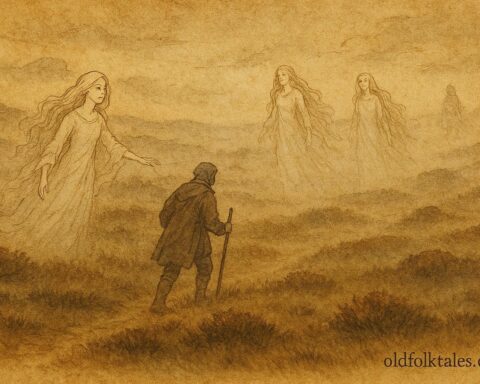
Three maidens stood by the water, their beauty unlike that of ordinary women. Nearby lay three shining cloaks, light as mist and pale as moonlit snow. One by one, the maidens stepped into the pool, laughing freely, their movements graceful and unguarded.
The young man understood at once that these were no mortal women. From old fireside tales, he recognized them as otherworldly maidens, beings who traveled between realms by means of enchanted garments. His heart beat fiercely, and without fully understanding why, he was drawn most strongly to the youngest of the three.
When the moment came, driven by longing rather than malice, he crept forward and seized her cloak. At once, the maidens sensed danger. Two rushed to retrieve their garments, donned them swiftly, and vanished into the sky like white birds fleeing a storm.
The youngest cried out, her voice filled with fear and sorrow. Unable to follow her sisters, she pleaded with the young man to return what he had taken. He stepped forward then, overcome by her beauty and her tears, and begged her to remain with him. Promising protection, devotion, and a mortal life free of want, he persuaded her at last to stay.
They were married, and for a time happiness reigned.
The maiden became his wife, gentle and industrious, learning the ways of human life while never losing her quiet strangeness. Though she loved her husband and bore him children, her eyes often wandered toward the sky and the distant peaks. The cloak, carefully hidden, remained the bond that held her to the earth.
Years passed, and familiarity dulled caution.
One day, the young man, now grown confident and content, forgot to secure the enchanted garment. The maiden found it where it lay, folded and waiting as if it had never left her. Without anger or reproach, she kissed her children, spoke farewell to her husband, and donned the cloak.
Before he could stop her, she rose into the air and vanished toward the high mountains.
Grief-stricken and desperate, the husband searched the forests and valleys, calling her name, but she was gone. At last, he learned through whispers and wandering folk that she dwelt atop the Glass Mountain, a place so steep and smooth that no mortal foot could climb it.
Determined, he set out on a long and perilous journey.
His path led through dark forests, across frozen passes, and into lands where human roads ended. Along the way, he encountered helpers, old men, animals, and wandering figures, who tested his humility and rewarded his kindness. Each gave him counsel or an object that would aid him in his final trial.
At last, he reached the Glass Mountain.
It rose sheer and shining, reflecting sky and cloud, impossible to climb by ordinary means. Many had tried and failed. Yet the forester’s son did not turn back. Remembering the advice he had been given, he used what little help he had earned and began the ascent.
The climb was slow and painful. Hands bled, strength failed, and fear threatened to overcome him. Still, he climbed, driven not by pride but by love and repentance.
At the summit, he found a shining hall where his wife lived among her kind. She saw him and wept, moved by the depth of his devotion. Through endurance and humility, he had proven worthy.
The enchantment was broken. She was restored to him, not as a captive, but by choice.
Together, they returned to the human world, their bond now forged in trust rather than possession.
Moral Lesson
This tale teaches that love cannot be sustained through control or deception. True devotion requires respect, trust, and perseverance. What is taken by force must be earned again through humility and sacrifice.
Knowledge Check
- Who is the protagonist of The Glass Mountain?
A forester’s son from the Alpine region of Tyrol. - What supernatural beings appear in the story?
Three bathing maidens with enchanted flying cloaks. - Why does the maiden leave her husband?
He forgets to secure her magical garment, allowing her to return to her realm. - What is the Glass Mountain?
A mythical, unclimbable mountain where the maiden dwells. - How does the hero succeed in his quest?
Through endurance, humility, and assistance earned along his journey. - What central lesson does the folktale convey?
Respect and trust are essential to lasting love.
Source & Cultural Origin
Source: Ignaz & Joseph Zingerle, Kinder- und Hausmärchen aus Tirol (1852)
Cultural Origin: Alpine folk tradition, Tyrol (Austria)