In the high Alpine regions of Switzerland, where mountains rise like stone cathedrals and valleys disappear into mist, the land has always demanded respect. These mountains are not gentle. They are places of sudden storms, hidden crevasses, echoing ravines, and long silences broken only by wind and falling rock. For generations, those who lived and traveled among these peaks understood that the Alps held more than visible dangers. They believed the mountains were alive with forces beyond human understanding.
Among the most enduring of these beliefs was the legend of the Tatzelwurm.
Discover the moral heart and wild spirit of the north through timeless Nordic storytelling
Known by many names, Tatzelwurm, Stollenwurm, or simply the mountain worm, this creature occupied a place between folklore, fear, and natural mystery. It was not celebrated in heroic epics nor defeated by legendary warriors. Instead, it existed in whispered accounts, eyewitness claims, and cautious warnings passed from shepherd to shepherd, traveler to traveler.
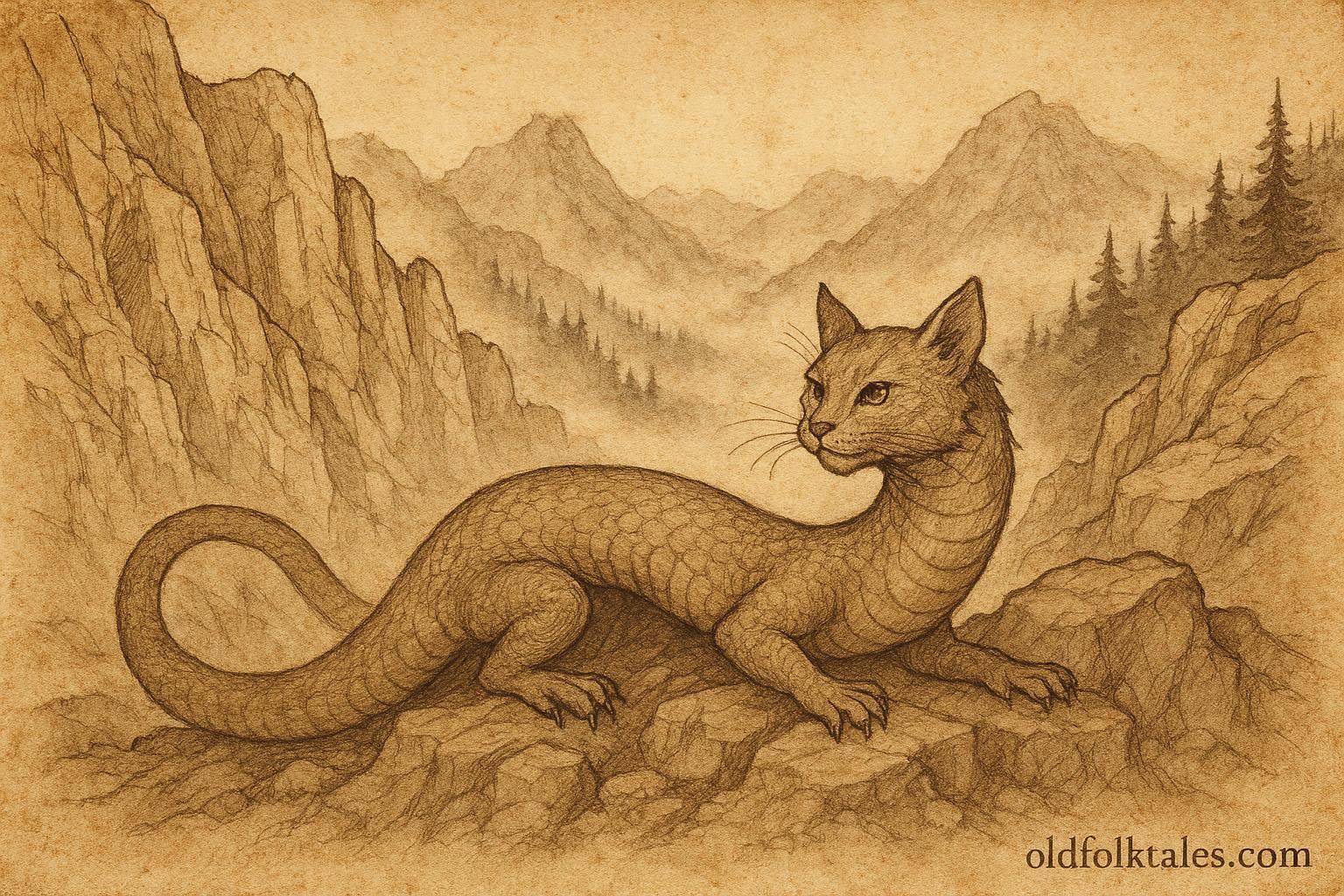
The Tatzelwurm was said to dwell in the Alpine regions of Switzerland, especially the Bernese Alps, though stories stretched across neighboring Alpine areas. Descriptions varied in detail but shared striking similarities. Witnesses consistently described a serpent-like body, thick and muscular, often several feet long. Unlike ordinary snakes, however, the creature was said to possess short, powerful legs, usually two, sometimes four, ending in clawed feet.
Its head was described as cat-like or reptilian, with sharp teeth, a blunt snout, and eyes that appeared unnervingly intelligent. Some claimed it had whiskers like a lynx; others described smooth, scaled skin. Its coloring was often dark, gray, brown, or greenish, allowing it to blend seamlessly into rocky terrain.
The creature’s habitat was as important to the legend as its form. The Tatzelwurm was said to inhabit rocky crevices, caves, abandoned mine shafts, and steep ravines, emerging rarely and retreating quickly when disturbed. Unlike dragons of medieval lore, it was not associated with fire, treasure, or flight. It was bound to the earth, shaped by stone and shadow.
The stories surrounding the Tatzelwurm arose not from imagination alone, but from the lived experiences of mountain peasants, herders, hunters, and woodcutters—people whose survival depended on deep familiarity with the Alpine environment. These were individuals who could distinguish between wolf tracks and bear signs, who understood avalanches and sudden weather changes. When they spoke of something unfamiliar, it carried weight.
Shepherds grazing cattle on high pastures told of livestock disappearing or found injured in strange ways. Goats were discovered with deep wounds that did not resemble the bites of known predators. At times, animals refused to approach certain cliffs or grazing areas, reacting with panic and agitation. Such disturbances were often attributed to the presence of the Tatzelwurm.
Travelers crossing narrow mountain paths told more direct encounters. Some claimed to have seen a creature coiled near the trail, raising its front body as if to threaten before vanishing into a fissure in the rock. Others reported hearing a low hiss or growl, unlike that of any snake or mammal known to them. A few accounts described a strong, foul odor, lingering in the air after a sighting.
In some versions of the legend, the Tatzelwurm’s gaze alone was said to cause illness or terror. Whether this reflected actual fear responses or later embellishment, such details reveal how deeply unsettling the creature was perceived to be. It represented not merely a physical danger, but the fear of confronting something unknown in an already perilous environment.
By the late 18th and early 19th centuries, Europe was gripped by a growing interest in cataloging and understanding the natural world. Scholars, physicians, and natural philosophers began recording unusual phenomena with a more analytical eye. Rather than dismissing Alpine creature reports outright, some attempted to reconcile them with emerging scientific thought.
One of the most notable figures associated with early documentation of such legends was Johann Jakob Scheuchzer, a Swiss physician and naturalist. In his writings on Alpine natural history, Scheuchzer recorded accounts of strange animals reported by credible witnesses. While cautious, he did not entirely dismiss the possibility that unknown species might exist in remote regions.
The Tatzelwurm appeared in travelogues, regional chronicles, and early natural history texts, often framed as secondhand reports or eyewitness testimony. These accounts emphasized consistency: similar descriptions emerging independently across different valleys and regions. For some scholars, this suggested either a shared cultural belief, or the presence of a misunderstood or rare animal.
Importantly, the Tatzelwurm was rarely portrayed as deliberately malicious. Unlike dragons of chivalric legend, it did not attack villages or hoard riches. Instead, it appeared as a territorial creature, reacting aggressively only when disturbed or approached too closely. In this way, it resembled the real dangers of the Alps themselves, indifferent, powerful, and unforgiving.
The legend also reflected a broader human anxiety toward wild landscapes. The Alps were not fully mapped or tamed during this period. Sudden landslides, disappearing travelers, and unexplained sounds were part of daily reality. The Tatzelwurm became a symbolic explanation for the mountains’ unpredictability, a living embodiment of nature’s refusal to be controlled.
Some stories even portrayed the Tatzelwurm as a guardian of certain places, punishing those who trespassed recklessly or showed disrespect for the land. In these accounts, the creature was not evil but necessary, a reminder that humans were guests in a world shaped long before them.
As scientific understanding advanced, belief in the Tatzelwurm gradually retreated from mainstream thought. Improved knowledge of wildlife, geology, and psychology offered alternative explanations for many reported encounters. Yet the legend never disappeared entirely.
Even today, the Tatzelwurm remains part of Alpine cultural memory. Locals may speak of it with a smile, but also with a quiet respect. It survives as a story told to caution travelers, to honor the dangers of the mountains, and to preserve a connection to a time when the boundary between known and unknown felt far thinner.
The Tatzelwurm endures not because it has been proven, but because it fulfills a deeper role. It reminds us that the natural world is vast, ancient, and not fully understood, and that humility is the wisest response when standing among the high peaks.
Experience legends where mountains breathe magic and heroes face moral choices that shape destiny
Moral Lesson
The legend of the Tatzelwurm teaches humility before nature. Not all mysteries are meant to be solved, and respect for the wild is essential for survival and balance.
Knowledge Check
-
Q: What is the Tatzelwurm in Swiss folklore?
A: The Tatzelwurm is a legendary Alpine creature described as a serpent-like beast with short legs. -
Q: Where was the Tatzelwurm most commonly reported?
A: In the Alpine regions of Switzerland, especially the Bernese Alps. -
Q: How did people describe the Tatzelwurm’s appearance?
A: As having a long body, short legs, and a cat-like or reptilian head. -
Q: Who recorded early accounts of the Tatzelwurm?
A: Swiss naturalists such as Johann Jakob Scheuchzer documented reported sightings. -
Q: What role did the Tatzelwurm play in Alpine culture?
A: It symbolized nature’s danger, mystery, and humanity’s vulnerability in wild landscapes. -
Q: Is the Tatzelwurm considered a dragon?
A: It is sometimes compared to a dragon but is more often classified as an Alpine cryptid.
Source: Alpine folklore recorded in 18th–early 19th century travelogues and natural history writings, including accounts by Johann Jakob Scheuchzer.
Cultural Origin: Alpine regions of Switzerland (especially the Bernese Alps)