In the rolling hills and wooded valleys of southwestern Bulgaria, where orchards thrive beneath open skies and ancient songs linger in the air, there once ruled a king whose greatest pride was neither crown nor palace, but a single golden apple tree growing in his garden.
This tree was no ordinary tree. Its trunk was strong and ancient, its leaves gleaming even in moonlight, and each year it bore one perfect golden apple, glowing as if shaped from sunlight itself. The apple was a symbol of the kingdom’s prosperity and harmony. As long as it ripened undisturbed, the land knew peace.
Discover the moral heart and wild spirit of the north through timeless Nordic storytelling
Yet each year, on the very night before the apple was to be harvested, it vanished.
No guard saw the thief. No track was left behind. At dawn, only an empty branch swayed where the golden fruit had hung.
The king had three sons, each different in nature. The two elder princes were proud, confident in their strength and cleverness, and quick to mock others. The youngest son was gentle, patient, and thoughtful. Because he spoke little and acted without boasting, his brothers dismissed him as weak and foolish.
Determined to end the mystery, the king ordered his sons to guard the apple tree, one per night.
On the first night, the eldest prince stood watch. He sharpened his sword and boasted that no thief could escape him. Yet as midnight deepened, sleep crept over him. By dawn, the apple was gone once more.
The second night, the middle brother kept watch. He swore he would succeed where the first had failed. But the night air was warm, the orchard quiet, and his confidence dulled his caution. Sleep overcame him as well, and again the apple disappeared.
On the third night, the youngest son asked for his turn. His brothers laughed.
“You?” they scoffed. “If warriors cannot guard the tree, what can you do?”
But the king, seeing his son’s calm resolve, allowed it.
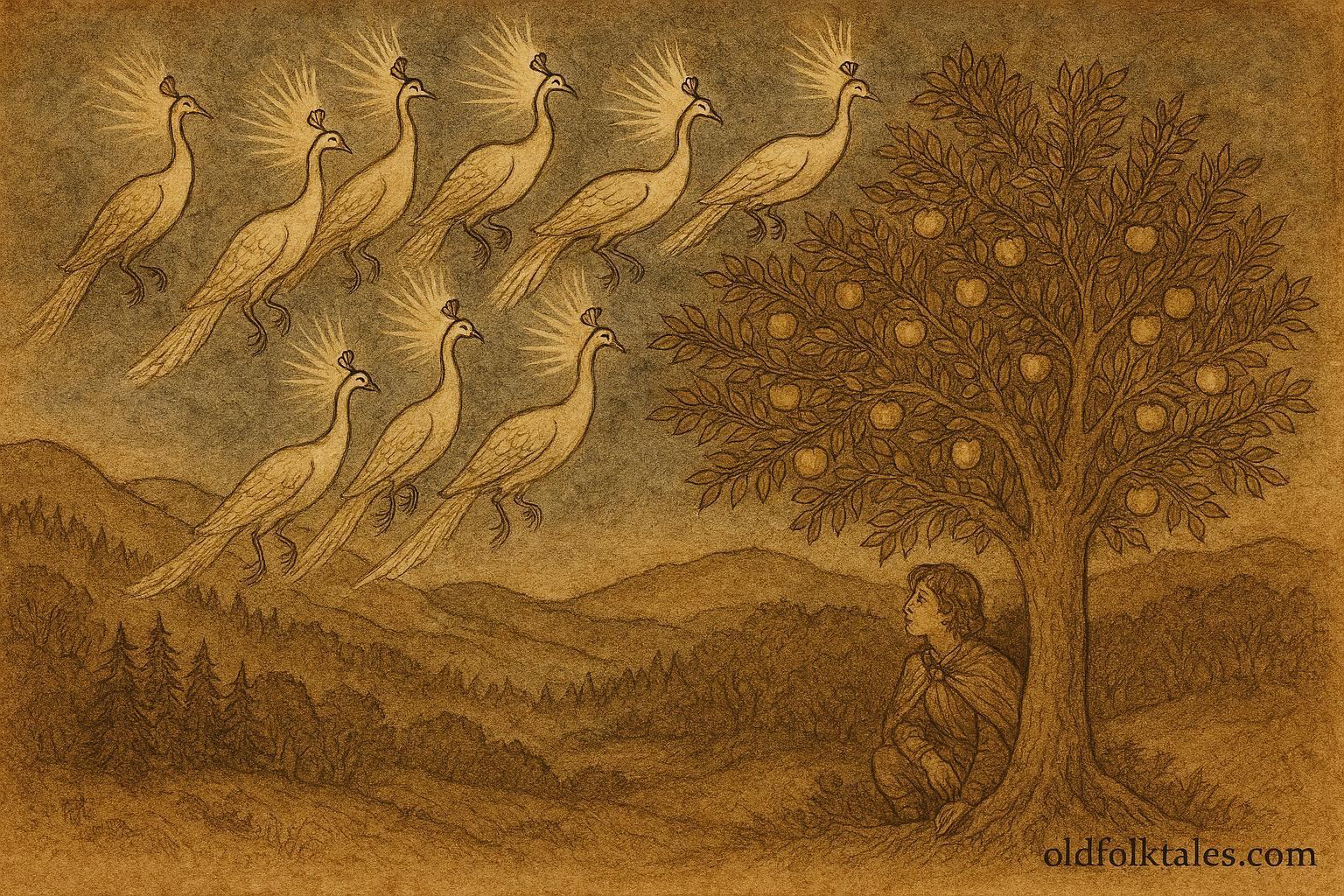
The youngest prince brought no sword. He brought only patience and watchfulness. He sat beneath the tree, listening to the night, the rustle of leaves, the breath of the earth. When midnight came, the air shimmered, and from the dark sky descended nine peahens, radiant and otherworldly.
Their feathers shone like moonlit jewels, their movements graceful and silent. One among them, the eldest, glowed brighter than the rest. As they approached the tree, the youngest prince stepped forward and seized a single feather from the brightest peahen.
With a cry like ringing silver, the peahens vanished, leaving the apple still on the branch.
At dawn, the prince showed his father the feather, proof at last of the thieves’ nature. The king rejoiced but knew the mystery was not yet ended.
The youngest son volunteered to follow the peahens and reclaim the stolen apples forever. His brothers mocked him again but secretly hoped he would fail.
Armed with the feather as his guide, the prince journeyed beyond familiar lands, through forests where paths twisted unnaturally, and over mountains where the air thinned and shimmered. At last, he reached the edge of another realm, where the world felt lighter, stranger, and older than memory.
There, he found a palace unlike any in the human world, its walls gleaming, its gardens alive with unnatural beauty. In this place lived the nine peahens, who by day took the form of maidens, daughters of an otherworldly king.
The youngest prince was welcomed not with suspicion, but with curiosity. He spoke humbly, never boasting of his quest or demanding reward. He worked where he was asked, helped without complaint, and treated every being with respect.
The eldest maiden, the one whose feather he had taken, watched him closely. She tested him gently, offering small challenges: patience in waiting, kindness toward servants, loyalty when tempted with ease or comfort. Each time, the prince chose humility over pride.
Meanwhile, his elder brothers, ashamed that the youngest had succeeded where they failed, followed him into the other realm. But unlike him, they demanded recognition and reward. They boasted of strength, sought shortcuts, and treated the enchanted world as something to be conquered.
They failed every test laid before them.
In time, the truth was revealed. The eldest maiden confessed that the golden apple was no theft of greed, but part of an ancient balance between realms. Only a ruler of virtue could restore harmony and claim both worlds without harm.
The youngest prince, through patience and loyalty, had proven himself.
He was offered a choice: return home with the golden apple alone, or remain, marry the eldest maiden, and one day rule both kingdoms in harmony.
He chose neither hastily. He asked first for his brothers to be spared and returned safely. Such mercy sealed his fate.
The prince married the maiden, and when he returned to his father’s kingdom, he did so not as a mocked youngest son, but as a true king in spirit. The golden apple tree flourished, bearing fruit in peace, and the bond between worlds remained unbroken.
Moral Lesson
True greatness is earned through humility, patience, and kindness. Those who persevere with virtue are rewarded, while pride and arrogance lead only to failure.
Knowledge Check
-
Q: What is stolen from the king’s tree in the folktale?
A: A magical golden apple is stolen each year. -
Q: Who steals the golden apple?
A: Nine magical peahens from another realm. -
Q: Which brother succeeds in the quest?
A: The youngest brother, known for patience and kindness. -
Q: What allows the youngest brother to succeed?
A: His humility, perseverance, and respect for others. -
Q: What does the golden apple symbolize?
A: Prosperity, balance, and rightful kingship. -
Q: Where does this folktale originate?
A: Southwestern Bulgarian folklore.
Source: Recorded in Bulgarian Folk Songs by Dimitar and Konstantin Miladinov (1861)
Cultural Origin: Southwestern Bulgarian folklore