In the ancient land of Lydia, where rolling hills gave way to olive groves and sheep grazed beneath a sun that seemed eternally watchful, there lived a young woman whose name traveled farther than the caravans that crossed the plains. Her name was Arachne, daughter of Idmon, a humble dyer whose vats were famous for their deep purples and rich crimson hues.
From childhood, Arachne showed an uncommon gift. While other girls tangled thread and grew weary at the loom, her fingers moved with quiet certainty, as though they remembered patterns never taught. Wool softened beneath her hands, flax obeyed her will, and colors blended so naturally that none could tell where one shade ended and another began. The cloth she wove seemed to breathe. Figures stepped forward from the fabric as if alive.
Soon, her work drew crowds. Shepherds paused on their journeys. Noblewomen left their own looms untouched to watch Arachne weave. Some swore they heard music in the rhythm of her shuttle. Others whispered that no mortal hands could create such beauty.
Yet Arachne herself grew hardened by praise.
When neighbors suggested that Athena, goddess of wisdom and crafts, must have favored her, Arachne’s lips tightened. She rejected the idea with open scorn.
“I owe the gods nothing,” she said. “My skill comes from my own hands. If Athena claims mastery of weaving, let her prove it.”
Such words, spoken lightly, carried great weight.
The Goddess Takes Notice
Athena was not blind to mortal affairs. She had taught humanity to weave, not merely cloth, but order, discipline, and restraint. Skill, when balanced with humility, pleased her. But pride that erased gratitude stirred her anger.
Still, Athena did not strike at once.
Disguised as a frail old woman, bent with years and leaning on a staff, the goddess came to Arachne’s home. Her voice trembled like wind through dry leaves.
“My child,” she said gently, “your talent is extraordinary. But wisdom grows alongside respect. Ask forgiveness. Honor the goddess who watches over your art.”
Arachne barely looked up from her loom.
“Old woman,” she replied, “keep your fears for yourself. I recognize no goddess above me. If Athena takes offense, let her come herself.”
At that moment, the air changed.
The disguise fell away. Before Arachne stood Athena in her divine form, tall, radiant, armored in authority. Her eyes burned with calm judgment, not rage. The room fell silent, as though even the threads held their breath.
“You have your wish,” Athena said.
“Let skill decide.”
The Weaving Contest Begins
Two looms were set side by side.
Athena wove first.
Her tapestry rose in measured perfection. At its center stood Mount Olympus, radiant and ordered, the gods enthroned in harmony. Athena depicted her own triumph over Poseidon for the guardianship of Athens, a symbol of wisdom overcoming brute force. Along the borders, she wove warnings: mortals punished for defying divine law, pride undone by its own excess.
Every thread spoke of balance. Every figure reinforced divine order.
Then Arachne began.
From the first pass of her shuttle, it was clear, her skill equaled the goddess’s. The crowd watched in awe as her tapestry unfolded with breath-taking clarity. But what she chose to weave was dangerous.
She depicted the failings of the gods.
Zeus appeared again and again, disguising himself to deceive mortal women. Poseidon raged without restraint. Apollo betrayed his promises. Dionysus spread madness. The scenes were flawless in execution, merciless in truth.
There was no reverence. No balance. Only accusation.
Athena studied the work in silence.
The skill was undeniable. The message was unforgivable.
Divine Judgment
With a sudden motion, Athena struck the tapestry, tearing it apart.
“Your hands are gifted,” the goddess said, her voice steady, “but your heart is reckless. You speak truth without wisdom and skill without humility.”
Arachne felt the weight of her defiance collapse upon her. Pride curdled into despair. Unable to bear the judgment, she sought to end her life, believing shame worse than death.
Athena stopped her.
“Live,” the goddess commanded.
“But live with your lesson.”
She touched Arachne with her staff.
The Transformation
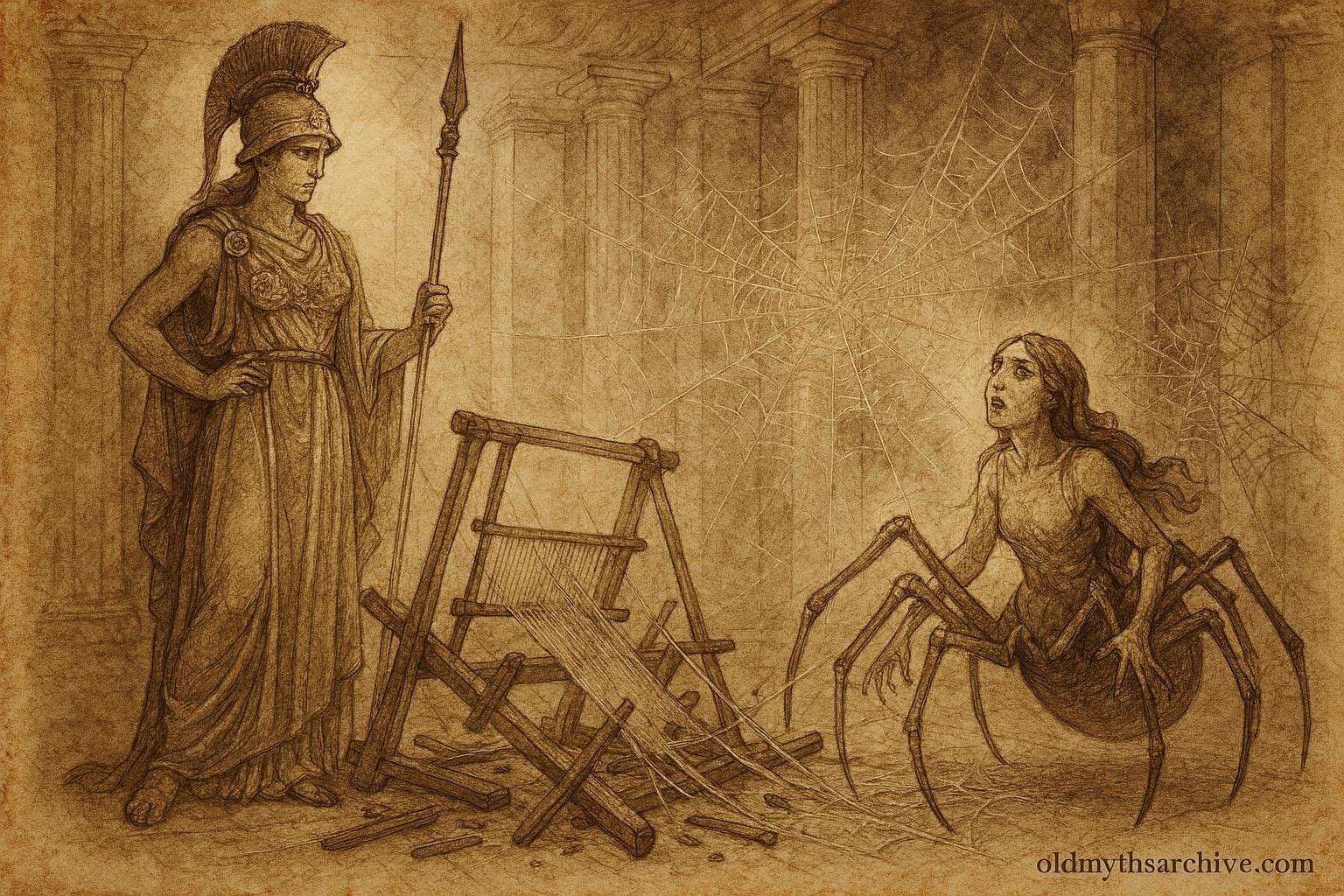
Arachne’s limbs shrank. Her fingers thinned into spindly legs. Her body curled inward, suspended by a single thread. Her voice faded into silence as her form changed forever.
She became a spider.
Condemned not to die, but to weave endlessly.
The World After Arachne
From that day onward, spiders spun intricate webs, delicate and precise, drawn from their own bodies. Their creations mirrored Arachne’s unmatched talent, beautiful, complex, and fragile.
The Greeks understood.
Art without humility invites ruin.
Skill without wisdom becomes arrogance.
Truth without reverence invites destruction.
Moral Lesson
Pride corrupts even the greatest gifts. True mastery honors both talent and the forces greater than oneself.
Knowledge Check
-
Who was Arachne in Greek mythology?
Arachne was a mortal woman famed for her extraordinary weaving skill. -
Why did Athena challenge Arachne?
Arachne denied divine influence and claimed superiority over the goddess. -
What did Athena weave in the contest?
Scenes emphasizing divine order and the punishment of hubris. -
Why was Arachne punished despite her perfect skill?
Because she lacked humility and showed disrespect toward the gods. -
What form did Arachne take after her punishment?
She was transformed into the first spider. -
What does the myth explain?
The origin of spiders and a moral lesson about pride.
Source: Metamorphoses by Ovid (c. 8 CE)
Cultural Origin: Ancient Greece (preserved through Roman literature)