In a quiet Romanian village tucked between rolling fields and dark-green forests, there lived a young girl named Mărioara. She was not known for wealth, nor for noble birth, nor for physical strength. Yet among neighbors and travelers alike, her name carried weight, for Mărioara possessed something far more powerful than gold or titles: a sharp mind and a fearless tongue guided by fairness.
Mărioara lived with her aging parents in a modest home near the edge of the village. Her father worked the land, and her mother spun wool and kept the household together through long, lean seasons. From a young age, Mărioara listened more than she spoke, observing the ways people bargained, argued, and deceived. She learned that words, when chosen wisely, could open doors or shut them forever.
Though poor, her family was honest. Yet honesty alone often failed in a world ruled by greedy landlords and arrogant nobles who believed power gave them the right to take what they pleased. More than once, Mărioara saw neighbors cheated of land, livestock, or fair judgment simply because they lacked influence. Each injustice sharpened her resolve.
The Nobleman’s Challenge
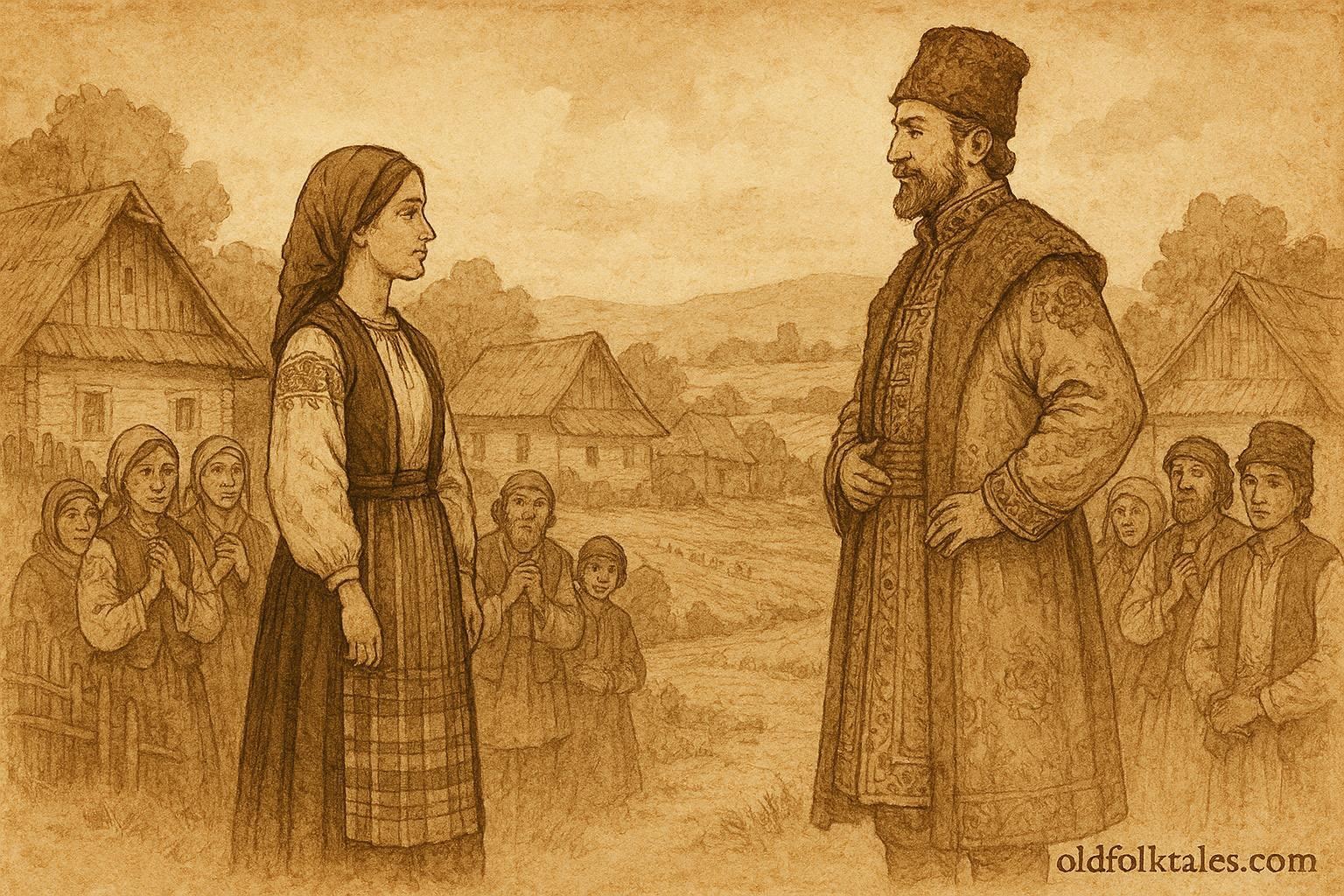
One summer, a wealthy nobleman passed through the village, demanding food, shelter, and entertainment as if they were owed to him by birthright. The villagers complied in silence, fearing punishment. Hearing of Mărioara’s reputation, the nobleman summoned her.
“So,” he said mockingly, “they claim you are clever. If that is true, answer me this: What is the strongest thing in the world?”
Mărioara bowed respectfully, then replied without hesitation.
“Justice, sir. For even kings fear it when it finally arrives.”
The nobleman laughed, amused but unsettled. He decided to test her further, posing riddles meant to humiliate her. Each time, Mărioara answered calmly, turning his own words against him with logic so clear that even his servants nodded in agreement.
Angered yet impressed, the nobleman dismissed her, but he did not forget her.
Outwitting Greed
Not long after, the nobleman attempted to seize land belonging to Mărioara’s family, claiming an old debt no one remembered. The villagers knew the claim was false but were too afraid to speak. Mărioara stepped forward.
“Let the nobleman show proof,” she said, “for land cannot be taken by memory alone.”
When he produced forged documents, Mărioara examined them carefully and pointed out contradictions in dates and names. She asked questions so precise that the nobleman grew flustered. His lies unraveled under the weight of her reasoning.
Forced to withdraw his claim, the nobleman left in humiliation. The villagers whispered in awe: a girl, armed only with wit, had defeated power.
Trials of Cleverness
News of Mărioara’s intelligence spread beyond the village. Soon, other nobles attempted to test or trick her, hoping either to use her mind for their gain or to break her reputation. Each challenge became another lesson in restraint and wisdom.
When a greedy lord demanded she solve impossible tasks, she reinterpreted his instructions so cleverly that he was forced to admit she had fulfilled them exactly as spoken. When offered riches to deceive others, she refused, knowing that cleverness without morality turns into cruelty.
Mărioara did not seek conflict, but she never fled from it either.
Recognition and Reward
At last, her reputation reached the ears of a fair ruler known for valuing wisdom over rank. Summoning Mărioara, he listened to her stories and tested her not with traps, but with questions about justice, fairness, and community.
Her answers were thoughtful and grounded in lived experience. She spoke of balance, of protecting the weak without shaming the strong, of laws meant to serve people, not the other way around.
Impressed, the ruler rewarded her family with land and protection, ensuring they would never again fear injustice. Mărioara returned home not as a noblewoman, but as a respected voice whose counsel was sought throughout the region.
A Lasting Legacy
Mărioara continued to live simply, helping her family and advising neighbors. She proved that intelligence is not born in palaces alone, and that courage does not always wield a sword. Sometimes, it speaks calmly in the face of power and refuses to bend.
Thus, her name endured, not as a legend of violence, but as a symbol of wisdom, fairness, and quiet strength.
Moral Lesson
True power lies in intelligence guided by justice. Cleverness used for fairness uplifts communities, while courage paired with wisdom can overcome even the strongest oppression.
Knowledge Check
-
Who is Mărioara in Romanian folklore?
A clever and resourceful girl known for her intelligence and fairness. -
What challenges does Mărioara face?
Greedy nobles, unfair claims, and social injustice. -
How does Mărioara overcome adversity?
Through wit, logic, and calm courage. -
What role does gender play in the story?
The tale highlights female intelligence in a male-dominated society. -
What reward does Mărioara receive?
Protection and prosperity for her family. -
What cultural value does the story emphasize?
Folk wisdom and justice over power and wealth.
Source: Povești nemuritoare, collected by Petre Ispirescu, 1882
Cultural Origin: Romanian rural folklore, 19th century