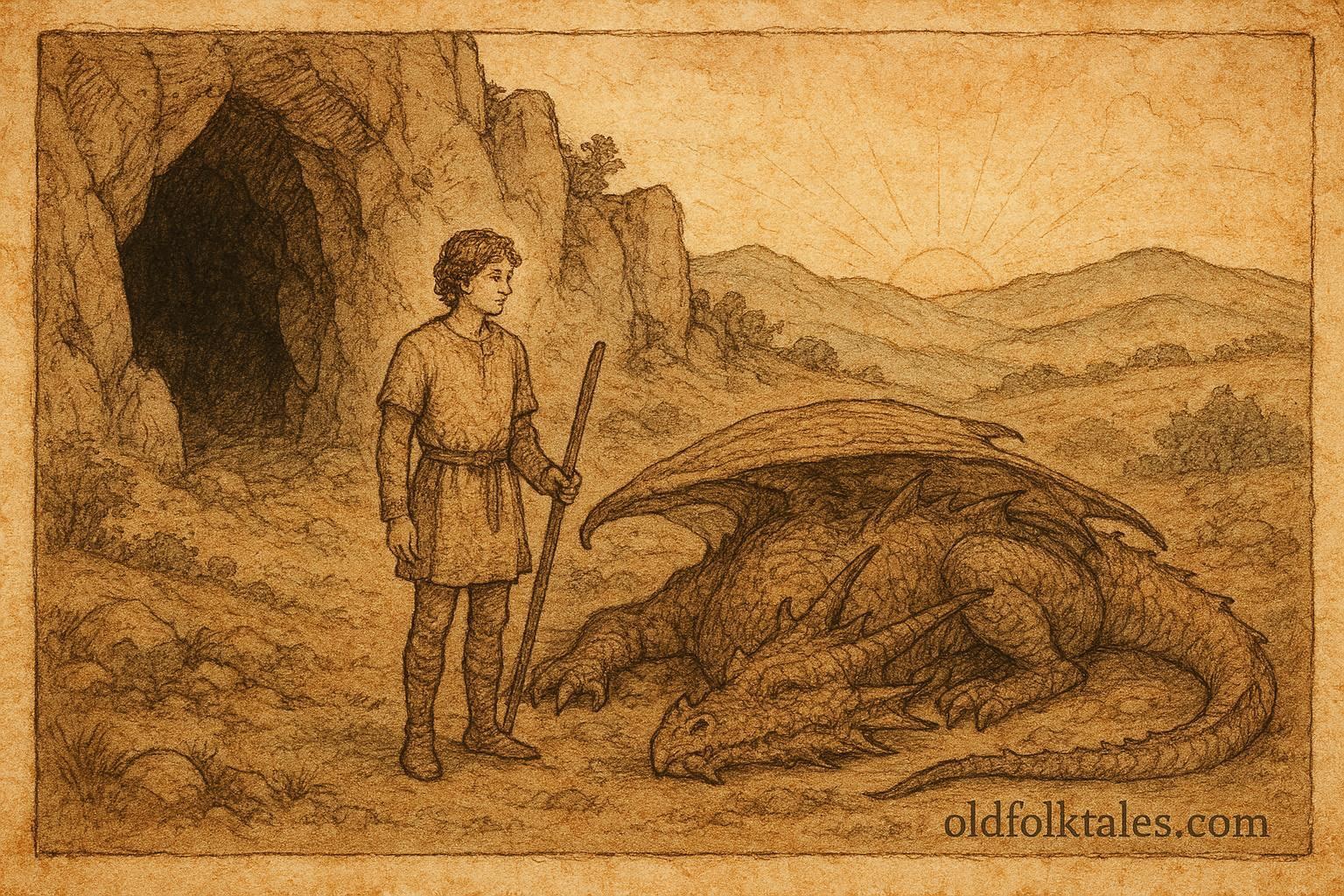
In a time remembered only through song and story, when mountains stood as borders between fate and fortune, there lay a Serbian land shaped by forests, rivers, and stone-roofed villages clinging to the hillsides. Life there followed the rhythms of the earth, seedtime and harvest, birth and burial, but for many years, fear had broken that rhythm. Beyond the last cultivated fields, where shepherd paths faded into wild grass, a dragon made its dwelling. Its lair lay hidden among rocks and twisted roots, in a place avoided even by birds. Smoke sometimes rose from that place without fire, and the ground trembled as though the mountain itself had grown restless.
The ruler of the land promised honor and reward to anyone who could destroy the beast and restore peace. Many warriors attempted the task. None returned victorious.
In one of the threatened villages lived three brothers, sons of honest parents who had raised them with the old teachings: respect for elders, loyalty to kin, and courage before hardship.
The eldest brother was strong of arm and broad of chest. He took pride in his strength and believed that force alone could bend the world to his will. The second brother was swift and sharp-eyed, quick with a blade and quicker with his temper. The youngest brother, however, was quiet. He spoke little, listened much, and learned from what others overlooked.
When news came that the dragon had again ravaged the land, the brothers gathered by the hearth as the fire crackled low.
The eldest brother stood first.
“I will go,” he said firmly. “No creature can stand against me. I will strike it down and return with its head.”
The second brother followed.
“If strength fails, speed will succeed,” he said. “I will outmaneuver the beast and finish what others could not.”
The youngest brother waited until both had spoken.
“Bravery without thought leads to ruin,” he said quietly. “A dragon must be understood before it can be defeated.”
His words were met with laughter. His brothers mistook silence for weakness and caution for fear.
At dawn, the eldest brother armed himself with heavy steel and marched toward the dragon’s lair. He announced his presence with shouting, calling the beast to face him. The dragon rose in fury, its scales thick as armor, its breath scorching the earth. The brother fought with all his might, but strength alone could not pierce the dragon’s hide. Wounded and shaken, he barely escaped.
Days later, the second brother set out, light-footed and confident. He struck swiftly, darting around the beast, but speed proved no match for cunning. The dragon’s tail struck like lightning, and the second brother fled, his pride broken.
Only then did the youngest brother prepare.
He did not rush. He walked the outskirts of the forest, observing signs left behind, scorched stones, clawed earth, broken branches. He listened to the wind and watched the dragon from afar. He noted when it slept, how it moved, where it rested its weight.
When he finally set out, he carried neither boast nor haste. He carried resolve.
He approached the lair at the hour when the dragon was most vulnerable, using the land itself as an ally. When the moment came, he struck not with rage, but with precision. The dragon roared, the hills echoed, and then silence fell.
The beast was defeated.
When the youngest brother returned, the land seemed to breathe again. The villagers gathered, their fear replaced by wonder. His brothers stood before him, humbled, and recognized the truth they had ignored.
Peace returned to the fields. Children played beyond sunset. Songs were sung again.
And so the people remembered, not the strength of the eldest, nor the speed of the second, but the wisdom of the youngest, whose courage was guided by thought.
Moral Lesson
This folktale teaches that true heroism does not depend on age, strength, or pride. Wisdom, patience, and courage guided by thought can overcome even the greatest dangers.
Knowledge Check
-
Who defeats the dragon in The Three Brothers and the Dragon?
The youngest brother defeats the dragon using wisdom and careful planning. -
Why do the older brothers fail?
They rely on strength and speed without strategy, underestimating the dragon. -
What qualities make the youngest brother successful?
Patience, observation, intelligence, and quiet courage. -
What role does the dragon play in the story?
The dragon represents chaos and danger threatening the survival of the community. -
What cultural values does the story emphasize?
Humility, wisdom, and moral worth over arrogance and physical power. -
What tradition does this folktale belong to?
Serbian oral folklore from the Balkan Slavic tradition.
Source & Cultural Origin
Source: Serbian oral tradition recorded by Vuk Stefanović Karadžić (1820s–1840s)
Cultural Origin: Serbian (Balkan Slavic folklore)