In the low, wind-swept plains of old Belarus, where fields stretched farther than a man could walk in a day and villages clung together like islands in a sea of grain, there lived a peasant whose life was shaped by work, weather, and the will of those above him. His cottage stood modestly at the edge of his lord’s lands, its walls patched with clay, its roof mended more times than he could remember. Smoke rose thinly from its chimney in winter and hardly at all in summer, for fuel was precious and meals were simple.
The peasant owned little, no horse of his own, no storehouse heavy with grain, but he possessed something rarer than livestock or silver: a clear mind and a calm tongue. From childhood, he had learned to listen before speaking, to weigh words as carefully as seed before planting. Poverty had sharpened him, not embittered him.
Above him ruled the pan, the noble landlord whose estate swallowed the horizon. The pan’s manor rose proudly among fenced fields and guarded barns. His servants hurried at the sound of his voice, and his table never lacked bread, meat, or drink. Yet despite abundance, the pan was restless. He believed his wealth proved his intelligence and his power proved his worth.
To him, peasants were tools, no different from plows or oxen. He enjoyed testing them, not to improve his land, but to satisfy his pride. When he heard whispers that one peasant answered orders too cleverly, obeyed too precisely, and never seemed confused, the pan’s curiosity sharpened into irritation.
“Bring him to me,” the pan ordered. “I will see how clever he truly is.”
The peasant arrived at the manor gate with his cap in his hands and his eyes lowered, as custom demanded. He bowed deeply and waited.
The pan studied him carefully.
“You will work for me tomorrow,” the pan said. “But listen well. You will complete a full day’s labor, and no more, and no less.”
The peasant bowed again.
“As you command, pan.”
The next day, the pan rose early and watched from his window. The peasant did not appear at dawn. Midmorning passed. Noon came. Only in the afternoon did the peasant arrive in the field, moving slowly, measuring each step.
He worked deliberately, no rushing, no lingering, and left exactly as the sun dipped low.
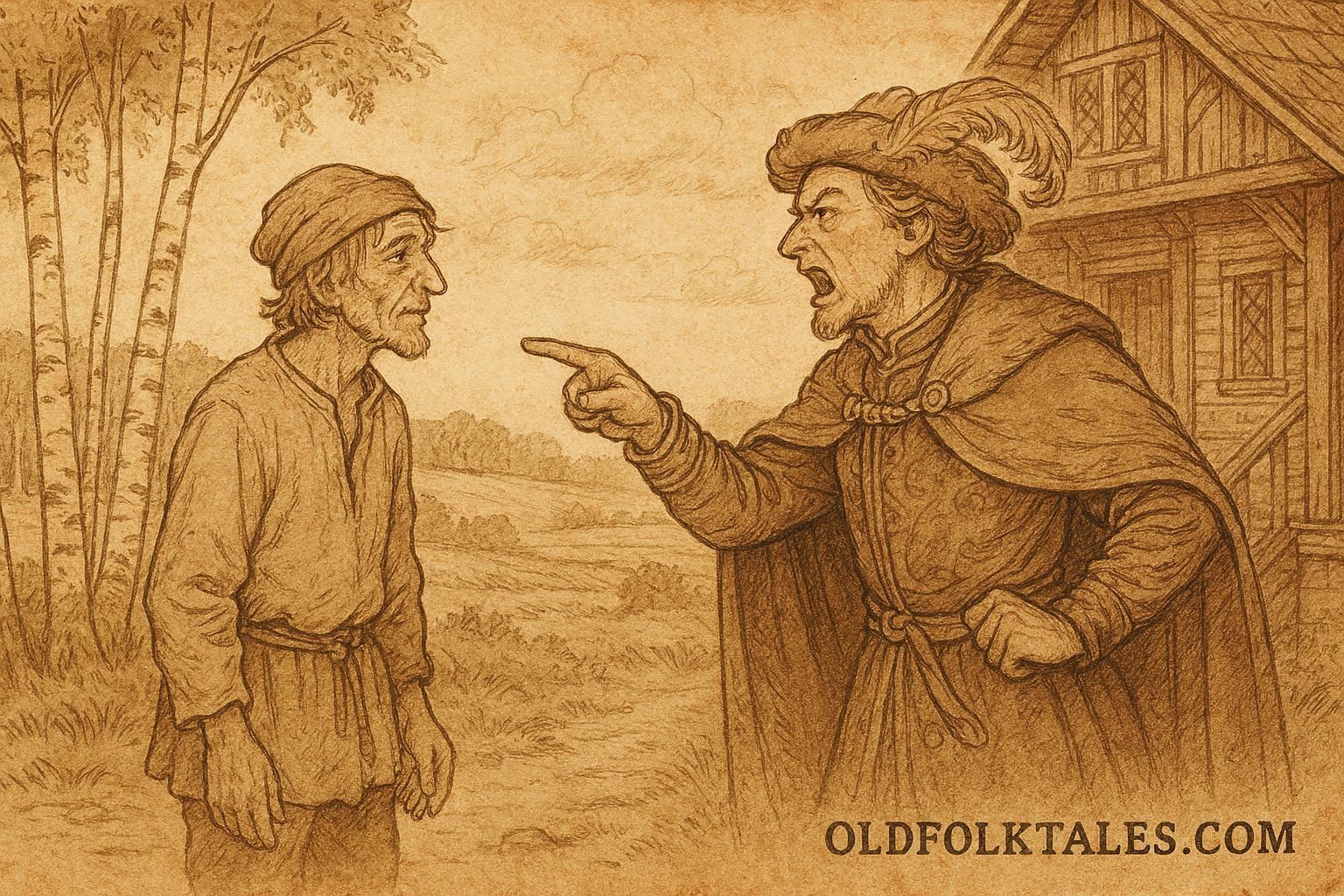
The pan stormed outside.
“You mock me! You have not finished the work!”
The peasant answered quietly,
“You ordered me to complete a full day’s labor. You did not say whose day. I gave you mine.”
Laughter rippled among the servants before they could stop themselves. The pan’s face darkened.
Determined to humiliate the peasant, the pan devised another test.
“You may harvest grain,” he said, “but you may take only what belongs to you.”
The peasant worked from morning until evening and returned empty-handed.
“Where is the grain?” the pan demanded.
“I took what was mine,” said the peasant. “My sweat, my strength, and my time. The grain was never mine to take.”
The pan clenched his fists. His tricks, meant to trap, were slipping like water through his fingers.
Soon the pan made the tasks stranger, more twisted. He ordered the peasant to come neither early nor late. The peasant arrived at the moment dusk met daylight. He commanded him to work without tools. The peasant labored until his hands were raw, then stopped.
“The tools you gave me have broken,” he said calmly, holding up his bleeding palms.
Each encounter chipped away at the pan’s pride. He believed himself clever, yet every test revealed his own foolishness. The peasant never insulted him. Never raised his voice. He simply obeyed exactly, and in doing so, exposed the emptiness of unfair commands.
Villagers whispered of these encounters. Not loudly, fear kept their voices low, but with growing hope. The peasant had not rebelled. He had not refused. He had shown that power could be resisted without defiance.
At last, the pan called the peasant one final time.
“You think yourself wise,” he sneered. “Answer me this, then. What is stronger than iron, lighter than feathers, and more valuable than gold?”
The peasant paused, not in confusion, but in thought.
“A good name,” he replied. “Iron rusts, feathers scatter, and gold tempts thieves. A good name feeds a man even when his hands are empty.”
The pan had no answer.
Silence settled over the courtyard. For the first time, the pan felt the weight of his own words and deeds pressing back against him. He dismissed the peasant with a wave, anger mixed with something unfamiliar, shame.
From that day on, the pan left the peasant alone. He did not become kinder, but he became quieter. The peasant returned to his fields, to his cottage, to his life of labor. Yet something had shifted.
The villagers understood: justice had spoken, not through force, but through wisdom.
And the peasant remained what he had always been, poor in wealth, rich in sense, and free in spirit.
Step into the enchanted forests and mystical realms of the Slavic imagination
Moral Lesson
This folktale teaches that intelligence, patience, and moral clarity can protect the powerless against greed. True authority lies not in wealth or rank, but in fairness and wisdom.
Knowledge Check
-
Who is the hero of this Belarusian folktale?
A poor but clever peasant who uses wit instead of strength. -
What does the greedy pan symbolize?
Feudal oppression, arrogance, and abuse of power. -
How does the peasant resist injustice?
By obeying unfair commands exactly and exposing their cruelty. -
Why does the pan fail repeatedly?
Because greed blinds judgment and pride dulls intelligence. -
What cultural value does the story emphasize?
Folk wisdom as a form of resistance and survival. -
Why is cleverness central in peasant folklore?
Because it allows the powerless to reclaim dignity without violence.
Source & Cultural Origin
Source: Collected by Pavel Shein, Belarusian Folk Tales and Songs (1874–1902)
Cultural Origin: Rural Belarusian folklore under feudal and post-feudal systems