In the northern reaches of the Belarusian lands, where winters stretched long and white across the earth and silence gathered beneath snow-laden trees, there stood a small village bound by hardship and custom. The houses were built low against the wind, their roofs thick with frost, their doors sealed tight against the cold that crept like a living thing. Life there was not easy, and warmth, whether from fire, food, or kindness, was never taken for granted.
In one such house lived a widower, his new wife, her own daughter, and his child from his first marriage. The stepdaughter was gentle by nature and quiet in manner. She rose before dawn, carried water from the frozen well, swept the floor, tended the fire, and never complained. Her hands were roughened by work, yet her voice remained soft, and her eyes held a steady calm.
Her stepmother, however, saw this gentleness as weakness.
The woman was sharp-tongued and hard-hearted, shaped by envy and bitterness. She favored her own daughter, who was idle and demanding, and she burdened the stepdaughter with every task that could be imagined. No matter how well the girl worked, it was never enough. Praise was withheld as carefully as grain in winter.
As the cold months deepened and the forest grew heavy with snow, the stepmother’s resentment hardened. She complained that the stepdaughter ate too much, worked too slowly, and brought bad luck into the house simply by breathing.
One evening, as the wind howled outside and ice crept along the window frames, the stepmother made her decision.
“She is useless,” the woman said to her husband. “Let the forest take her. If she survives, she was meant to. If not, we are rid of her.”
The father, weary and weak-willed, said nothing.
Before dawn, the stepmother wrapped the girl in thin clothing, placed a small loaf of bread in her hands, and pushed her out into the frozen world. The door closed behind her with a final thud.
The forest swallowed sound.
Snow blanketed the ground, muffling each step. Trees stood tall and still, their branches weighed down with ice. The girl walked deeper and deeper, her breath forming small clouds in the air. Her fingers numbed. Her feet burned with cold. Yet she did not cry out. She did not curse her fate. She pressed onward until her strength failed and she sank upon a fallen log.
As the cold tightened its grip, a voice rose from the silence.
“Cold, cold, little girl?”
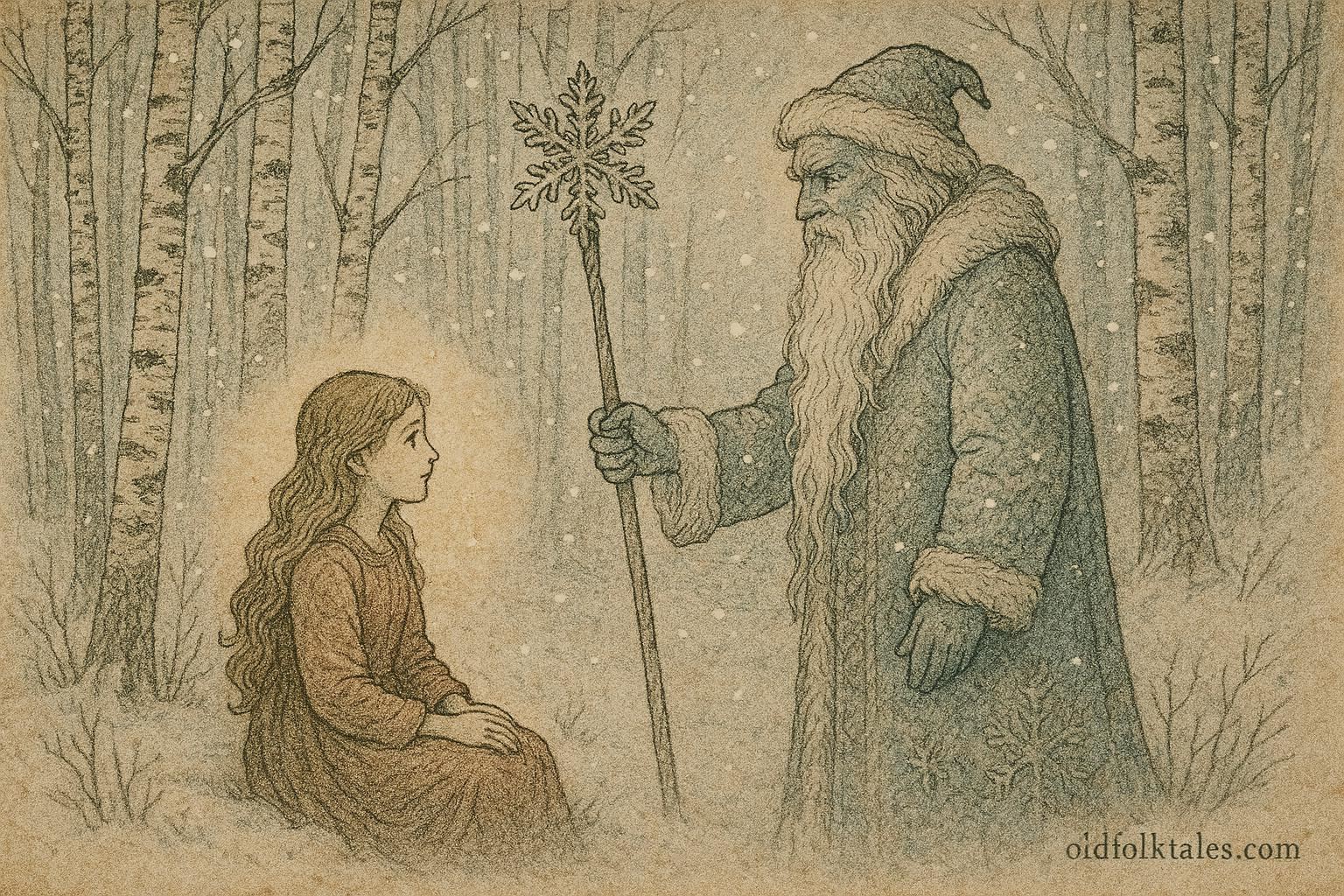
Before her stood Dzied Maroz, the Frost Spirit, ancient as winter itself. His beard shimmered with ice, his staff cracked the ground with frost, and his eyes were sharp and searching.
“Yes, Grandfather Frost,” the girl replied, bowing her head. “I am cold.”
“Cold, cold, little girl?” he asked again, his voice echoing like wind through branches.
“Yes, Grandfather Frost,” she answered gently. “But thank you for asking.”
Each time he spoke, the cold deepened. Each time, she answered with patience and courtesy. She did not beg. She did not complain. She accepted the winter as it was, enduring without bitterness.
At last, Dzied Maroz nodded.
“You are kind,” he said. “And kindness endures even the cold.”
He struck the ground with his staff. Warmth spread like sunlight through snow. He wrapped her in fine garments, placed rich gifts at her feet, and guided her safely home.
When the stepmother saw the girl return alive, and laden with treasure, her eyes burned with greed. She sent her own daughter into the forest the very next day, dressed in furs and fed well, expecting the same reward.
But when Dzied Maroz appeared, the girl answered him with complaints and demands.
“Cold? Of course I am cold! Do something!”
The Frost Spirit’s gaze hardened. The wind rose. The cold bit deeper.
When the stepmother opened the door once more, only silence greeted her.
Winter teaches without mercy.
Moral Lesson
This folktale teaches that kindness, patience, and humility create warmth even in the harshest conditions, while greed and cruelty invite the very hardship they seek to escape.
Knowledge Check
-
Who is Dzied Maroz in Belarusian folklore?
An ancient Frost Spirit who embodies winter and moral judgment. -
Why is the stepdaughter rewarded?
She responds to hardship with patience, respect, and kindness. -
Why does the stepmother send the girl into the forest?
Out of cruelty, jealousy, and desire to be rid of her. -
What lesson does winter represent in the story?
That nature reflects moral balance and justice. -
How does the stepmother’s plan fail?
Her greed leads her to repeat the trial, resulting in punishment. -
What cultural values does this tale emphasize?
Endurance, humility, and moral fairness.
Source & Cultural Origin
Source: Collected by Jan Czeczot, Peasant Tales from the Belarusian Lands (1837)
Cultural Origin: Belarusian winter folklore and domestic moral tales