In the deep forests of Sweden, where pine and birch grow thick and the earth stays damp with shadow, rivers have always been treated with caution. They cut silently through stone and soil, winding their way past villages and farms, feeding fields and forests alike. By day, they seem harmless, clear, cold, and bright with reflected sky. But by night, the water becomes something else entirely.
It is at night that Näcken appears.
Long before roads were laid or bridges built strong enough to challenge the current, travelers learned to avoid rivers after dusk. Not because of wolves or bandits, but because of music, music that drifted across the water like mist, soft and aching, impossible to ignore.
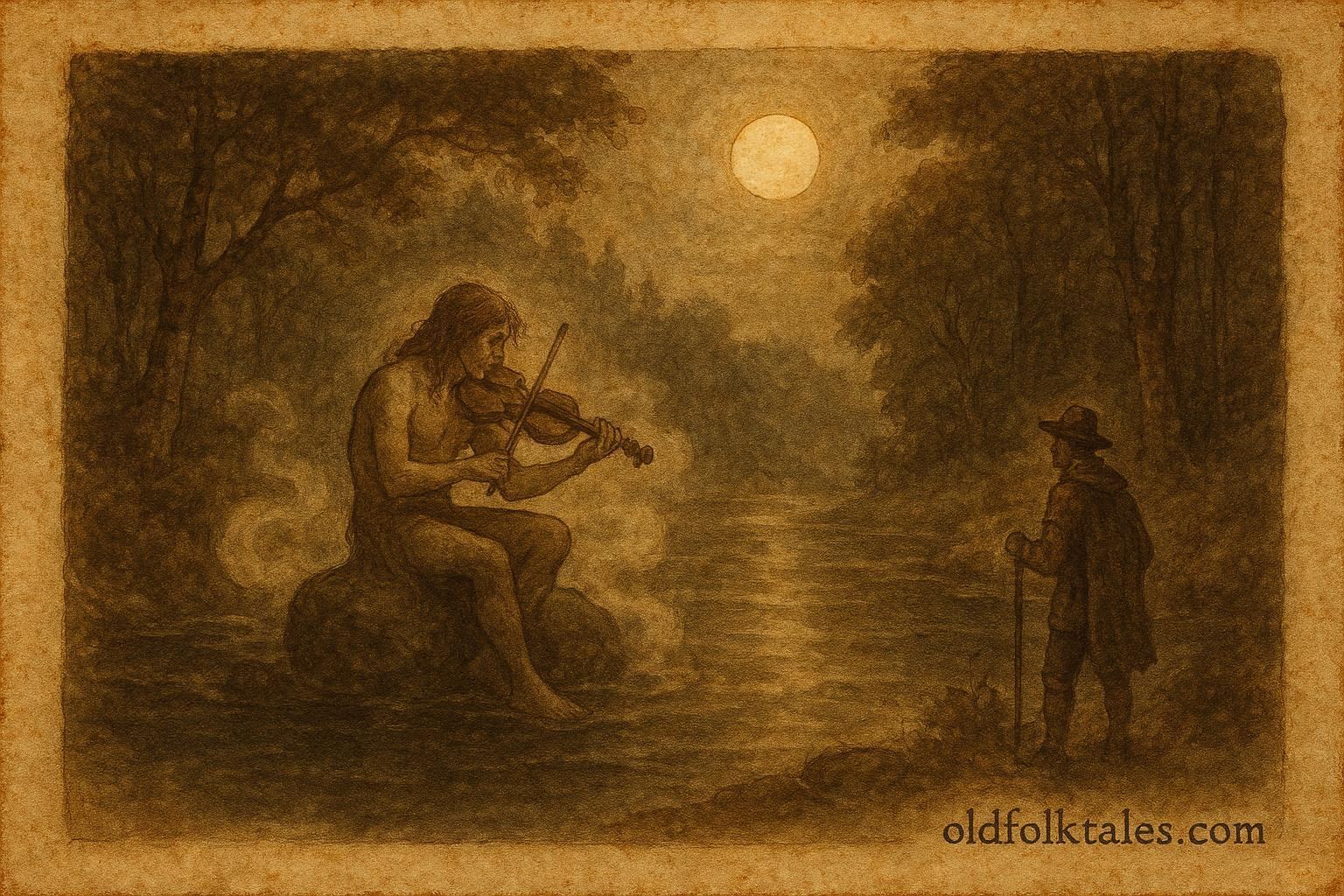
Näcken was a fiddler, or so he seemed. He appeared as a young man seated upon a smooth river stone, his clothes dark and plain, his hair hanging loose and damp about his shoulders. In his hands rested a fiddle, polished and pale, and when his bow touched the strings, the river itself seemed to listen.
Those who heard the music felt drawn toward it without knowing why.
The melody was unlike any played at village dances or weddings. It carried no laughter, no clear sorrow, but stirred something deeper, loneliness, memory, longing. People said it reminded them of home even when they were near it, or of love they had never known. The closer one came to the river, the clearer the music became, until the sound filled the mind and left no room for fear.
Näcken did not chase. He did not shout or threaten.
He waited.
One autumn evening, when the moon rose thin and white over the treetops, a young farmhand named Lars was returning from a neighboring village. The path he followed ran close to the river, and though he knew the old warnings, he was tired and eager to reach home before full dark.
As he approached a bend in the water, he heard it.
A single note, long and trembling, stretched across the night air.
Lars stopped walking.
The forest seemed to grow still. Leaves no longer stirred, and even the insects fell quiet. The sound came again, this time forming a melody so gentle that his breath caught in his chest. Without thinking, he stepped toward the riverbank.
There, upon a stone half-submerged in water, sat the fiddler.
The moonlight revealed his face, pale, almost luminous, with eyes that reflected the river’s surface. His fingers moved effortlessly across the strings, as though the instrument were an extension of himself. He smiled faintly when he noticed Lars.
“Come closer,” the fiddler said softly, without stopping his song.
Lars took another step. The stones beneath his boots were slick with moss, and cold water lapped at his soles. Yet he felt no alarm, only calm, as though every hardship he had known was loosening its hold.
Then, faint but sharp, another memory surfaced.
His grandmother’s voice.
If you hear music where no one should be playing, speak the name. Names have power.
With great effort, Lars forced himself to stop. His mouth felt dry, his legs heavy, but he lifted his head and spoke.
“You play beautifully,” he said, “but no man plays alone at night by the river.”
The fiddler’s bow slowed.
“And who do you think I am?” he asked.
Lars swallowed. “Näcken.”
At the sound of his name, the music broke apart as if the strings had snapped. The fiddler’s form wavered, his legs dissolving into rippling water, his face twisting briefly into something ancient and inhuman, eyes dark as deep pools, skin pale as drowned bone.
Näcken hissed, a sound like water rushing through reeds.
“You are wise,” he said, sinking into the river. “Wisdom saves where strength fails.”
The water stilled. The forest breathed again. Lars ran and did not look back.
Others were not always so fortunate.
Stories spread of children who vanished near streams, of drunkards found downstream with no wounds but water in their lungs. Some said Näcken took pleasure in their ignorance. Others believed he was bound to the river itself, unable to act against those who showed respect or knowledge.
Yet Näcken was not always cruel.
Old fiddlers whispered that he taught music to those who bargained carefully, granting skill beyond human measure in exchange for blood, bread, or patience. Some claimed churches built near rivers drove him away, their bells breaking his melodies. Others said he still lingered, waiting, playing softly where no one listened.
What all agreed upon was this: Näcken was not a monster to be fought, but a force to be understood.
The river gives life. The river takes life. And Näcken is its voice.
Discover the moral heart and wild spirit of the north through timeless Nordic storytelling
Moral Lesson
This folktale teaches that knowledge, awareness, and respect for nature are stronger than temptation or force. Those who recognize danger and remember traditional wisdom can protect themselves, while carelessness leads to loss.
Knowledge Check
1. Who is Näcken in Swedish folklore?
Näcken is a shape-shifting water spirit who lures people toward rivers using enchanting music.
2. Why does Näcken use music instead of force?
The music symbolizes temptation and deception, drawing victims willingly rather than through violence.
3. How can people protect themselves from Näcken?
By recognizing him and speaking his true name, which breaks his power.
4. What does the river represent in the story?
The river symbolizes nature’s dual role as both life-giver and danger.
5. What cultural lesson does the tale pass down?
Respect for natural forces and the importance of inherited wisdom.
6. From which culture does the Näcken legend originate?
Swedish rural folklore, especially forested river regions.
Source: Swedish oral tradition, recorded in 19th-century folklore collections, notably by Gunnar Olof Hyltén-Cavallius, c. 1840s
Cultural Origin: Sweden (forested river and stream regions)