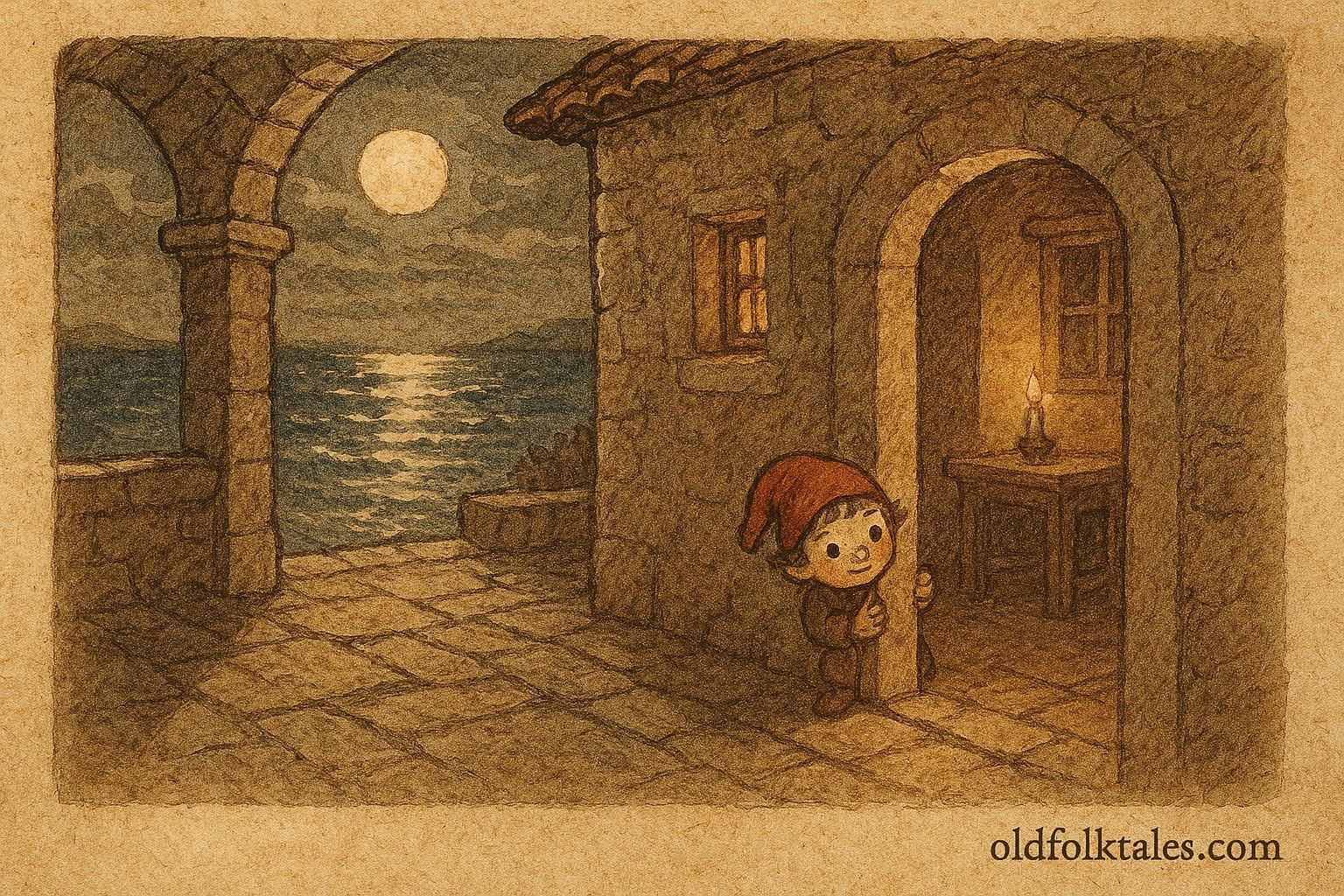
Along the rugged coastline of Croatia, where the Adriatic Sea laps gently against jagged rocks and small villages cling to the hillsides, families lived in houses built of stone and timber, their windows often glowing softly in the evening. These homes were more than shelters; they were sanctuaries of life, laughter, and memory, but also spaces watched over by unseen spirits of the world. Among these spirits, none was more mischievous, or more feared, than Tintilinić, the child of the night.
Tintilinić was unlike ordinary children. He was the spirit of an unbaptized child, small, invisible to most eyes, yet always present in the quietest moments of the night. He wore a red cap, bright and unmistakable to those who glimpsed him, and carried with him a restless energy that stirred shadows and whispered secrets in the dark.
Discover the moral heart and wild spirit of the north through timeless Nordic storytelling
Though some feared him, Tintilinić was not evil in the ordinary sense. He was a being caught between life and death, curiosity and consequence, a reminder that the world is wider than the eye can see, and that innocence can hold both danger and wonder. He wandered the coastal homes, slipping silently along wooden floors and peeking from behind curtains, observing human life with wide, unblinking eyes.
One night, in a small village by the sea, a family sat down to supper. The father carved pieces of fish he had caught that morning, the mother poured fresh water from the spring, and the children laughed as they chased one another around the room. Tintilinić, unseen but ever-present, watched from the corner of the ceiling, the red cap barely visible in the shadows. He giggled softly, not maliciously, but the sound was enough to send the youngest child tumbling in fright.
“Did you hear that?” whispered little Ana, clutching her doll.
“It is only the wind,” her older brother said, though his voice wavered. Deep down, he knew of the stories, the tales of Tintilinić passed down by grandparents and neighbors. “Some say the night child wanders when a soul is not yet at rest,” he added, carefully.
The family had long respected the old customs: leaving a small lamp burning by the hearth, saying prayers before sleep, sprinkling salt near the doors to ward off spirits. Yet Tintilinić was clever, playful, and persistent. No precaution could fully restrain him, for he was both curious and restless, drawn to homes full of life.
That night, Tintilinić decided to explore more than just the edges of the room. He slid along the floorboards, unseen, and approached the mother’s spinning wheel. He nudged the bobbin with his tiny hands, causing the thread to tangle. A soft sigh escaped the mother as she noticed the disruption in the morning light, yet she said nothing, for she understood the invisible visitor.
Next, he darted toward the children’s shoes left by the doorway. With a mischievous tug, he made them scatter across the floor, giggling at the mild chaos he had caused. Then he turned to the hearth, where the last embers of the evening fire glowed. Tintilinić tapped a small pot, and it wobbled, almost spilling. But before anything fell, he vanished in a flash of movement, leaving only the faint scent of salt and smoke.
Despite his antics, Tintilinić was more than a prankster. He also carried messages from the unseen world, revealing truths to those willing to pay attention. That same night, an elderly grandmother sitting by the window saw a brief shimmer of a red cap in the moonlight. She whispered, “Ah, the night child comes again.” She rose carefully and sprinkled a circle of salt at the threshold. Tintilinić paused at the edge, invisible to her eyes, sensing the ancient protective charm. He tilted his head curiously, then vanished into the shadows, leaving the home undisturbed for the rest of the night.
In coastal villages, stories of Tintilinić served a purpose beyond fear or amusement. He reminded families of life, death, and moral consequence. Parents taught children to be diligent in caring for the young and the unbaptized, to respect prayers, and to honor those who had passed. To forget was to invite the night spirit’s subtle mischief—a reminder that the unseen world exists alongside the living.
One stormy evening, a young boy named Luka decided to test his courage. He had often listened to stories of Tintilinić but had never seen him. Armed with nothing but a candle, he waited awake as the house darkened, and the winds of the Adriatic rattled the shutters.
Around midnight, the faintest giggle echoed through the room. The candle flickered, and there, for a moment, Luka saw it: a tiny figure in a red cap, perched atop the mantle. Tintilinić’s eyes were large, reflecting the candlelight, his gaze curious rather than cruel.
“Are you real?” Luka whispered, trembling.
Tintilinić tilted his head, then darted across the room in a blur, leaving behind only a faint whisper: “I am always here, watching, learning, teaching.”
The boy’s heart raced, not entirely with fear, but with awe. By morning, he told his grandmother everything. She smiled knowingly. “You have seen what many do not. Remember: the night child is a guardian of sorts. Mischief is his language, but his lessons are hidden in his play.”
Over time, the villagers learned to coexist with Tintilinić. They left small offerings near the hearth, a bit of bread, a sprinkle of sugar, a whispered prayer. These gestures were not about bribery, but respect. In return, Tintilinić rarely caused serious harm. He reminded the people of their duties, their respect for life, and the presence of the unseen world.
Yet the night spirit child was not without danger. Stories told of families who ignored the old customs entirely. Doors left open, prayers skipped, and lamps left unlit often drew Tintilinić into more serious mischief: spoiled meals, toppled chairs, or even subtle confusion that led to small accidents. These incidents were never fatal, but they were reminders that life and death, innocence and responsibility, were intertwined.
One notable tale speaks of a young woman named Marija, who neglected to leave a candle by the crib of her newborn. Tintilinić appeared, not maliciously, but with insistence. The baby cried through the night, blankets were scattered, and toys were moved. Marija awoke at dawn exhausted but enlightened. She realized that the small, seemingly insignificant gestures, lighted lamps, prayers, attention to tradition, held protective power. From then on, she tended carefully to both her child and the home, honoring the unseen presence.
Thus, Tintilinić became a symbol of balance between joy and caution, innocence and moral responsibility. Parents recounted his antics to children not simply to frighten them, but to instill respect for life, careful attention to detail, and the wisdom of old customs.
The tales also extended beyond the coastal villages into the Burgenland region, where Croatian communities carried them north. Even there, Tintilinić retained his signature traits: a red cap, a penchant for mischief, and the subtle teaching of unseen truths. Later literary retellings by Ivana Brlić‑Mažuranić in Tales of Long Ago (1916) preserved these stories, spreading his legend to generations who may never have seen the Adriatic coastline, yet could imagine the playful, enigmatic spirit of the night child.
By the time the sun rose over the waves, the villagers would often find small, inexplicable signs of Tintilinić’s presence: footprints too small for any human, a candle slightly tilted, or a toy moved overnight. These were not curses, but gentle reminders that the boundary between the visible and invisible world is thin, and that respect, humility, and vigilance are the virtues that maintain harmony between them.
Over centuries, the legend of Tintilinić became an enduring part of Croatian coastal folklore. He was a figure of innocence and caution, play and lesson, mischief and guidance. The red cap, always bright, became a symbol not only of his presence but of the importance of moral vigilance, respect for life, and acknowledgment of unseen forces.
Even today, in villages along the Adriatic, children grow up hearing the tales. Mothers whisper them at bedtime, grandparents recount them beside flickering hearths, and fishermen pause in quiet reflection, knowing that Tintilinić walks the night with curiosity, teaching lessons that words alone cannot convey.
Moral Lesson
The tale of Tintilinić teaches that life, death, and morality are interconnected, and that even playful mischief can carry deep lessons. Respect for tradition, attentiveness to the unseen, and humility in everyday life are as important as courage or cleverness. The story encourages mindfulness, compassion, and the understanding that even innocence can contain both joy and consequence.
Knowledge Check
-
Who is Tintilinić?
A mischievous spirit of an unbaptized child wearing a red cap in Croatian folklore. -
What regions is Tintilinić associated with?
Coastal Croatia and Burgenland Croatian communities. -
What is the purpose of Tintilinić’s mischief?
To teach respect, attentiveness, and moral lessons to the living. -
How do villagers protect themselves from Tintilinić?
By following customs: lighting lamps, saying prayers, leaving small offerings. -
What themes are central to Tintilinić’s story?
Life and death, innocence and danger, unseen spirits in everyday life. -
Which author popularized Tintilinić in literature?
Ivana Brlić‑Mažuranić, in Tales of Long Ago (1916).
Source: Traditional oral tradition; popularized in Tales of Long Ago by Ivana Brlić‑Mažuranić, 1916
Cultural Origin: Croatia (coastal and Burgenland Croatian folklore)