In the heart of Vienna, when the city’s streets were narrower and its stone walls still echoed with the sounds of horse hooves and church bells, there stood a well unlike any other. It lay tucked between tall houses, hidden from the grand squares and markets, and descended deep into the earth where light struggled to reach.
At first, it was an ordinary well, one of many that sustained the city’s households. But in time, whispers began to spread. Those who drew water too early or lingered too long near its mouth fell ill. Some collapsed where they stood. Others never returned home at all.
Fear followed quickly.
People spoke of a basilisk living in the depths of the well, a monstrous creature born of darkness and decay. It was said to be part serpent, part cock, with a gaze so deadly that no blade could save anyone who met its eyes. To look upon it was to die where one stood, struck down not by teeth or claws, but by sight alone.
At first, the city dismissed the rumors. Vienna was no stranger to superstition, and tales often grew larger with every telling. But as the deaths continued, disbelief gave way to dread. The well was sealed, then guarded. Even so, fear clung to the surrounding streets like fog.
No one dared approach it.
Merchants rerouted their paths. Children were forbidden from playing nearby. Neighbors shuttered their windows at dusk. The well became a silent threat at the city’s core, a reminder that danger could exist even in familiar places.
The city council debated what to do. Soldiers could not fight what they could not face. Scholars argued over the nature of the beast, while priests prayed for deliverance. None volunteered to confront the basilisk, for courage alone offered no defense against a killing gaze.
It was then that an unlikely figure stepped forward.
He was a baker by trade, a man accustomed to early mornings and steady hands. His life revolved around flour-dusted benches, glowing ovens, and the daily rhythm of kneading and waiting. He was not known for strength or status, only for reliability and clear thinking.
Listening to the stories, the baker noticed something others had overlooked. The basilisk did not leave the well. It did not hunt. It killed only when someone looked directly upon it.
That, he realized, was the key.
Rather than asking how to strike the monster, he asked how to avoid its gaze.
The baker went to the council and offered a solution. At first, his idea was met with hesitation and doubt. Yet desperation has a way of opening minds, and soon permission was granted.
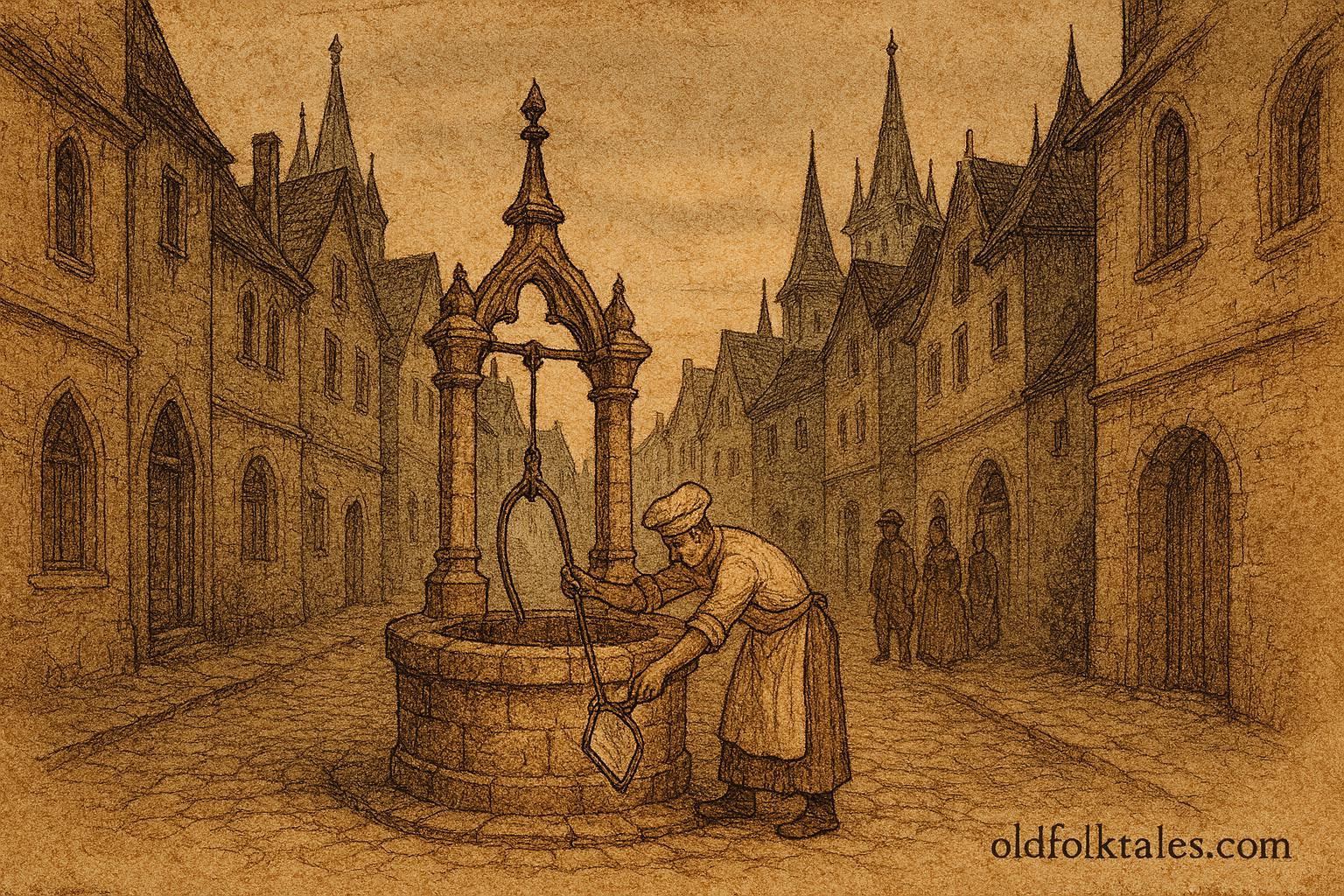
From his shop, the baker took a polished mirror, the kind used to check the browning of loaves deep within the oven. Carefully, he fixed it to a long pole, ensuring the surface faced downward. He wrapped his hands in thick cloth and said a quiet prayer, not for glory, but for steadiness.
As word spread, citizens gathered at a distance. No one cheered. No one spoke. They watched in breathless silence as the baker approached the cursed well.
The stone rim was cold beneath his fingers. From below came a damp, stagnant air that smelled of earth and old water. Slowly, deliberately, he lowered the mirror into the darkness, never once leaning over the opening.
Deep in the well, the basilisk stirred.
Drawn by movement, the creature rose from its hiding place. For the first time in years, its deadly eyes opened fully, only to meet its own reflection. Unaware of mirrors or deception, the basilisk unleashed the full force of its gaze upon itself.
A terrible cry echoed upward, then silence.
The mirror trembled, then grew still.
When the baker pulled the pole back, nothing followed. No sound, no movement, no threat. The well lay quiet, as harmless as it had once been.
Cautiously, guards approached. A stone was dropped into the depths. It struck water and nothing more. The basilisk was gone, undone not by strength or steel, but by its own power turned inward.
Relief swept through Vienna like a long-held breath finally released.
The well was reopened. Streets returned to life. Children played again, and merchants reclaimed their routes. The baker returned to his ovens, refusing rewards beyond what was fair, content that the city was safe.
Yet the story did not fade.
It was told and retold, carved into memory and stone, reminding generations that monsters do not always fall to force. Sometimes, the sharpest weapon is thought itself, and the courage to use it calmly, when fear urges panic.
Moral Lesson
The Basilisk of Vienna teaches that intelligence and careful reasoning can overcome even the most terrifying threats. Fear clouds judgment, but calm thinking reveals solutions where brute force fails. True courage lies in understanding danger, not rushing blindly toward it.
Knowledge Check
-
What is the Basilisk of Vienna?
A legendary monster said to live in a city well, killing with its deadly gaze. -
Where did the basilisk live in the story?
It lived deep inside a well in the city of Vienna. -
Who defeats the basilisk in the folktale?
A clever baker defeats the basilisk using a mirror. -
How does the baker kill the basilisk without weapons?
He lowers a mirror into the well, causing the basilisk to destroy itself. -
What does the basilisk symbolize?
It represents fear of the unknown and hidden dangers in confined spaces. -
What lesson does the story teach?
Intelligence and calm problem-solving are stronger than brute force.
Source: Viennese civic chronicles (c. 1530–1550)
Cultural Origin: Vienna, Austria (urban folklore)