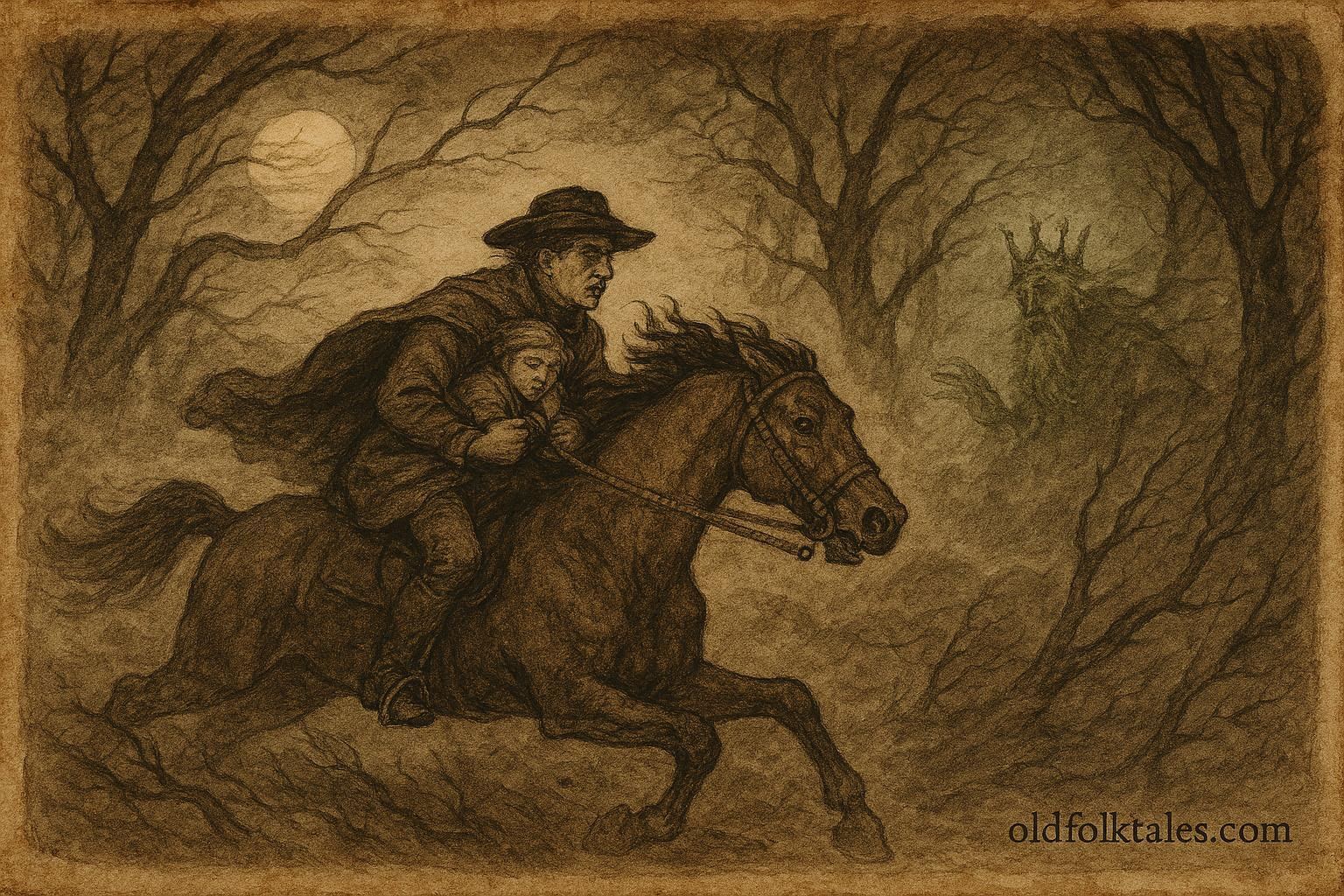
The night was dark and cold, and a biting wind swept across the northern German forests. Mist clung to the branches like spectral fingers, and the full moon, pale and distant, cast eerie shadows upon the winding paths. In the midst of this forbidding landscape, a father rode urgently through the night, clutching his young son, whose fever burned hotter than the lanterns flickering in distant farmhouses. The boy shivered and whimpered in his father’s arms, and every few moments, his small hand would reach for comfort that seemed just beyond the grasp of the father’s strong, protective arms.
As the forest pressed in around them, strange whispers drifted on the cold night air, soft and melodic, yet chilling to the bone. The father’s eyes darted into the shadows, alert for any sign of danger. “Stay close to me, little one,” he murmured. But the boy, half-delirious and weak, seemed to see visions that the father could not: a figure gliding through the trees, tall and impossibly graceful, crowned with a faint greenish glow, its eyes shimmering with unearthly light.
Journey into the charm of British wit and Irish wonder through centuries of folk tradition
“You are cold, my child,” the voice whispered, honeyed and tempting, drifting across the wind. “Come with me, I will play with you, and you shall be safe and warm forever.” The child’s lips trembled, and he looked toward the unseen presence. “Father, father! Do you not see the Erlking? He wants me to come with him!”
The father’s heart clenched. He could see nothing, yet the terror in his child’s voice was undeniable. He spurred his horse onward through the twisting forest paths, his cloak flapping like a dark banner behind him. “Fear nothing, my son! The forest is ours to pass. There is no Erlking here, only your fever,” he said, attempting both to comfort his child and to quell his own rising dread.
But the Erlking was patient and relentless. He whispered again, softer now, coaxing and persuasive: “Come, little one. My daughters will dance with you, and you shall hear the sweetest songs. Leave the darkness of the forest behind and fear nothing.” The child’s eyes widened, his fevered face pale, and he reached once more toward the voice that promised warmth and delight in the cold, unforgiving night.
“Do you not see him, father?” the boy cried, trembling violently. “He is here! He will take me if we do not hurry!” The father’s jaw tightened. He leaned low over his horse, urging it faster, the hooves drumming a relentless rhythm against the forest floor. The wind howled around them, tearing through the branches like a chorus of wild spirits. Every shadow seemed to stretch and twist, every rustle of leaves a whisper from the unseen.
The father’s mind raced as he tried to reason: his son’s fever had clouded his senses. The forest was full of strange noises at night, harmless creatures and the wind itself making eerie sounds. Yet something about the voice, the smooth, terrible cadence that seemed to slip into his own ears, made the father’s blood run cold. He could not shake the feeling that some otherworldly being was pursuing them, watching, and waiting.
“Father, I see him! He beckons me!” the boy screamed, shivering violently in his arms. His tiny body shook with fever and fear, and the father’s hands were clammy and tight around the reins. The father’s heart ached with helplessness, knowing that no matter how fast they rode, no mortal speed could outrun the forest itself, nor the unseen powers that lay beyond it.
The Erlking’s voice rose with a terrifying sweetness, promising protection, play, and joy: “Come with me, little child. You shall ride with the wind and dance among the moonbeams. There is nothing to fear.” And yet, with every whisper, the child’s face grew paler, his hands slackened, and his small cries weakened against the dark power surrounding them.
The father urged his horse faster, urging the boy toward their distant home, where warm light and human care awaited. Yet the forest seemed endless, the trees reaching like grasping hands, the night thickening into a suffocating shroud. His son’s breath grew shallow, and terror knotted the father’s chest. “Hold on, my boy! We are almost there! Almost home!” he called, his voice breaking over the sound of the wind.
By the time the father burst from the forest’s edge into the glow of the village, the child was limp in his arms, cold and unresponsive. No warmth, no playful laughter, only silence. The villagers rushed to help, but the father knew the truth: the Erlking had claimed him, as he had promised, in the shadows where human eyes could not see. The supernatural force had been patient, cunning, and merciless.
Stories of the Erlking spread through northern Germany for generations, a cautionary tale for parents and travelers alike. No night travel was without risk, and no child was truly safe from unseen forces, whether in fever, in dreams, or in the haunted spaces of the forest. The legend endured, a chilling reminder that the natural world, so beautiful by day, held unseen dangers by night, and that the world of spirits, sickness, and death could intersect with the human realm in ways both subtle and horrifying.
Even today, the tale of the Erlking lingers in the cold northern forests, a whispered story told to children to remind them of night’s perils and mortality’s fragility. And whenever the wind rustles through the trees with an eerie cadence, the faintest whisper seems to carry a chilling promise: unseen, patient, and eternal, the Erlking waits.
Experience legends where mountains breathe magic and heroes face moral choices that shape destiny
Moral Lesson
The Erlking teaches that the natural and supernatural worlds are filled with unseen dangers, and human vulnerability—especially in illness—reminds us of the fragility of life. Vigilance, care, and the warmth of home are the only protection against forces beyond our understanding.
Knowledge Check
-
Who is the Erlking in the folktale?
A supernatural forest spirit who lures children with promises of play and safety, ultimately claiming their lives. -
What triggers the father’s urgent ride through the forest?
His child is feverish and weak, and the father races to bring him safely home. -
What themes are central to the story?
Fear of the supernatural, illness and mortality, and unseen dangers in nature. -
What cultural region does this tale originate from?
Northern Germany, influenced by Scandinavian and Danish folklore. -
How does the Erlking attempt to lure the child?
By whispering sweet promises of play, warmth, and comfort, coaxing the child away from his father. -
What lesson does the story convey about human vulnerability?
Children and the sick are especially susceptible to danger, and life’s fragility demands vigilance and care.
Source: Adapted from Johann Wolfgang von Goethe, poem Der Erlkönig, 1782.
Cultural Origin: Northern Germany (influenced by Scandinavian legend).