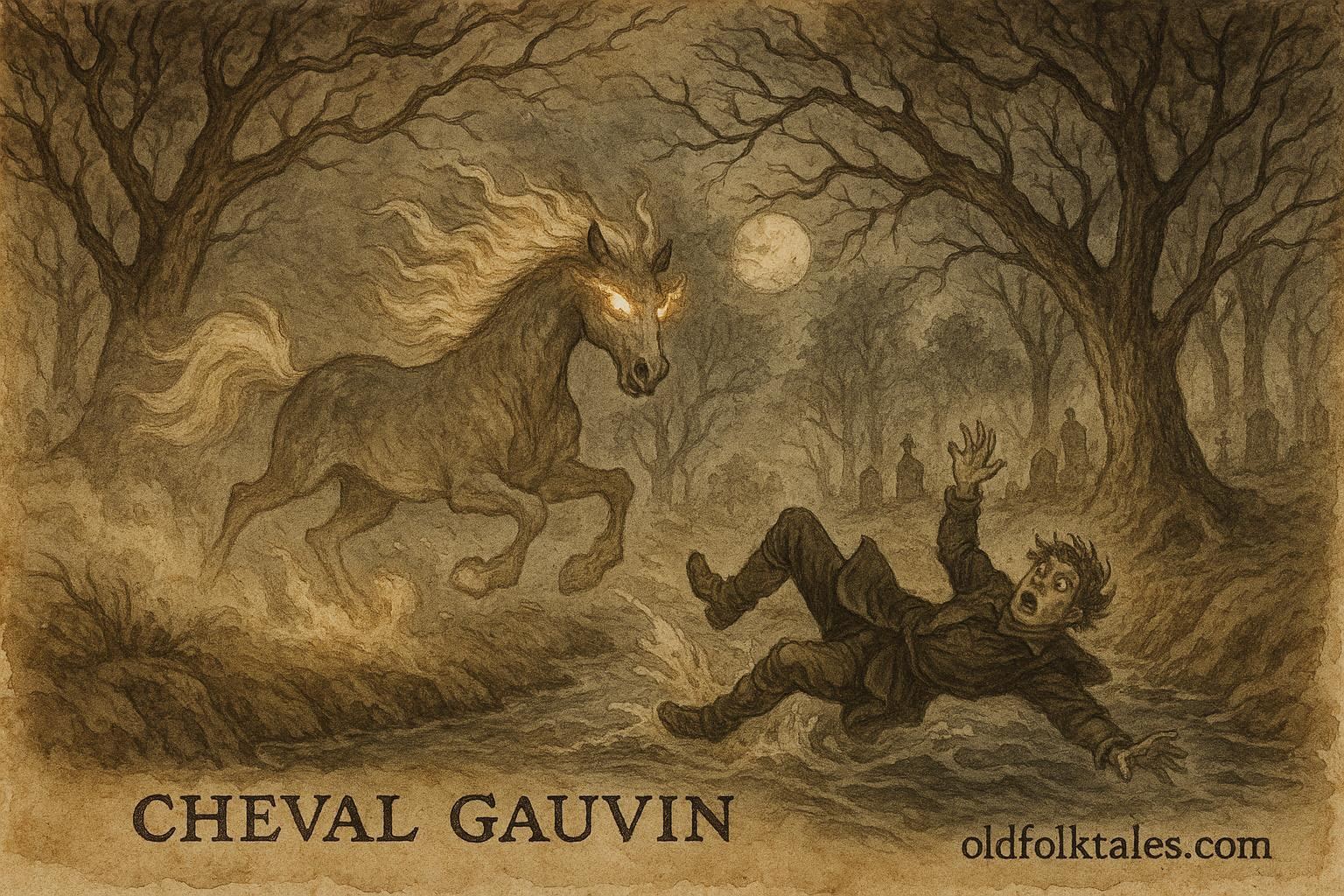
In the shadowed forests and mist-laden valleys of the Jura mountains, villagers whispered of a dark and malevolent presence known as Cheval Gauvin. Unlike ordinary horses, this creature was a phantom: its coat shimmered with an unnatural sheen in the moonlight, its eyes glowed like lanterns reflected in black water, and its hooves struck the earth with a sound that echoed across the forest like rolling thunder. To encounter Cheval Gauvin was to brush against the very boundary between the living world and that of spirits, a dangerous, often fatal brush.
The stories told of Cheval Gauvin were chilling in their consistency. Travelers riding late at night might see a shadowed shape galloping along the forest paths or across graveyards, alone or accompanied by a faint, otherworldly mist. Those who dared to mount the horse rarely survived. Legends spoke of riders being hurled into deep ravines, hurled into icy rivers, or lost forever within the tangled woods, their cries swallowed by the wind. Even to approach it was perilous, for Cheval Gauvin could sense fear and hesitation, and it would delight in leading mortals to their doom.
Children were warned most carefully, for the horse was said at times to abduct young girls, vanishing with them into the deepest shadows where no human could follow. Parents would keep their doors locked and their children close during misty nights, telling them that the horse’s call, soft and melodic, was a lure no mortal should obey. “Do not answer, do not follow,” they said. “Cheval Gauvin will claim you if you stray from the path.”
The horse’s malevolence was tempered with cunning. It did not always attack openly; sometimes it appeared gentle, almost inviting, standing in a clearing with its coat gleaming under the moon, waiting for the unwary to approach. Many who encountered it felt an irresistible pull, a strange fascination that compelled them to mount its back. Once astride, the rider found that the horse’s strength was beyond imagining, galloping faster than any earthly steed and steering toward ravines, rivers, or treacherous cliffs. Attempts to dismount were futile; those who tried were thrown violently into danger, leaving nothing but echoes and silence behind.
Despite its fearsome reputation, Cheval Gauvin became a figure in the oral lore that shaped communities. Elders would recount its appearances not merely to frighten children, but to instill caution and respect for the unseen world. Forests, graveyards, and isolated paths were sacred boundaries, spaces where humans could encounter forces beyond comprehension. To cross these spaces lightly, or to underestimate them, was folly. The horse reminded mortals that the human and spirit worlds coexisted closely, and that arrogance or curiosity could lead to fatal consequences.
Stories of encounters varied. A woodcutter once described seeing Cheval Gauvin pacing near the edge of a graveyard, its eyes flickering like candle flames in the fog. He froze, recognizing the danger, and whispered prayers as he slowly stepped backward. Another tale told of a young man who, despite the villagers’ warnings, mounted the horse in a moonlit glade. The beast leapt across cliffs and through rushing streams until, at the bottom of a ravine, the rider vanished into darkness, leaving only a few torn scraps of clothing as evidence.
Over time, Cheval Gauvin’s legend spread across the Jura and Bernese Jura, crossing linguistic and regional boundaries. The horse became a symbol of nature’s mysterious and dangerous power, and of the fragile line between human safety and the unknown. Even today, locals speak of hearing phantom hooves echoing in forests during misty nights, and parents still caution children about straying too far from home after sunset.
Though terrifying, the story of Cheval Gauvin carries a lesson. It reminds mortals to respect the natural world, to understand that some places are fraught with dangers beyond comprehension, and to honor boundaries, both physical and spiritual. Curiosity and pride may lure humans into the forest, but only caution, humility, and attentiveness ensure safe passage through life’s darker, uncertain paths.
Moral Lesson
Cheval Gauvin teaches that the world holds unseen dangers beyond human understanding, and that respecting boundaries between the mortal and spirit realms is essential for survival. Caution, humility, and awareness protect against the unknown.
Knowledge Check
-
Who or what is Cheval Gauvin in the folktale?
A malevolent phantom horse that haunts forests, graveyards, and villages, often leading riders to their doom. -
What are the main dangers of encountering Cheval Gauvin?
Riders can be thrown into rivers, ravines, or lose their lives; it can also abduct young girls. -
What themes are central to the story?
Fear of the unknown, boundaries between the human and spirit worlds, and the consequences of curiosity or arrogance. -
What cultural region does Cheval Gauvin originate from?
The French-speaking Jura region extending into the Swiss Jura. -
How did locals use the legend of Cheval Gauvin in their communities?
As a cautionary tale to teach respect for forests, graveyards, and the unseen spiritual world. -
What moral lesson does Cheval Gauvin convey?
Humans must respect boundaries between the mortal and spirit realms; humility, caution, and awareness safeguard against unseen dangers.
Source: Adapted from folklore collected by Désiré Monnier, published 1854, and recorded in regional oral tradition.
Cultural Origin: French-speaking Jura region extending into Swiss Jura.