In the wide Bulgarian countryside, where fields stretched farther than a man could walk in a day and the sky arched low and endless above them, there lived a farmer whose name was spoken with equal parts admiration and weariness. He was known as a man of iron will and iron back, one who bent neither easily nor often. From his youth, he had worked the land with a fierce devotion, carving furrows into stubborn soil and coaxing grain from ground others had abandoned.
He believed in effort above all else. What a man earned with his hands, he deserved. What he could not control, he mistrusted. The farmer rose before dawn and slept only when the stars had long claimed the sky. His fields were tidy, his harvests plentiful, and his voice carried far across the valley whenever he spoke his mind.
Yet for all his diligence, the farmer lacked patience with things he could not measure, time, fate, and death among them. When neighbors crossed themselves at bad news or whispered prayers at funerals, he scoffed.
“Everyone dies,” he would say. “But not today, and not before their work is done.”
Autumn came heavy that year. The wheat stood tall and ripe, the air thick with dust and the promise of cold. One evening, after stacking the last sheaves, the farmer sat outside his house, rubbing his sore knees and watching the sun sink behind the hills. Shadows stretched long across the yard, and a quiet settled that felt deeper than usual.
That was when he noticed her.
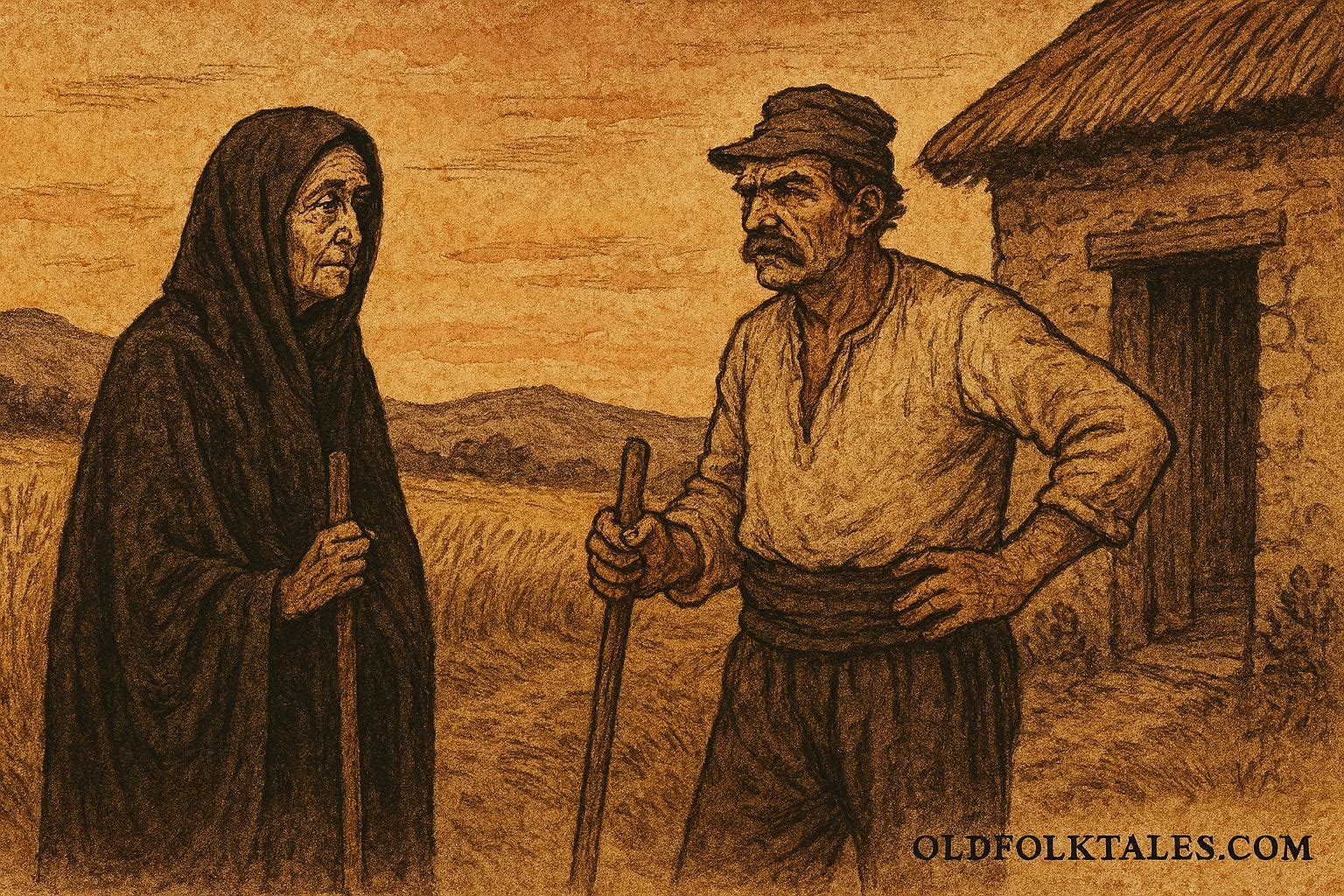
An old woman stood at the edge of his land, so still she might have been carved from the dusk itself. She leaned on a wooden staff worn smooth by centuries of use. A dark shawl covered her silver hair, and her eyes, sharp, clear, and unblinking, watched him with unsettling calm.
The farmer frowned. Visitors rarely came so late.
“Good evening, grandmother,” he called. “Are you lost?”
She stepped forward slowly, her feet making no sound on the dry earth.
“I am not lost,” she said. “I have come exactly where I was meant to be.”
Something in her voice tightened his chest.
“And what business brings you here?” he asked.
“I have come for you.”
The world seemed to tilt.
The farmer laughed loudly, though his hands clenched. “You’ve chosen the wrong man. I have fields to tend and plans yet unfinished.”
She studied him for a long moment, then said, “I am Death.”
The word fell like frost.
He swallowed hard but did not step back. “Death comes when God wills it,” he said stubbornly. “And I am not ready.”
Grandmother Death inclined her head slightly. “No one ever is.”
The farmer’s mind raced. Fear pressed against him, but so did defiance.
“Grandmother,” he said, lowering his voice, “surely you can see that my work is not done. Grant me time, and I will use it well.”
She regarded him, as one might regard a child bargaining for daylight.
“Very well,” she said at last. “I will give you more time. But remember, when I return, words will not turn me away.”
Then she vanished, leaving the air cold and still.
The farmer stood alone beneath the darkening sky, heart pounding. When dawn came and found him alive, relief flooded him. Soon, relief turned to pride.
“I spoke well,” he told himself. “I earned my days.”
Years passed.
The farmer grew older, but his will did not soften. He worked as fiercely as ever, though his joints stiffened and his breath shortened. Whenever sickness brushed him or accidents loomed, he remembered Grandmother Death and smirked.
“She knows me,” he would mutter. “I still have time.”
One winter night, as snow fell, thick and silent, the old woman returned.
“I have come again,” she said.
The farmer groaned. “Now? The roads are frozen, and spring is near. Let me live until the thaw.”
She paused, then nodded. “Until spring.”
Spring came. Then summer. Then autumn.
When she returned the next time, the farmer was no longer startled, only irritated.
“Already?” he snapped. “I have grain to sell and debts to settle.”
“One last delay,” she said. “Choose carefully.”
He chose more time.
Years piled upon years. His beard whitened. His hands trembled. His fields passed to younger men. Still, he clung to life with stubborn fingers.
At last, Grandmother Death came again.
“This time,” she said softly, “there will be no more bargaining.”
The farmer looked at his wrinkled hands, his empty fields, his long life spent fighting the inevitable.
“I understand now,” he said quietly. “Take me.”
And she did.
Moral Lesson
This Bulgarian folktale teaches that time is not a prize to be won through cleverness or defiance. Death grants no true favors, only opportunities for understanding. Wisdom lies in humility, gratitude, and accepting the natural order before regret takes root.
Knowledge Check
1. How is Death portrayed in the story?
As an old woman known as Grandmother Death.
2. What flaw defines the farmer’s character?
Stubbornness and refusal to accept mortality.
3. Why does Death grant the farmer more time?
To allow him the chance to gain wisdom and humility.
4. What warning does the farmer ignore repeatedly?
That Death will return and bargaining will end.
5. What cultural belief does the story reflect?
That death is a natural, impartial force in life.
6. What is the central lesson of the folktale?
Acceptance of mortality brings wisdom; denial leads to regret.
Source: Bulgarian folk tales retold by Angel Karaliychev, 1944.
Cultural Origin: Nationwide Bulgarian folk tradition