In a land of wide plains and wooded hills, where rivers cut silver paths through the countryside and villages lay scattered beneath open skies, there ruled an emperor whose power was great and whose pride was greater still. His word was law, his judgment unquestioned, and his wealth renowned across neighboring lands. Yet of all his possessions, none stirred his pride more deeply than his only daughter.
The maiden was unlike others of her age. She was swift of foot, keen of mind, and possessed of a quiet strength that did not rely on force. From childhood she had run across fields and hills with tireless ease, keeping pace with horses and outstripping the fastest messengers of the court. The emperor boasted of her endlessly, declaring that no man alive could match her speed, let alone surpass it.
When the maiden came of age, noblemen and warriors began to seek her hand in marriage. The emperor, unwilling to give up his greatest treasure to an unworthy suitor, devised a contest that would satisfy both his pride and his desire for control.
He proclaimed throughout the land:
“Let it be known that my daughter shall marry only the man who can outrun her in open contest. Any who fail shall forfeit not only the contest, but their freedom, for they have wasted the emperor’s time.”
The proclamation spread swiftly. Some were drawn by ambition, others by the maiden’s reputation, and still others by the challenge itself. Yet the emperor’s decree was merciless, and many paid dearly for their pride.
The Failure of Strength
One by one, suitors arrived at the imperial court. Strong men mounted swift horses, confident in muscle and training. When the race began, the maiden ran lightly beside them, her steps measured and unhurried. At first, the men surged ahead, but before long, their breath failed, their horses tired, and the maiden passed them with steady grace.
Each loss was met with the emperor’s cold satisfaction. His daughter remained unclaimed, his pride reinforced by every failed attempt.
Yet the maiden herself did not rejoice. She understood that the contest was not one of worth, but of vanity. Though obedient to her father’s will, she did not share his cruelty. Quietly, she pitied those who lost and feared what would come of a contest built on pride alone.
The Arrival of the Clever Youth
One day, a young man arrived at the court. He was neither richly dressed nor armed with great strength. He carried himself humbly and spoke with respect. Unlike others, he did not boast of victory or mock those who had failed before him.
When asked why he wished to compete, he answered simply, “Because I trust that wisdom may prevail where strength does not.”
The emperor laughed at him, amused by his modesty and certain of his defeat. The maiden, however, watched him closely. In his calm gaze and measured words, she sensed something different.
That night, as custom allowed, the maiden walked in the garden where suitors awaited their trial. She approached the young man quietly.
“You know the terms,” she said. “If you lose, you will not leave this place freely.”
“I know,” he replied. “But I also know that contests built on pride often hide their own undoing.”
The maiden studied him, then spoke in a lowered voice.
“Tomorrow, do not run blindly. Trust me.”
She said no more and departed, leaving the young man deep in thought.
The Contest
At dawn, the emperor and his court gathered to witness the race. Trumpets sounded, and the crowd watched eagerly as the maiden and the young man took their places at the edge of the plain.
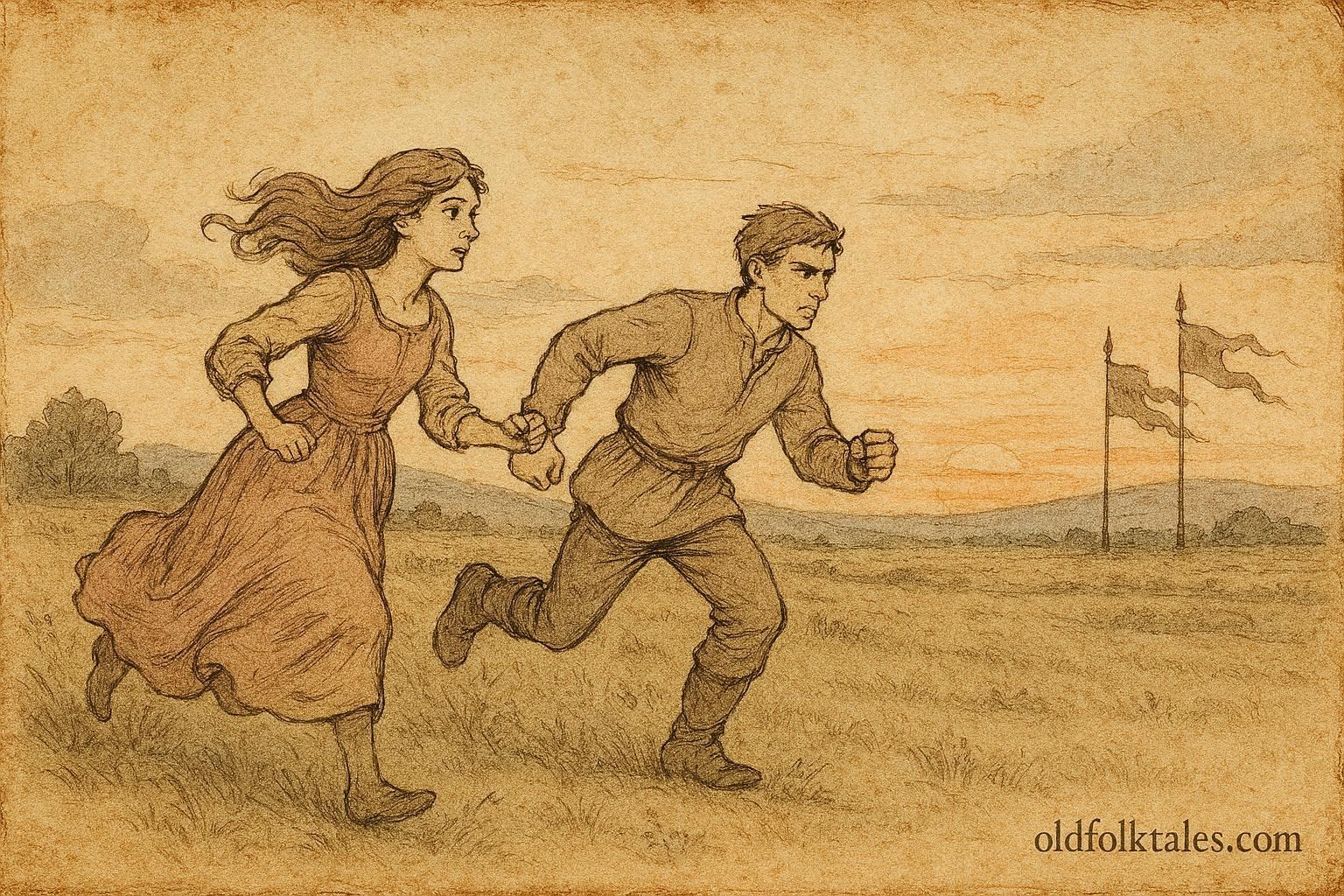
At the signal, the maiden ran swiftly ahead, her form light and effortless. The young man followed, but not at full speed. Murmurs spread among the crowd as he fell behind.
The emperor smiled, confident of another victory.
Yet as the race continued, the maiden slowed deliberately, allowing the young man to draw closer. At certain points, she veered subtly from her path, guiding him without words. When exhaustion might have claimed him, she adjusted her pace, preserving his strength.
At the final stretch, when all eyes were fixed upon them, the maiden stumbled, just enough.
The young man passed her, crossing the finish before she rose.
A stunned silence followed.
Truth Revealed
The emperor rose in anger, accusing deceit. But the maiden stepped forward before he could speak further.
“Father,” she said, “you demanded a contest of speed, not cruelty. This man did not win by force, but by understanding. He trusted me, and I chose cooperation over pride.”
The court murmured. The emperor saw at last that his daughter’s wisdom equaled her speed and surpassed his own.
Bound by his word, he granted the marriage.
Union of Equals
The maiden and the young man were wed, not as victor and prize, but as partners. Together, they ruled with fairness, tempering strength with thought, and authority with compassion.
The emperor, humbled by the outcome, learned that pride blinds even the powerful, while wisdom often walks quietly.
Moral Lesson
True victory comes not through force or pride, but through trust, cooperation, and mutual respect. Wisdom shared is stronger than strength alone.
Knowledge Check
1. Why does the emperor create the contest?
To protect his pride and control his daughter’s marriage.
2. What sets the young man apart from other suitors?
His humility, patience, and trust in wisdom over strength.
3. How does the maiden influence the outcome?
By guiding the race and choosing cooperation over competition.
4. What does the race symbolize?
The balance between intelligence and physical ability.
5. What lesson does the emperor learn?
That pride limits understanding and justice.
6. What cultural tradition does this tale belong to?
Serbian and South Slavic oral folklore.
Source: Vuk Stefanović Karadžić, Srpske narodne pripovijetke, 1853
Cultural Origin: Serbian (South Slavic oral tradition)